 Dec, 1 2025
Starting a new medication can feel overwhelming. You’re handed a bottle, a piece of paper with tiny print, and told to take it every day-sometimes with food, sometimes without, sometimes at night, sometimes in the morning. One wrong step, and you could end up in the emergency room. The truth? medication safety isn’t just for doctors and pharmacists. It’s your job too.
Why Medication Safety Matters More Than You Think
Every year in the U.S., over 1.3 million people visit the emergency room because of bad reactions to medications. About 350,000 of them end up hospitalized. That’s not rare. That’s common. And half of those cases happen because of simple mistakes: taking the wrong dose, mixing pills that shouldn’t be mixed, or using an old bottle that’s past its date. The good news? Most of these errors are preventable. Research from the Agency for Healthcare Research and Quality shows that following basic safety steps can cut your risk of a bad reaction by up to 50%. That’s not a guess. That’s data from real hospital studies.The Six Rights: Your Medication Safety Checklist
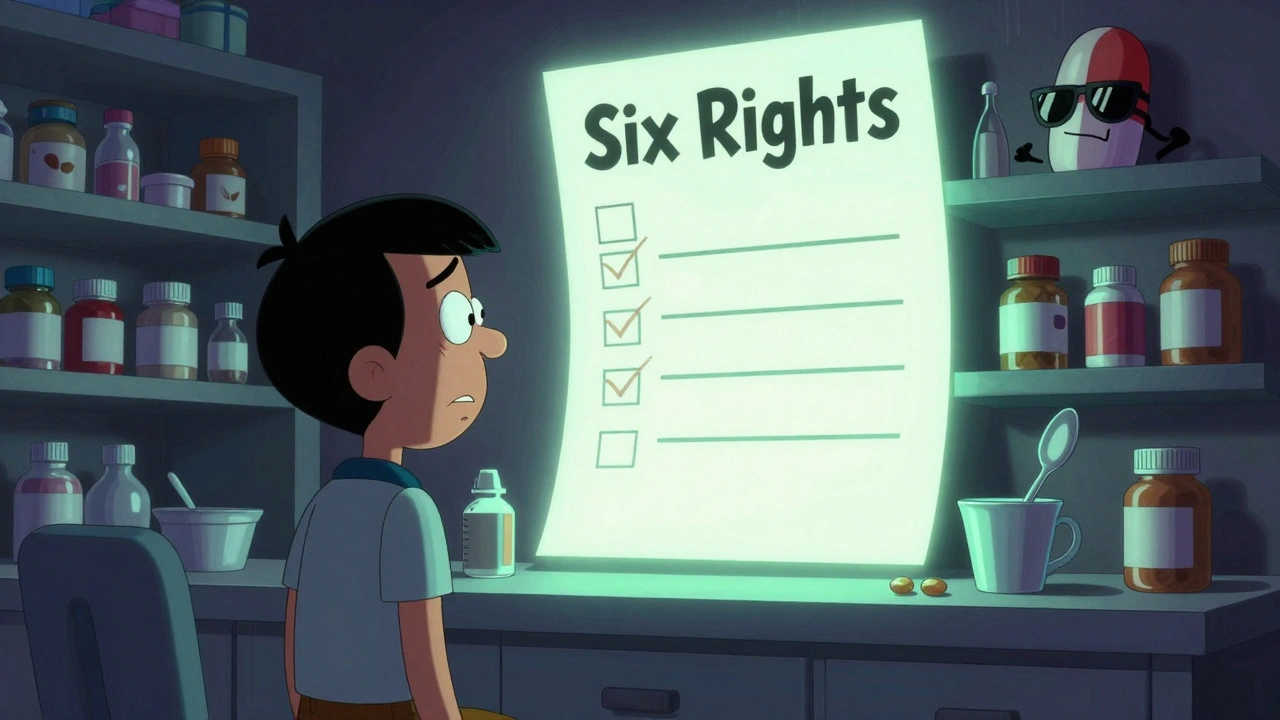
Healthcare providers use a simple system called the Six Rights to keep patients safe. You should use it too. Before you take any pill, ask yourself:- Right patient - Is this medicine really for you? Double-check your name and date of birth on the label. Hospitals use two identifiers for this reason.
- Right medication - Does the pill look like what you were told to expect? Generic versions can look different. If it’s a new color, shape, or size, ask your pharmacist.
- Right indication - Why are you taking this? Don’t assume. Ask: “What condition is this treating?” If you don’t know, you might take it when you shouldn’t.
- Right dose - Are you using the measuring cup or syringe that came with the medicine? Never use a kitchen spoon. A tablespoon from your kitchen can be 25% to 50% off from a real dosing tool.
- Right route - Is it meant to be swallowed, placed under the tongue, applied to the skin, or injected? Taking a cream orally or a pill as a spray can be dangerous.
- Right time - Does it need to be taken with food? On an empty stomach? At bedtime? Some medicines lose effectiveness if taken at the wrong time of day.
Keep a Complete Medication List
You’re probably not just taking one pill. Maybe you’re on blood pressure medicine, a vitamin, a pain reliever, and a sleep aid. That’s four different drugs. And each one can interact with the others. The CDC says patients who keep a full list of everything they take - including over-the-counter drugs, vitamins, and herbal supplements - have 27% fewer medication errors. That’s huge. Your list should include:- The name of the medicine (brand and generic if you know it)
- The dose (e.g., 10 mg, 5 mL)
- How often you take it (e.g., once daily, every 8 hours)
- Why you’re taking it (e.g., “for high blood pressure,” “for arthritis pain”)
- The prescribing doctor’s name
Storage Matters More Than You Realize
Not all pills are created equal when it comes to storage. Some need to be kept cold. Others need to stay dry. If you store them wrong, they can lose strength - or become dangerous.- Insulin must be refrigerated (between 36-46°F) until you open it. After that, it can stay at room temperature for about a month.
- Most oral pills should be kept below 86°F (30°C) in a dry place. The bathroom cabinet? Bad idea. Steam and heat ruin medicine.
- Liquid antibiotics often expire faster than pills. Check the label. Some only last 14 days after mixing.
Never Share or Take Someone Else’s Medicine
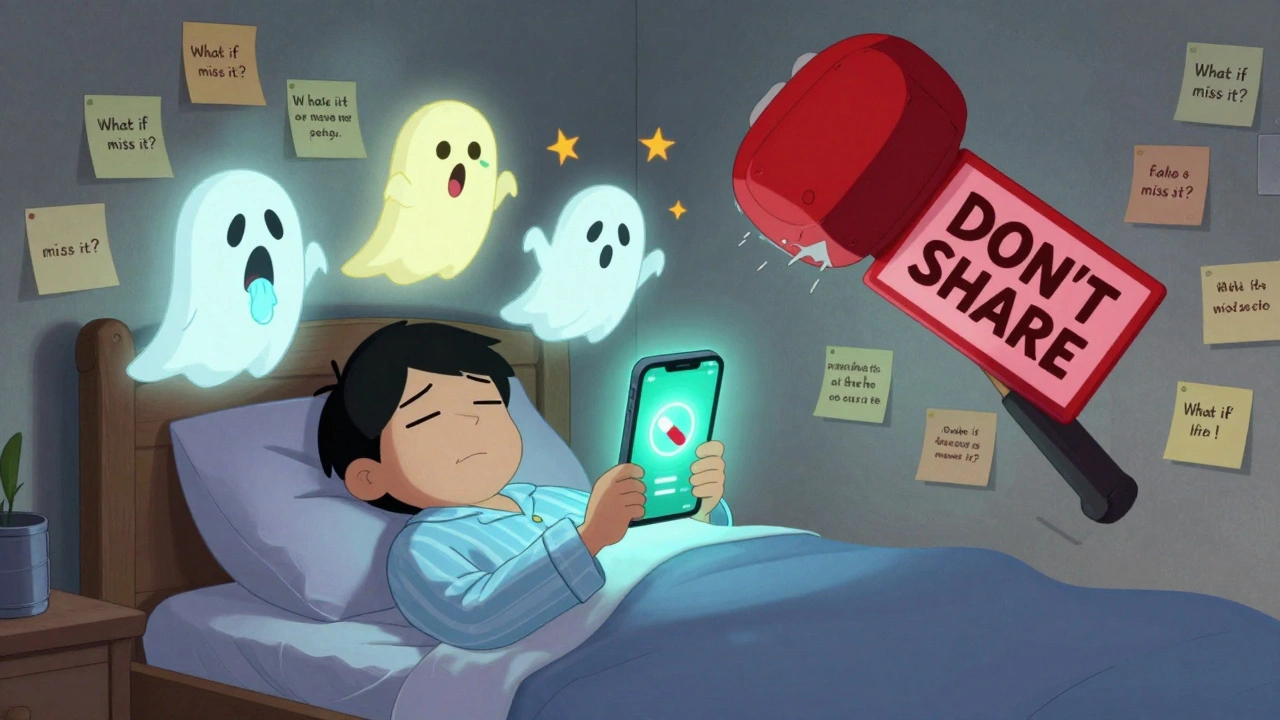
Your friend says their headache medicine works wonders. Your mom says her sleep pill helps her relax. Don’t do it. The FDA says sharing medications causes 8% of emergency visits for bad drug reactions. Why? Because what’s safe for one person can be deadly for another. A pill that helps your sister’s anxiety might raise your blood pressure to dangerous levels. Or worse - it could interact with something you’re already taking. Even if it’s “just one pill,” it’s not worth the risk.
Read the Label - In Good Light
You’d think this would be obvious. But 15% of medication errors happen because people misread labels in dim light. Turn on the light. Put on your glasses. Read the label out loud. Check for:- How many to take
- How often
- Warnings like “May cause drowsiness” or “Avoid alcohol”
- Expiration date
Use the Right Tools - No Kitchen Spoons
A teaspoon from your drawer isn’t a teaspoon in medicine terms. It can hold anywhere from 3 to 7 milliliters. The dosing tool that comes with your medicine? That’s calibrated to the exact amount. Use it. Every time. If you lost the syringe or cup? Call your pharmacy. They’ll send you a new one - free.Ask Questions - Don’t Assume
Pharmacists are trained to answer your questions. But most people don’t ask. Here are the three most important ones to ask every time you get a new prescription:- What should I do if I miss a dose? - Only 22% of patients ask this. But it’s critical. Some meds you take right away. Others you skip and wait. Getting it wrong can hurt.
- How should I store this? - 40% of medications have specific storage needs. If you don’t know, you’re risking the drug’s effectiveness.
- What side effects should I watch for? - Only 65% of pharmacy visits include this discussion. But knowing what’s normal (like mild nausea) versus what’s dangerous (like swelling, chest pain, or confusion) could save your life.
Use a Reminder App - It Really Helps
For first-time users, keeping track of multiple pills at different times is hard. Studies show people who use apps like Medisafe or MyMeds improve their adherence by 28%. The best apps do more than just buzz. They:- Scan your pill bottle’s barcode to confirm it’s the right one
- Give you simple explanations of what the medicine does
- Send alerts if you’re due for a refill
- Let you share your schedule with a family member
Watch for Changes - Even Small Ones
Your body is smart. It tells you when something’s off. If you start feeling dizzy after starting a new pill, that’s not normal. If your skin turns yellow, your urine looks dark, or you feel unusually tired, call your doctor. Don’t wait. Also, watch for changes in how the pill looks. Generic drugs are used in 90% of prescriptions. They work the same - but they might look different. If your new bottle has a different color or shape, don’t assume it’s wrong. Ask your pharmacist: “Is this the same medicine, just a different brand?”Transitions Are Dangerous - Be Extra Careful
One of the riskiest times for medication errors is when you leave the hospital. You might be discharged with three new prescriptions, told to stop two others, and told to cut back on a third. It’s confusing. The Patient Safety Network says 22% of medication errors happen during hospital discharge. That’s why you need to:- Ask for a written discharge summary with all medication changes
- Take your full medication list to your follow-up appointment
- Call your pharmacist within 48 hours to review the new list

Lydia Zhang
December 2, 2025 AT 20:39Been on 7 meds for 5 years. Still mix up the blue ones with the green ones. Just hope I don’t OD before I figure it out.
Kay Lam
December 3, 2025 AT 16:47I used to think I was fine until my pharmacist pointed out I was taking my blood pressure med at bedtime instead of morning because I read 'take once daily' and assumed it meant whenever I remembered. That’s when I started writing everything down. Now I keep a little notebook in my purse with the names, times, and why I’m taking each one. It’s not glamorous but it’s saved me from three ER trips already. The body doesn’t lie. If you feel weird after a new pill, don’t wait. Call someone. Even if it’s 11pm. Even if you feel dumb. Better dumb than dead.
Matt Dean
December 4, 2025 AT 11:05Of course you need a checklist. People who can’t follow six basic rules shouldn’t be allowed to take pills. I’ve seen folks take insulin like candy and wonder why they’re in the hospital. It’s not rocket science. It’s basic responsibility. Stop being lazy and read the label.
Walker Alvey
December 4, 2025 AT 17:49So we’re now treating adults like toddlers who can’t read? Six Rights? Really? Next they’ll hand us a sticker chart for taking our vitamins. The real problem isn’t the meds-it’s the system that infantilizes people until they forget how to think for themselves. You don’t need a checklist. You need a brain. And apparently, most people left theirs at home.
Adrian Barnes
December 6, 2025 AT 09:42While the article presents a well-structured framework for medication adherence, it fundamentally fails to address the systemic commodification of pharmaceutical care in the United States. The onus placed on the individual patient to maintain exhaustive documentation, navigate opaque labeling conventions, and self-advocate within a profit-driven healthcare infrastructure is not merely inconvenient-it is ethically indefensible. The statistics cited are statistically significant but contextually bankrupt without addressing price gouging, pharmacy understaffing, and the erosion of clinical pharmacology education in primary care.
Declan Flynn Fitness
December 7, 2025 AT 18:50Love this. Seriously. I use Medisafe and it’s a game changer. Set it up with your family so they get alerts if you miss a dose. I had my sister get a notification when I forgot my heart med last week. She called me. I felt bad. But I was alive. Use the syringe. Don’t use the spoon. And yes, your bathroom cabinet is a sauna for pills. Put them in a drawer. Simple. 😊
Michelle Smyth
December 8, 2025 AT 20:10The Six Rights framework is a reductive heuristic that masks the epistemological crisis of pharmaceutical literacy in late-stage capitalism. The reliance on consumer-facing checklists assumes a Cartesian subject capable of rational agency, when in fact, the pharmacological landscape is deliberately obfuscated by patent thickets, generic substitution protocols, and linguistic obfuscation on labels. One cannot 'read the label' if the label is a product of corporate legal teams, not clinical science.
Patrick Smyth
December 10, 2025 AT 12:01My wife almost died because she took her thyroid med with coffee. The pharmacist told her once. She forgot. I had to beg her to write it down. Now she has a sticky note on the mirror. I know it sounds silly. But I’d rather look silly than lose her. Please. Just write it down. For your family. For yourself. It’s not a chore. It’s love.
patrick sui
December 12, 2025 AT 02:43Big +1 to using barcode scanners in apps. I scan every new bottle when I get it. The app tells me if it’s a generic swap and what the active ingredient is. Also, I always ask my pharmacist: 'Is this the same as last time?' Even if it looks the same. I had a case where the filler changed and it gave me bad stomach cramps. They didn’t even know until I asked. Knowledge is power, but asking questions is the real superpower. 🙌
Declan O Reilly
December 12, 2025 AT 16:39Just started my first real med routine after my surgery and holy crap this article saved me. I thought I was smart until I almost took my painkiller with my blood thinner. Then I read this and realized I didn’t even know what 'with food' meant. Now I have a little whiteboard in my kitchen. I check it every morning. I still forget sometimes but I’m trying. And I asked my pharmacist three questions today. She smiled. Felt good. Thanks for this.