 Mar, 8 2026
When a patient gets a biosimilar drug, they expect the same safety as the original biologic. But unlike generic pills, biosimilars aren’t exact copies. They’re complex proteins made in living cells, and tiny differences in manufacturing can affect how the body reacts. That’s why adverse event monitoring for biosimilars isn’t just a formality-it’s a critical, ongoing process that keeps patients safe and ensures these cost-saving drugs can be trusted.
Why Biosimilars Need Special Safety Tracking
Generics are simple chemical copies of brand-name drugs. Biosimilars? They’re made from living organisms-cells, yeast, bacteria. Even with the same recipe, no two batches are perfectly identical. A slight change in temperature during production might alter the protein’s shape. That’s not a flaw-it’s biology. But it means the immune system might respond differently. That’s why immunogenicity, or the chance a drug triggers an unwanted immune reaction, is the #1 safety concern.
Think of it like this: two people take the same insulin, one from the original brand, one from a biosimilar. Both get headaches. Was it the drug? Or the flu? Without clear tracking, you’ll never know. That’s why every report of a rash, fever, or allergic reaction matters. These signals don’t just sit in a database-they’re analyzed, compared, and acted on.
How Adverse Events Are Reported and Tracked
There are two main ways adverse events get noticed: spontaneous reports and active surveillance.
Spontaneous reporting is the backbone. Doctors, pharmacists, and even patients can report side effects to systems like the FDA’s FAERS or EMA’s EudraVigilance. In the U.S., serious reactions must be reported within 15 days. Non-serious ones? Within 90. But here’s the catch: if a report just says “insulin” without naming the exact product, it’s useless. That’s why product identification is everything.
Active surveillance digs deeper. Systems like the FDA’s Sentinel Initiative scan millions of electronic health records, insurance claims, and pharmacy databases. They look for patterns: Are more people getting joint pain after switching to a specific biosimilar? Is there a spike in antibody formation six months after starting a new batch? This isn’t waiting for reports-it’s hunting for problems before they grow.
Global Differences in Tracking Systems
Not every country tracks biosimilars the same way.
In the European Union, biosimilars follow the same rules as reference products. No extra steps. The EMA believes if a biosimilar is approved, it’s as safe as the original. Their system relies on consistent reporting and shared databases like VigiBase, which holds over 28 million global reports.
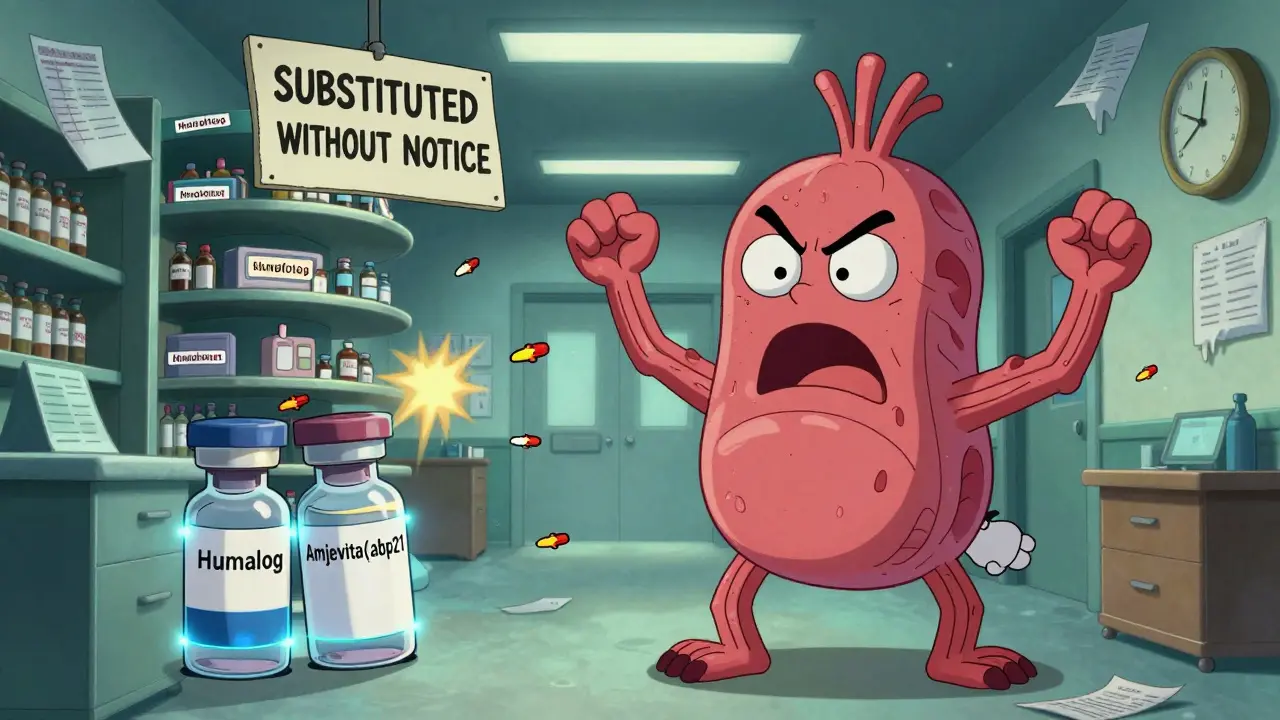
In the United States, it’s different. Since 2017, the FDA requires a unique four-letter suffix on biosimilar names-like “-abp21” for Amjevita. This helps doctors and pharmacists know exactly which product was given. But in practice? A 2022 survey found 63% of U.S. physicians still get confused. Why? Because pharmacies sometimes switch products without telling the prescriber.
Health Canada takes a middle path. They don’t use suffixes. Instead, they demand that every adverse event report clearly states the manufacturer’s brand name. And since January 2023, they’ve enforced this with fines up to $500,000 for non-compliance. In 2022, 87.3% of biologic reports in Canada included brand names-far higher than the U.S.
Real-World Problems: When Tracking Fails
It’s not just about systems-it’s about people.
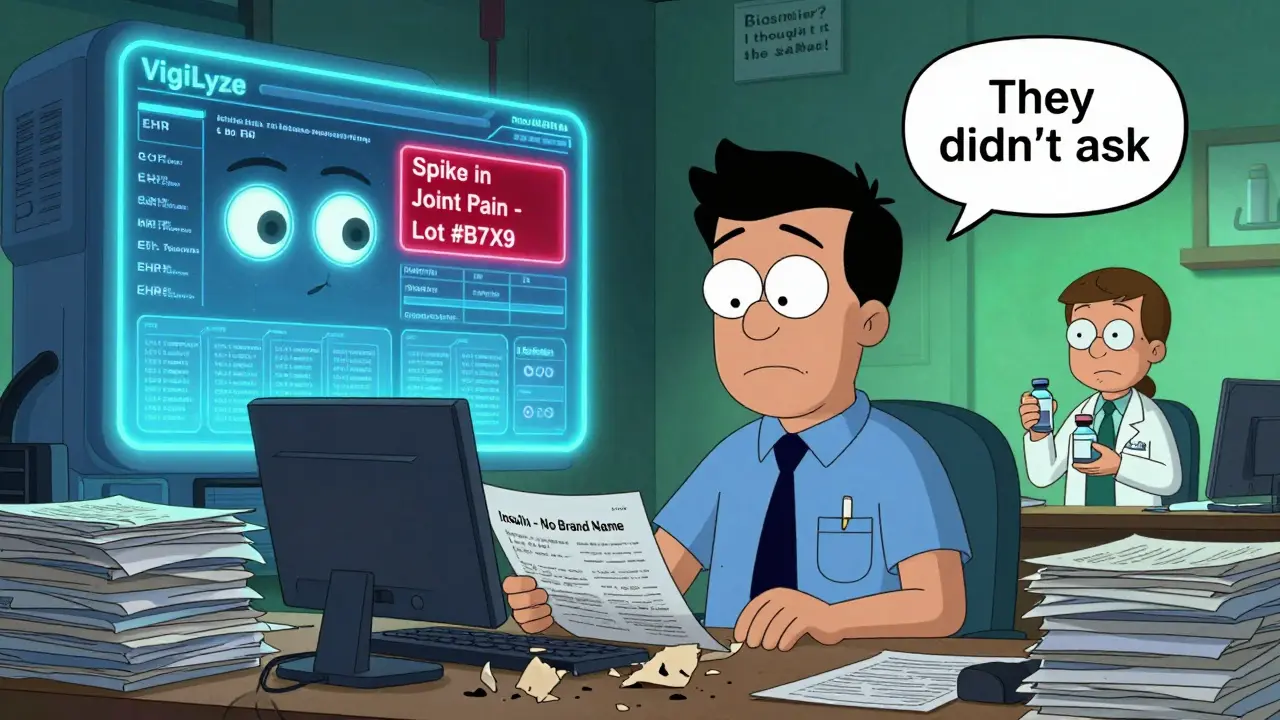
Dr. Sarah Chen, a rheumatologist at Johns Hopkins, says she’s seen cases where a patient reported severe fatigue after a biosimilar injection. The pharmacy had substituted the product without updating the chart. No one knew which version was given. The report got tossed. No follow-up. That’s not rare.
A 2022 survey of U.S. patients found 41% didn’t know if they were getting the brand or biosimilar. Some thought they were getting the same drug every time. Others didn’t even know biosimilars existed. When side effects happen, they blame the disease, not the drug.
And then there’s underreporting. Biosimilars made up 8.7% of biologic prescriptions in 2021, but only 0.3% of adverse event reports came from them. That gap suggests many reactions are never documented. Why? Lack of awareness. Time constraints. Confusing paperwork. A 2021 study showed only 38% of U.S. pharmacists knew exactly what to document.
Technology Is Changing the Game
Manual reporting won’t cut it anymore. The volume is too high. The stakes are too high.
EMA launched VigiLyze in 2022-an AI tool that scans 1.2 million new reports a year. It flags unusual patterns: a sudden spike in liver enzyme elevations linked to a specific lot number. It does this with 92.4% accuracy.
U.S. companies are starting to use natural language processing to scan clinical notes. If a doctor writes, “Patient had swelling after switch to adalimumab biosimilar,” the system pulls it out-even if the term “biosimilar” wasn’t in the official form. One mid-sized pharma firm cut analysis time from 6 months to 4 weeks and saved $300,000 in labor costs.
But it’s expensive. Setting up AI tools costs $250,000-$500,000. Most small manufacturers can’t afford it. That’s why big players like ArisGlobal and Oracle Health Sciences now offer cloud-based monitoring platforms. They handle the tech, the reporting, the compliance-so companies focus on making the drug.
What’s Next? The Road Ahead
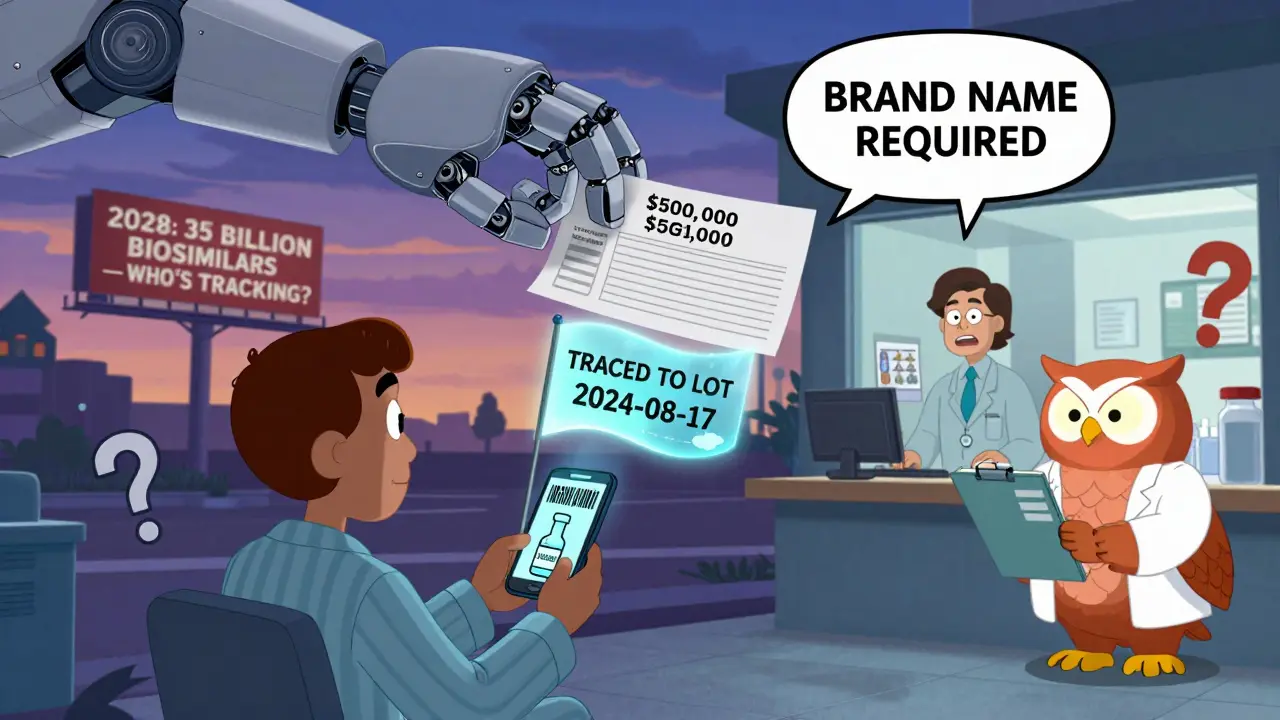
By 2028, the global biosimilar market will hit $35 billion. That means hundreds of products, dozens of manufacturers, and millions of patients.
Regulators are preparing. The WHO is pushing for a global unique identifier system-like a barcode for biologics-by 2026. Each batch would have a digital fingerprint. If a patient has a reaction, you trace it to the exact vial. Pilot studies in Switzerland show this could cut misattribution errors by over 70%.
And then there’s interchangeability. The FDA now requires extra studies for biosimilars labeled “interchangeable”-meaning a pharmacist can swap them without a doctor’s OK. That’s a big deal. But it also means the safety net has to be tighter. Post-market studies are now mandatory to track what happens when patients switch back and forth between products.
One thing’s clear: the old system of waiting for reports isn’t enough anymore. We need smarter tracking, clearer labeling, and better training. Because when a patient gets a biosimilar, they shouldn’t have to wonder if they’re safe. The system has to prove it.
What Patients and Providers Can Do
Here’s what actually works:
- Always ask: “Which product am I getting?” Write down the brand name and manufacturer.
- Report every side effect-even if it seems minor. Your report matters.
- If your pharmacy switches your drug without telling you, speak up. Ask for documentation.
- Use patient portals or apps that log your medication history. Many now let you scan the vial barcode.
Doctors and pharmacists: document the exact product name, lot number, and manufacturer. Don’t assume. Don’t guess. If you don’t record it, it doesn’t exist in the safety system.
Are biosimilars as safe as the original biologic drugs?
Yes, based on current data. Regulatory agencies like the FDA, EMA, and Health Canada require biosimilars to show no clinically meaningful differences in safety, purity, or effectiveness compared to the reference product. Real-world studies from Denmark, Canada, and the U.S. have found no evidence that biosimilars cause more side effects than the originals. But ongoing monitoring is still essential because rare reactions-especially immunogenicity-can only be caught after thousands of patients use the drug.
Why can’t biosimilars be identical to the original biologic?
Biosimilars are made from living cells, not chemicals. The manufacturing process involves complex biological steps-cell culture, purification, folding-that can’t be perfectly replicated. Even tiny changes in temperature, pH, or nutrient levels during production can alter the protein’s structure. These differences are minor and don’t affect safety, but they mean the final product isn’t chemically identical. That’s why they’re called “highly similar,” not “identical.”
What’s the biggest risk with biosimilars?
Immunogenicity-the risk that the body’s immune system reacts to the drug as if it’s a foreign invader. This can lead to reduced effectiveness, allergic reactions, or even dangerous conditions like neutralizing antibodies that affect natural proteins in the body. While rare, it’s the primary focus of safety monitoring. That’s why tracking lot numbers and reporting every suspected reaction matters so much.
Do all countries track biosimilars the same way?
No. The EU treats biosimilars like any other biologic with no special tracking rules. The U.S. uses unique four-letter suffixes on names to help distinguish them. Health Canada requires brand names to be clearly reported and enforces this with penalties. India and Japan have their own reporting timelines and documentation rules. The lack of global standardization creates challenges for multinational tracking and data comparison.
Why are so few adverse events reported for biosimilars?
Underreporting is common. Many healthcare providers don’t know how to document biosimilars correctly. Patients often don’t know they’re on a biosimilar. Pharmacies may switch products without informing anyone. In the U.S., biosimilars accounted for nearly 9% of biologic prescriptions in 2021 but only 0.3% of adverse event reports. This gap suggests many reactions are missed, which weakens the safety net.
How can patients help improve biosimilar safety monitoring?
Patients can make a difference by always asking which product they’re receiving-brand name and manufacturer. Keep a personal log of medications and side effects. Report any reaction, no matter how small, to their doctor or through official channels like the FDA’s MedWatch system. If a pharmacy substitutes a drug without notice, ask for an explanation. Awareness and documentation are the first lines of defense.

Judith Manzano
March 8, 2026 AT 22:34I’ve been on a biosimilar for rheumatoid arthritis for two years now, and honestly? I’ve felt better than when I was on the original. No more midnight nausea, no more swollen fingers. I know people are scared of the unknown, but the data doesn’t lie. We’ve got over a decade of real-world use in Europe-no surge in reactions, no hidden dangers. It’s not magic, it’s science.
rafeq khlo
March 9, 2026 AT 11:55It is a fact that the regulatory framework for biosimilars is fundamentally flawed and based on assumptions rather than empirical evidence. The very notion that minor structural variations in protein folding can be deemed clinically insignificant is scientifically naive. The immune system does not operate on statistical averages-it reacts to molecular anomalies. And yet we allow these products to be prescribed en masse without mandatory long-term immunogenicity registries. This is not oversight. This is negligence.
Morgan Dodgen
March 10, 2026 AT 02:59Let’s be real here. The FDA and pharma are in bed together. That four-letter suffix? A gimmick. You think they actually track anything? Nah. I’ve seen pharmacy logs-half the time the biosimilar isn’t even logged right. And don’t get me started on the AI tools. VigiLyze? More like VigiLie. They’re trained on biased datasets from the same labs that approved the drugs. It’s all a smoke screen. 🤡
Philip Mattawashish
March 10, 2026 AT 07:42Who the hell gave these corporations the right to play god with our biology? Biosimilars aren’t drugs-they’re corporate experiments on human bodies. And you think the FDA cares? They’re paid by the same companies that make them. They don’t want to know about side effects. They want to sell more. And now they’re pushing interchangeability like it’s a fucking product launch. You’re not a patient. You’re a data point. And your immune system? It’s collateral.
Tom Sanders
March 10, 2026 AT 15:48So… we’re just supposed to trust this stuff? I mean, I don’t even know what’s in my insulin anymore. My pharmacist just hands me a vial like it’s a soda. No one explains anything. And if I ask, they act like I’m being weird. Why is this so hard? Just tell me which one I’m getting. That’s not too much to ask.
Jazminn Jones
March 11, 2026 AT 19:26The lack of standardized nomenclature across jurisdictions is a glaring regulatory failure. The EU’s laissez-faire approach, the U.S.’s arbitrary suffix system, and Canada’s punitive documentation model each represent incompatible paradigms of pharmacovigilance. This fragmentation impedes global signal detection and creates dangerous blind spots. Until there is a unified, ISO-certified biologic identifier protocol, we are not monitoring-we are guessing.
Stephen Rudd
March 12, 2026 AT 04:09You people act like biosimilars are some revolutionary breakthrough. Newsflash: they’re not. They’re just cheaper knockoffs that Big Pharma uses to extend monopolies. The original biologics are still the gold standard. Anyone who switches without a clinical reason is playing Russian roulette with their immune system. And don’t even get me started on those pharmacy substitutions. That’s not healthcare-that’s corporate roulette.
Erica Santos
March 13, 2026 AT 17:55Oh look, another 12-page white paper on ‘safety surveillance.’ How noble. Meanwhile, patients are getting rashes and no one’s asking if the vial label matches the prescription. The real tragedy isn’t immunogenicity-it’s that we’ve turned medicine into a paperwork circus while people suffer in silence. You can’t automate empathy. But you sure can automate profit.
George Vou
March 14, 2026 AT 02:42they said the same thing about vaccines and now look at the autism rates. biosimilars are just the next step in the pharma agenda. you think they care if you get a weird reaction? nah. they just want you to keep buying. and dont even get me started on the lot tracking. its all a lie. i saw a doc write 'adalimumab' and the bottle said 'amjevita' and no one blinked. its all rigged.
Scott Easterling
March 14, 2026 AT 10:46Let me get this straight: we’re trusting a protein that’s made in a vat of yeast with a 0.003% chance of misfolding… and we’re okay with that? And then we let pharmacists swap it without telling anyone? This isn’t healthcare. This is a casino where the house always wins. And the patients? They’re the ones getting the hangover.
Mantooth Lehto
March 14, 2026 AT 17:11I had a reaction last month. Swelling, fever, felt like I was dying. I reported it. Got a form letter back. No follow-up. No call. Nothing. Meanwhile, my doctor says, ‘It’s probably just stress.’ 😔 I’m not crazy. I’m just tired of being ignored. If you’re on a biosimilar, keep a log. Write down the lot number. Take a pic of the vial. Don’t wait for someone else to care. Your life isn’t a footnote.
Melba Miller
March 16, 2026 AT 16:54It’s funny how Americans act like they’re the only ones who care about safety. Canada’s system is way better. No suffixes? Fine. But they enforce brand reporting with fines. That’s accountability. Here? We’ve got a patchwork of half-baked systems and pharmacists who don’t even know what they’re handing out. We’re not leading innovation. We’re leading chaos.
Nicholas Gama
March 18, 2026 AT 16:41Immunogenicity is the only real risk. Everything else is noise.
Mary Beth Brook
March 20, 2026 AT 10:01AI-driven pharmacovigilance is the only scalable solution. Manual reporting is obsolete. The FDA’s Sentinel system already aggregates 800M+ records. The bottleneck isn’t data-it’s interpretation. NLP models trained on clinician notes can detect subtle temporal patterns invisible to humans. The future isn’t waiting. It’s already running in the cloud.