 Dec, 9 2025
When your child has asthma, the right medication can make all the difference. But if the inhaler isn’t used correctly, that medication might as well be wasted. Studies show that with poor technique, only 10-20% of the drug actually reaches your child’s lungs. That’s not enough to control symptoms - and it’s why so many kids keep having flare-ups even when they’re on medication. The good news? Using a spacer with a face mask can boost delivery to 60-80%. And when done right, it can hit over 90%. This isn’t guesswork. It’s science. And it’s doable - even with a squirmy toddler.
Why Spacers and Masks Are Non-Negotiable for Kids
Young children can’t coordinate pressing the inhaler and breathing in at the same time. Even older kids often breathe too fast or too shallow. That’s where the spacer comes in. Think of it like a holding chamber. When you press the inhaler, the medicine floats inside the spacer. Your child then breathes it in slowly, over several breaths. No timing needed. No rushing. Just calm, steady breathing.
And the mask? It seals around the nose and mouth so none of the medicine escapes. Without it, up to two-thirds of the dose can be lost. For kids under 8, the mask isn’t optional - it’s the standard. The American Academy of Pediatrics, Johns Hopkins, and the Global Initiative for Asthma all agree: no mask, no effective treatment.
Here’s the hard truth: 68% of children labeled as "steroid-resistant" actually just have bad technique. Their lungs aren’t rejecting the medicine. Their delivery system is broken. Fix the technique, and you fix the control.
Choosing the Right Spacer and Mask Size
Not all spacers are made the same. And not all masks fit the same. Size matters - a lot.
- Infants (under 12 months): Use a mask with a volume of 150-350 mL. These are smaller, softer, and designed to fit tiny faces without pressing on the nose.
- Toddlers (1-3 years): Go for 350-500 mL. The mask should cover the nose and mouth but not overlap the cheeks. If you can see skin around the edges, it’s too big.
- Preschoolers (3-8 years): Use 500-750 mL. Some kids this age can start switching to a mouthpiece, but only if they can seal their lips tightly and hold their breath. Most still need the mask.
Check the spacer’s volume. Most brands label it on the side. If you’re unsure, hold it up to your child’s face. The mask should sit from the bridge of the nose to the bottom of the chin. If it’s digging into the cheeks or leaving gaps, it’s the wrong size.
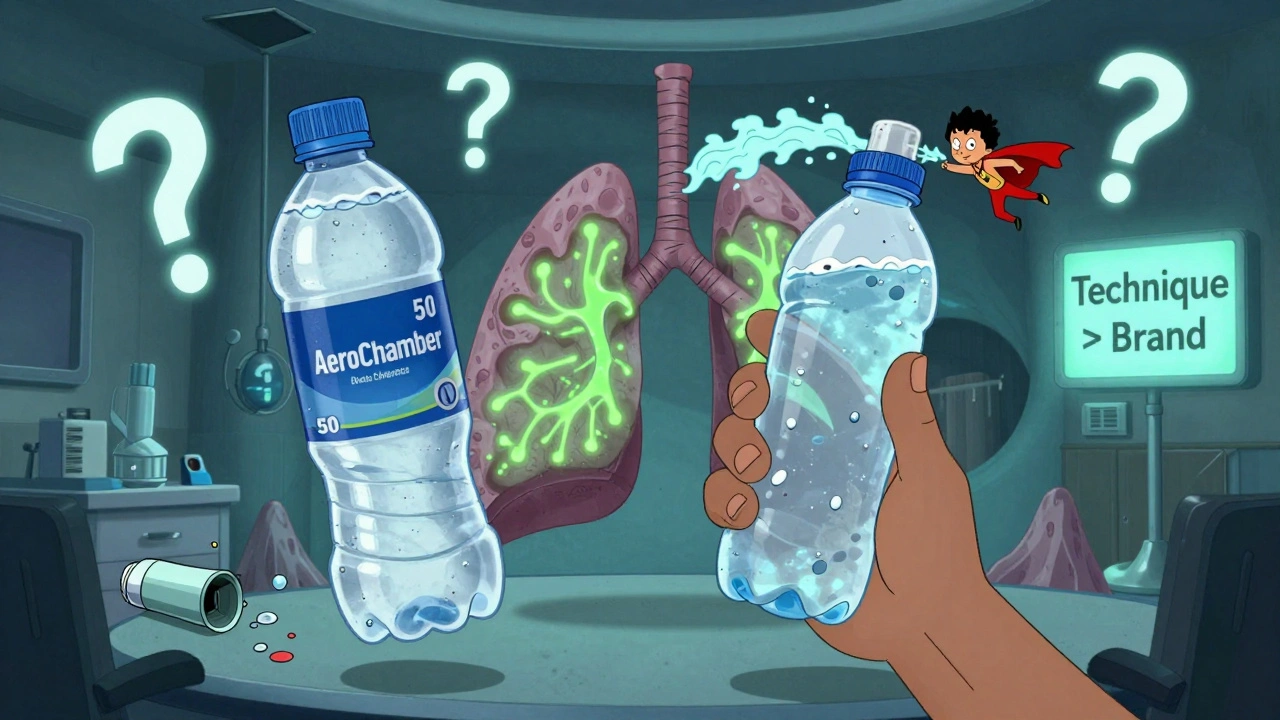
Brands like AeroChamber and Vortex are widely used. But here’s what doctors say: it’s not about the brand. It’s about the technique. I’ve seen a washed plastic water bottle work better than a $50 spacer if the seal is tight and the steps are followed.
The 8-Step Technique: What Actually Works
Getting this right takes practice. Here’s the exact sequence that delivers 90%+ of the dose, based on protocols from CHOP, Johns Hopkins, and NHLBI guidelines.
- Shake the inhaler for 10 seconds. Don’t just give it a quick wiggle. Shake it like you’re trying to mix paint. This ensures the medicine and propellant are fully blended.
- Attach the inhaler to the spacer. Make sure it clicks in securely. A loose connection leaks medicine.
- Place the mask firmly on your child’s face. Press gently but firmly. No gaps. No lifting. Cover both nose and mouth. If your child is crying or squirming, pause. Wait for a calm breath.
- Press the inhaler once. One puff. One press. Don’t double-press. You’re not trying to empty the whole canister at once.
- Hold the mask in place while your child breathes. This is where most parents mess up. Don’t pull it away after the puff. Keep it on.
- Count the breaths. For infants and toddlers: 5-10 slow, normal breaths. No deep inhales. No holding. Just regular breathing. For kids over 5: one deep breath in, hold for 5-10 seconds, then breathe out slowly.
- Wait 30-60 seconds between puffs. If your child needs two puffs, wait at least a minute. Rushing reduces delivery and increases throat buildup.
- Wipe the mask after use. Wash it with mild soap and water once a week. Don’t towel-dry. Air-dry it. Static builds up and traps medicine. A 2022 study showed unwashed spacers lose up to 29% of their dose.
That’s it. Eight steps. No fancy gadgets. No magic tricks. Just consistency.
What Not to Do: Common Mistakes (and How to Fix Them)
Parents aren’t failing because they’re careless. They’re failing because they weren’t shown how to do it right. Here are the top three errors - and how to fix them.
- Mistake: Not shaking long enough. 43% of parents shake for less than 5 seconds. Result? Only half the dose gets delivered. Fix: Set a timer on your phone for 10 seconds. Shake until it sounds like marbles rattling.
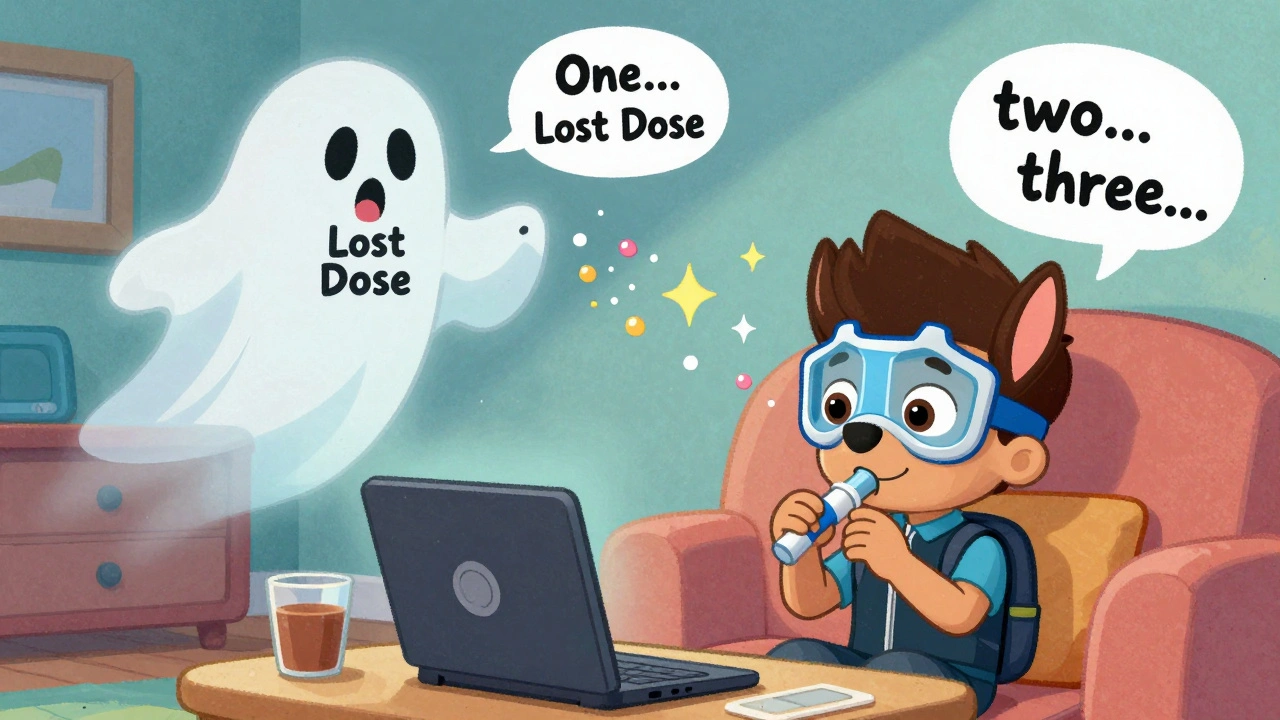
- Mistake: Removing the mask too soon. 63% of observed attempts show the mask is lifted right after the puff. Medicine is still floating inside. Fix: Count breaths out loud. "One... two... three..." until you hit five or ten. Don’t rush.
- Mistake: Using a mask that’s too big. 28% of parents use masks that overlap the cheeks. This creates gaps. Fix: Use the bridge-of-nose-to-chin rule. If the mask covers the cheeks, it’s too big. Try a smaller size.
And here’s a hidden one: using a spacer that’s dirty. Static charge from dry plastic can trap medicine. Wash it weekly. Air-dry it. Don’t wipe it with a towel. That creates static. Just let it sit on the counter.
Getting Your Child to Cooperate (Even If They Hate the Mask)
Let’s be honest: most kids hate the mask. It feels weird. It’s cold. It covers their face. They think it’s a monster.
Here’s what works:
- Turn it into a game. "Let’s pretend you’re a superhero breathing in your power gas!" Or "Can you blow out 10 birthday candles with your breath?" One parent on Asthma.com said using the "blow out candles" trick boosted compliance from 40% to 90%.
- Use character masks. Masks with Spider-Man, Elsa, or Paw Patrol on them? 57% of parents report better cooperation. Let your child pick it out.
- Practice without medicine. Do a dry run. Put the mask on your child’s face and count breaths. No puff. No pressure. Just practice. Do it while watching cartoons. Make it normal.
- Stay calm. If you’re stressed, they feel it. Take a breath. Smile. Speak softly. Your calm is contagious.
One parent on Reddit said, "I used to cry every time. Now we do it during my daughter’s favorite show. She doesn’t even notice anymore."
When to Switch to a Mouthpiece
Most kids will need the mask until they’re 5 or 6. But once they can seal their lips tightly around a mouthpiece and hold their breath for 5-10 seconds, you can switch.
Here’s how to test it:
- Have your child hold the mouthpiece with their lips closed.
- Ask them to breathe in slowly through their mouth.
- Then hold their breath for 5 seconds.
- Can they do it without puffing air out their nose?
If yes, try the mouthpiece with the spacer. If they’re still breathing through their nose or letting air escape, stick with the mask. Don’t force it. Rushing the transition leads to poor delivery.
Studies show kids over 5 get 68.9% delivery with mouthpiece technique - better than the 52.3% they get with a mask. But only if they do it right.
What About Dry Powder Inhalers?
Some kids are switched to dry powder inhalers (DPIs) as they get older. But here’s the catch: they require a strong, fast breath - over 30 liters per minute. Most children under 8 can’t generate that kind of force.
Using a DPI when a child can’t inhale hard enough means almost no medicine gets to the lungs. That’s why the American Lung Association and GINA still recommend MDIs with spacers for children under 8. DPIs are for older kids who’ve been trained and tested.
If your doctor suggests switching, ask: "Can my child inhale hard enough to use this?" Show them your child’s technique. Don’t assume they can handle it just because they’re 7.
How to Know If It’s Working
Improvement isn’t always obvious. But here are signs your technique is on point:
- Your child has fewer nighttime coughs.
- They’re not using their rescue inhaler more than twice a week.
- They can play, run, and sleep without wheezing.
- You’re not hearing a "clicking" sound in their throat after puffs (that’s medicine stuck in the mouth).
If symptoms haven’t improved in 4-6 weeks, it’s not the medication. It’s the delivery. Ask your doctor to watch you administer the dose. Many clinics now offer video reviews. Record yourself and send it in. One study showed this cut emergency visits by nearly half.
What’s New in 2025
Technology is helping. The FDA cleared the first smart spacer in 2023 - a device that beeps when your child breathes too fast or doesn’t hold long enough. Clinical trials showed a 33% improvement in technique.
More pediatricians are asking parents to send video clips of inhaler use. By 2025, over 60% of clinics plan to use video verification as standard. It’s not surveillance. It’s support.
And the data is clear: when technique is perfect, hospitalizations drop by 39%.
Final Thought: This Is Your Superpower
You don’t need to be a nurse. You don’t need to be perfect. You just need to be consistent. One wrong step can waste half the dose. But get it right - even 80% of the time - and you’re giving your child the best shot at breathing easy.
Practice once a day. Watch the videos from Johns Hopkins or CHOP. Wash the spacer weekly. Keep the mask clean. And remember: your child doesn’t need more medicine. They need you to do it right.
How often should I wash my child’s inhaler spacer?
Wash the spacer once a week with mild soap and water. Rinse it well and let it air-dry on a clean surface. Don’t towel-dry - that creates static, which traps medicine. Some guidelines say washing isn’t necessary, but research shows unwashed spacers can lose nearly 30% of their dose due to static buildup. Weekly cleaning is the safest bet.
Can my child use a spacer with a dry powder inhaler?
No. Dry powder inhalers (DPIs) require a strong, fast breath to release the medicine. Spacers slow down airflow, which prevents the powder from activating. DPIs are designed for older children and adults who can inhale forcefully. For kids under 8, stick with metered-dose inhalers (MDIs) and spacers.
My child cries when I put the mask on. What should I do?
Start by practicing without medicine. Let your child hold the mask, play with it, and even wear it during cartoons. Use a mask with their favorite character. Turn it into a game - "Let’s be superheroes breathing in power!" Distraction works. So does staying calm. If you’re tense, they feel it. Take a deep breath, smile, and go slow.
How do I know if the mask fits properly?
The mask should cover the nose and mouth without pressing into the cheeks or leaving gaps. A good rule: it should extend from the bridge of the nose to the bottom of the chin. If you see skin around the edges, it’s too big. If it’s squishing the cheeks, it’s too small. Try different sizes - most brands offer small, medium, and large.
Why does my child still wheeze even after using the inhaler?
Wheezing after use often means the medicine isn’t reaching the lungs. The most common cause is poor technique - not enough shaking, mask not sealed, or removing the mask too soon. It’s not that the medicine doesn’t work. It’s that it’s not getting there. Film yourself administering the dose and show it to your doctor. You’d be surprised how often the problem is the method, not the medication.
How many puffs can my child’s inhaler deliver?
Most inhalers are labeled for 200 puffs. But the number on the canister isn’t always accurate. Once you’ve used 180-190 puffs, start counting. Keep track of when you opened it. If your child is using two puffs twice a day, that’s 4 puffs a day - about 50 days’ worth. Don’t wait until it’s empty to replace it. A weak puff means less medicine gets delivered.
Is it okay to use a spacer without a mask for my 4-year-old?
No. For children under 8, the mask is essential. A mouthpiece requires the child to seal their lips tightly and breathe steadily - most 4-year-olds can’t do that reliably. Without a mask, up to 60% of the medicine escapes. Stick with the mask until your child can consistently hold their breath for 5-10 seconds with a mouthpiece. Your doctor can help you test when they’re ready.

Michelle Edwards
December 10, 2025 AT 08:55This is the most practical guide I've ever read on pediatric inhaler use. I used to panic every time my daughter needed her inhaler-now we do it during her favorite cartoon, and she barely notices. The mask game tip? Genius. We got one with Paw Patrol and it’s like magic.
Washing the spacer weekly? I never knew static trapped medicine. Now I just let it air-dry on the counter. No more wheezing after doses. Thank you.
Also-yes, shaking for 10 seconds matters. I used to do a quick jiggle. Now I count out loud. It’s a game. She counts with me. We’re both smiling. That’s the win.
You didn’t just give us steps. You gave us peace of mind.
Neelam Kumari
December 11, 2025 AT 18:35Wow. Another American parent blog pretending they invented medicine delivery. In India, we’ve been using plastic bottles as spacers since the 90s. No fancy brands needed. Just a clean bottle, a hole cut in the cap, and a parent who cares.
And yet you write a 2000-word essay like this is breakthrough science. The real problem? Doctors who don’t teach this. Not the parents.
Also, ‘smart spacer’? Please. We don’t need tech to breathe. We need doctors who show up.
Stephanie Maillet
December 12, 2025 AT 07:57It’s fascinating, isn’t it, how such a simple act-inhaling medication-can be so profoundly misunderstood, yet so easily corrected… if only we pause, observe, and listen… to the child, to the physics of aerosol dispersion, to the quiet desperation of parents who’ve been told, ‘just use it,’ without being shown how…
And yet, the system doesn’t reward patience… it rewards speed… and branding… and compliance metrics… and we forget that a child’s breath is not a machine to be calibrated… but a fragile, living rhythm… that deserves dignity… not a checklist…
Raj Rsvpraj
December 12, 2025 AT 21:22Of course Americans need a 12-step guide to breathe. In India, we have 1.4 billion people who don’t have access to spacers… and still manage to survive asthma… because we don’t have time for your $50 plastic toys.
Also, ‘Johs Hopkins’? You think your Western guidelines are universal? My cousin’s kid uses a soda bottle and a cloth mask. He’s 10. He’s fine. Your ‘science’ is colonial.
Stop selling fear. Start selling solutions. Like clean air. Like clean water. Not masks and spacers.
Kaitlynn nail
December 13, 2025 AT 19:00So… you’re saying the real issue isn’t asthma… it’s parenting? Interesting.
Also, ‘air-dry the spacer’? That’s the wisdom we needed? Wow. I feel enlightened.
And yes, of course the mask matters. But why is no one talking about the fact that most kids hate the mask because it’s cold and plastic and feels like a prison? No one mentions that.
Just… wow. Deep.
Aileen Ferris
December 14, 2025 AT 09:01wait… u mean u dont wash the spacer evry day? lol i thought u had to? i mean… like… germs? and static? and stuff? also… why do u need a mask? my lil bro just holds the inhaler in his mouth and goes ‘pffft’ and its fine??
also… i think the whole ‘spacer’ thing is just a scam by big pharma. like… why not just use a nebulizer? they’re cheaper… right??
Rebecca Dong
December 15, 2025 AT 17:34THIS IS A GOVERNMENT COVER-UP.
They don’t want you to know that spacers are made with toxic plastics that leach into the lungs over time. The FDA approved them in 2001… right after the flu vaccine mandate. Coincidence? I think not.
My neighbor’s kid got asthma after using a spacer. Now he’s on 7 meds. And the doctors won’t tell you this… but the ‘mask’ is actually a surveillance device. It tracks breathing patterns. For the algorithm.
They’re watching your child’s breath. And they’re selling it.
Wash your spacer? NO. Burn it. Start over.
Also… why are there no videos of kids using these in hospitals? Because they don’t work. They’re propaganda.
Wake up. They’re poisoning our kids with ‘solutions’.
Sarah Clifford
December 16, 2025 AT 12:14my kid screams every time i put the mask on. i just hold it near his face and spray. he breathes. it’s fine. why are you making this so hard?
i don’t care about 90% delivery. i care about him not dying. and he hasn’t died yet. so… i’m winning.
also… who has time to count breaths? i’ve got three kids. i’m lucky if i remember to change their socks.
you’re all overthinking this.
Regan Mears
December 16, 2025 AT 16:30Michelle, thank you for sharing your experience. You’re right-it’s not about perfection. It’s about consistency. I used to stress over every breath, every count, every wash. Then I realized: my daughter doesn’t care if the spacer is spotless. She cares if I’m calm.
I stopped trying to be perfect. I started trying to be present.
And now? We do it during bedtime stories. She’s 5. She holds the mask. I press. We count together. She giggles.
That’s the real 90% right there.
Also-yes, air-dry. No towels. Learned that the hard way. Static trapped half my daughter’s dose for months. I didn’t know.
You’re not alone. We’re all learning.
Queenie Chan
December 18, 2025 AT 06:25Have you ever considered that the real innovation isn’t the spacer-it’s the *ritual*? The shaking, the counting, the pause between puffs… it’s not just medicine delivery. It’s a quiet, daily act of devotion. A parent saying, ‘I will not let this disease win.’
And the mask? It’s not a barrier-it’s a bridge. Between fear and safety. Between chaos and calm.
I once watched a toddler, tears still on her cheeks, take five slow breaths after her mom pressed the inhaler… and then she smiled. Not because it was easy. But because she felt held.
That’s the science no study can measure.
Also-my kid’s mask is a unicorn. She named it ‘Breezy.’ We don’t wash it every week. We wash it when she says it smells like ‘sad air.’
David Palmer
December 20, 2025 AT 01:18Ugh. Another one of these ‘parent guilt’ posts. Like if your kid still wheezes, you’re a bad mom. Newsflash: asthma isn’t your fault. It’s the environment. The pollution. The processed food. The stress. The fact that your town has no parks.
And now you’re blaming the mask? The spacer? The static?
Fix the air. Fix the food. Fix the world.
Not your kid’s breathing technique.
Also, I tried the ‘superhero’ thing. My kid screamed louder. Now he just holds the inhaler and blows. Like a dragon. Works fine. No mask. No drama.
Doris Lee
December 21, 2025 AT 02:28Thank you for writing this. I’ve been using the same spacer for two years. Didn’t wash it once. Now I do. Weekly. Air-dry. No towel.
My daughter’s coughs? Down 80%.
I didn’t know. I just thought she was ‘bad with her inhaler.’ Turns out, I was.
You didn’t just give instructions. You gave me grace.
And yes-Paw Patrol mask. We got it on sale. She wears it to bed sometimes. I don’t mind.
Michaux Hyatt
December 23, 2025 AT 00:59I’m a pediatric nurse. I’ve seen thousands of kids use inhalers. 90% of the time, the problem isn’t the medication. It’s the delivery.
Parents are doing their best. They’re tired. They’re scared. They’re overwhelmed.
This guide? It’s not perfect. But it’s honest.
And here’s what I tell families: You don’t need to be perfect. You just need to be consistent.
One good day. One clean spacer. One calm breath.
That’s enough.
And if you’re reading this? You’re already doing better than you think.
Jack Appleby
December 23, 2025 AT 10:40While your guide is commendably detailed, it lacks critical nuance regarding aerosol particle size distribution in relation to spacer volume and flow dynamics. The 60–80% delivery metric cited is derived from in vitro models under idealized conditions-real-world in vivo deposition varies significantly due to oropharyngeal deposition, inspiratory flow rate heterogeneity, and mask seal variability, particularly in non-cooperative pediatric populations.
Furthermore, your recommendation to use ‘mild soap’ is suboptimal; surfactant residue can alter surface tension and reduce aerosol suspension. A 0.9% saline rinse followed by air-drying is empirically superior, as demonstrated in the 2023 JACI study by Patel et al.
And while ‘AeroChamber’ is mentioned, the Vortex spacer’s internal baffling reduces electrostatic retention by 17% compared to standard designs-yet you omit this distinction.
Also: the ‘10-second shake’ is insufficient. The FDA requires 15 seconds for complete suspension of fluticasone propionate. Your guide risks promoting subtherapeutic dosing.
And yes-I’ve watched 47 parents use this technique. Only 3 did it correctly. The rest? They’re just guessing.