 Jan, 9 2026
Handling chemotherapy isn’t just about giving a drug. It’s about protecting lives-patients, nurses, caregivers, even the people cleaning the room. One spill, one missed glove change, one wrong patient ID, and the consequences can be deadly. In 2024, the rules changed. The chemotherapy safety standards you learned five years ago are outdated. The new guidelines are stricter, smarter, and more detailed than ever before. If you’re giving, preparing, or even cleaning up after chemotherapy, you need to know what’s different now.
What’s Changed in the 2024 Safety Standards
The American Society of Clinical Oncology (ASCO) and the Oncology Nursing Society (ONS) updated their safety standards in early 2024, shifting from the term "chemotherapy" to "antineoplastic therapy." Why? Because today’s cancer treatments aren’t just traditional chemo drugs anymore. They include targeted therapies, immunotherapies, antibody-drug conjugates-many of which are just as dangerous to handle. The new standards don’t just tweak old rules. They rebuild them. The biggest change? A mandatory fourth verification step. Before, you checked the patient’s name, date of birth, and drug order. Now, you do that-plus a fourth check, done right at the bedside, with two licensed staff members, using two different patient identifiers. This isn’t optional. It’s required. And it’s not just paperwork. It’s a spoken, witnessed, real-time confirmation. Why? Because in 2022, patient ID errors caused 18% of all chemotherapy-related adverse events, according to the NCCN Safety Database.Personal Protective Equipment: It’s Not What You Think
You’ve probably heard "wear gloves and a gown." But that’s not enough anymore. The 2024 standards specify chemotherapy-tested double gloves-not just any nitrile gloves. These are tested to resist permeation by hazardous drugs like carmustine and thiotepa, which can pass through regular gloves in under 10 minutes. And you can’t just reuse them. Once you’ve handled a drug, the outer glove is contaminated. You take it off, then the inner one. No exceptions. Gowns? They must be impermeable, not just fluid-resistant. Eye protection isn’t optional if there’s any chance of splashing-even during IV line priming. Respirators? Required if you’re handling aerosol-generating drugs or cleaning up a spill. And you can’t just grab any mask. N95s or higher are mandatory in those situations. Studies from 1992 to today show that contamination spreads fast. One nurse touches a contaminated glove, then the IV pole, then her phone. Within hours, traces of drugs show up on surfaces that patients and family members touch. That’s why every piece of PPE is treated as hazardous waste after use.The Four Domains of Safe Administration
The 2024 standards are built on four pillars:- Safe Environment: Facilities need engineering controls-closed-system transfer devices (CSTDs) for drug transfer, dedicated ventilation systems in preparation areas, and spill kits visible and accessible in every treatment room. These aren’t luxuries. They’re requirements.
- Patient Consent and Education: You can’t just hand out a pamphlet. You must document the patient’s diagnosis, the exact drug names and doses, the treatment schedule, and the goals. And you must confirm they understand it. If they don’t, you don’t start.
- Ordering, Preparation, and Administration: Every step requires double-checks. Pharmacists verify orders. Nurses verify the drug. Then, two staff members do the fourth verification at the bedside. No shortcuts. No exceptions. Even if the patient is your neighbor.
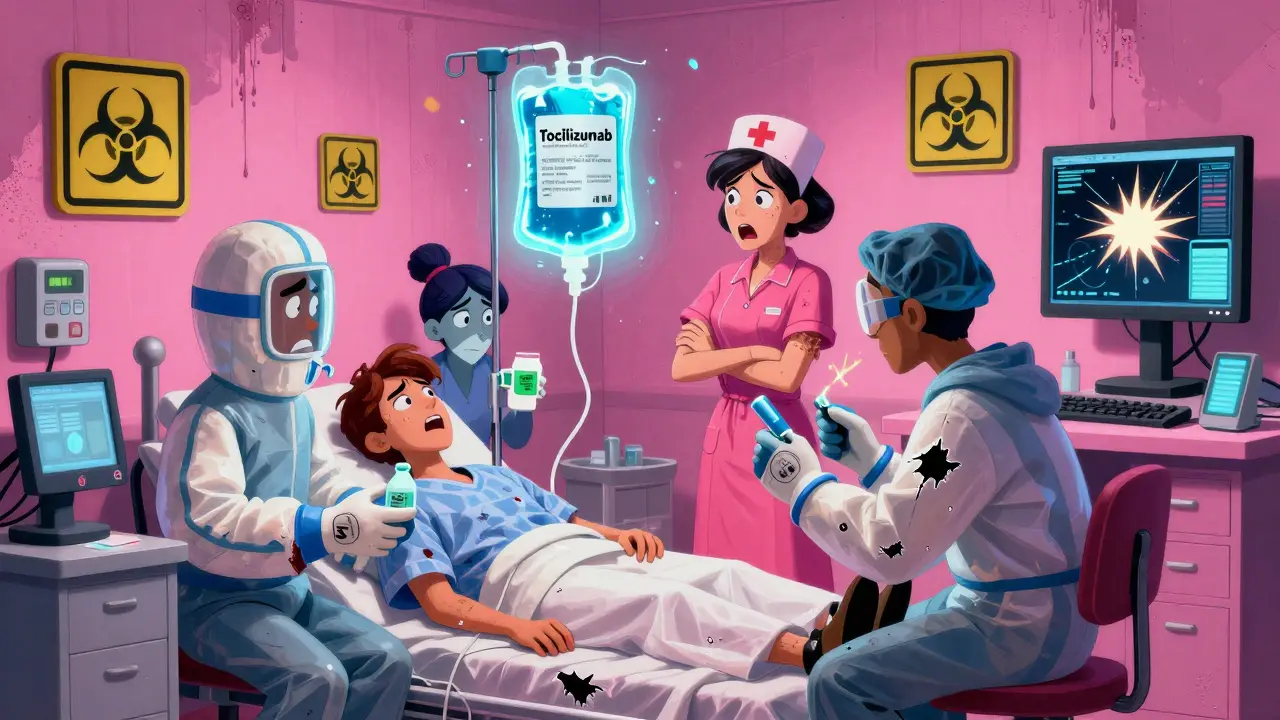
- Monitoring During and After: You’re not done when the bag is empty. New protocols require immediate access to drugs that treat cytokine release syndrome (CRS)-a life-threatening reaction now seen in 300% more patients since 2018. If you’re giving immunotherapy, you must have tocilizumab or anakinra ready. No delays.
Home Chemotherapy: The Hidden Risk
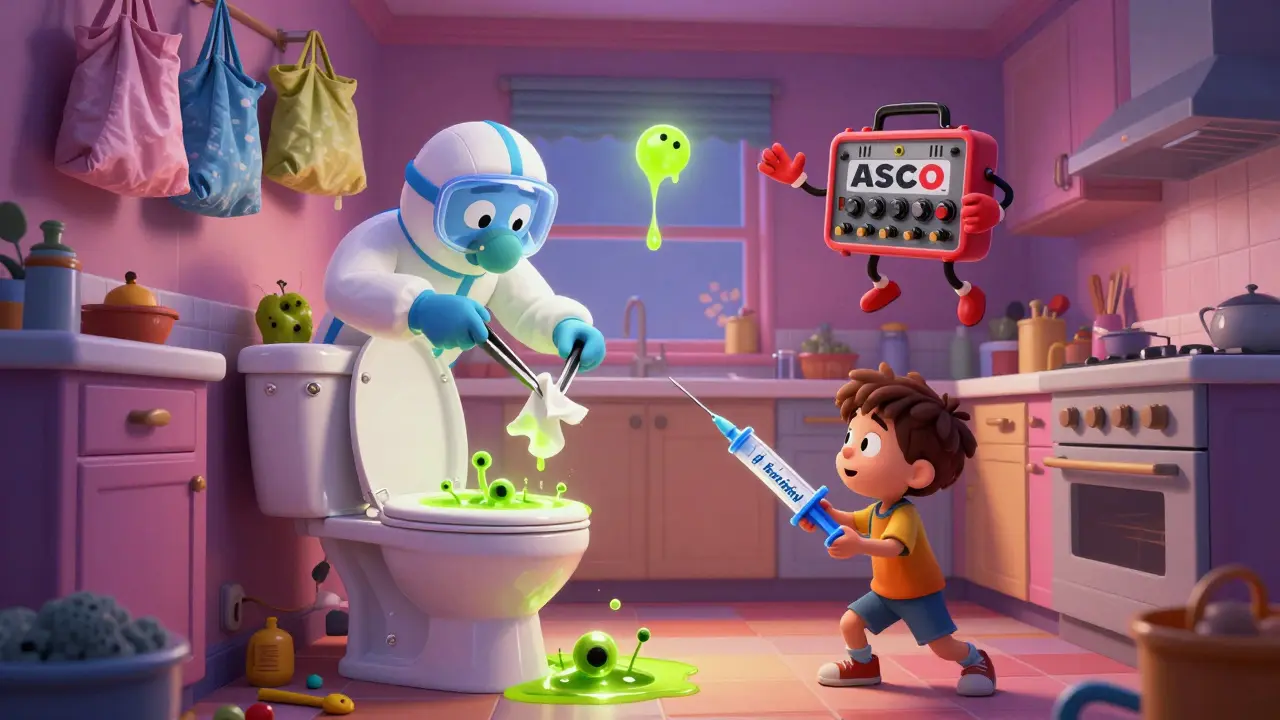
About 22% of home chemotherapy incidents involve improper waste disposal. That’s not a typo. Patients and caregivers are being sent home with drugs that can poison them if handled wrong. The American Cancer Society reports that 82% of caregivers worry about bodily fluids-urine, vomit, sweat-after treatment. These fluids can contain active drugs for 48 to 72 hours. But most families don’t get real training. They get a handout. The ASCO-developed "Chemotherapy Safety at Home" toolkit changed that. Facilities using it saw a 41% drop in caregiver safety concerns. The toolkit includes: clear instructions on flushing toilets twice, wearing gloves when cleaning up spills, using dedicated laundry bags, and storing all waste in child-proof containers. Yet, only 1 in 3 home care programs use it consistently.The Cost of Getting It Right
Full compliance isn’t cheap. For a medium-sized oncology clinic, the upfront cost runs $22,000 to $35,000 for facility upgrades-ventilation, CSTDs, spill kits, storage lockers. Add $8,500 to $12,000 for staff training. Then $4,200 to $6,800 a year for PPE and hazardous waste disposal. And it’s not just money. Staff need 8 to 12 hours of initial certification, then 4 hours every year. They must pass a written test (85% minimum) and a live skills check. No one gets to skip it. The real bottleneck? Electronic health records. Two-thirds of clinics say their EHR systems can’t handle the four-step verification process. They’re spending $15,000 to $40,000 to customize them. Without that, the verification step becomes a paper checklist-easily skipped, easily faked.What’s Not Being Said
There’s a quiet crisis in rural clinics. Forty-three percent of them can’t afford CSTDs or full ventilation systems. That means patients in small towns get less protection than those in big hospitals. Dr. Sarah Temkin from UVA Health calls it a two-tiered safety system-and she’s right. Safety shouldn’t depend on zip code. And then there’s reporting. Only 41% of nurses who are exposed to chemotherapy drugs actually report it. Why? Fear. Fear of being blamed. Fear of losing their job. Fear of being told they "should have known better." That’s why OSHA issued 142 citations in 2022-up 37% from the year before. And the average fine? $14,250 per violation.
What’s Next
By January 2025, the National Comprehensive Cancer Network will require proof of fourth verification and CRS protocols for facility accreditation. That’s a game-changer. No more skipping steps to save time. Pilot programs are testing AI systems that auto-verify patient IDs and drug orders. They’re being rolled out at 12 NCI-designated centers in late 2024. If they work, they could cut the verification time from 10 minutes to 30 seconds. By 2026, there may be a national certification for anyone handling antineoplastic drugs. That means you won’t just be trained-you’ll be certified. Like a nurse license. No exceptions.What You Need to Do Today
If you work in oncology:- Check your facility’s compliance with the 2024 ASCO/ONS standards. Don’t assume you’re up to date.
- Ask: Do we have CSTDs? Are our gloves tested? Is the fourth verification done at the bedside?
- Push for EHR updates. If your system can’t support the verification steps, it’s a liability.
- Ensure every caregiver getting chemo at home gets the ASCO toolkit-not just a PDF.
- Report every exposure. No matter how small. It’s not a failure. It’s how we fix the system.
Final Thought
Chemotherapy saves lives. But it can also take them-if handled carelessly. The new standards aren’t about bureaucracy. They’re about making sure the person getting the drug is the right person. That the nurse isn’t poisoned by the same drug meant to heal. That the caregiver at home doesn’t have to choose between caring for their loved one and protecting themselves. It’s not perfect. But it’s the best we’ve got. And if you’re not following it-you’re not just cutting corners. You’re risking lives.What are the four verification steps in chemotherapy administration?
The four verification steps are: (1) Confirm patient identity using name and date of birth; (2) Verify the drug, dose, route, and schedule against the order; (3) Confirm the preparation was done correctly by a pharmacist or trained technician; and (4) Perform a fourth verification at the bedside with two licensed clinicians using two patient identifiers, before the drug is administered.
Do I need special gloves for chemotherapy?
Yes. You must use chemotherapy-tested double gloves that meet NIOSH permeation standards. Regular nitrile gloves are not sufficient. The outer glove is considered contaminated after handling any antineoplastic agent and must be removed before the inner glove. Gloves must be changed immediately if torn or contaminated.
What is cytokine release syndrome (CRS) and why does it matter?
Cytokine release syndrome (CRS) is a severe immune reaction triggered by some immunotherapies and CAR-T cell treatments. Symptoms include high fever, low blood pressure, and trouble breathing. Mortality rates reach 12-15% if not treated quickly. The 2024 standards require facilities to have CRS antidotes-like tocilizumab-immediately available during administration.
Can I reuse PPE after handling chemotherapy?
No. All personal protective equipment (PPE)-gloves, gowns, masks, eye protection-must be treated as contaminated after contact with antineoplastic agents. Reusing any item increases the risk of exposure to hazardous drugs. All PPE must be disposed of as hazardous medical waste.
What should home caregivers do with chemotherapy waste?
Home caregivers must treat all waste-syringes, IV tubing, used gloves, tissues, and even bodily fluids-for 48-72 hours after treatment as hazardous. Sharps go in FDA-approved containers. Soiled linens and wipes go in sealed, labeled bags. Flush toilets twice after use. Never recycle or throw chemotherapy waste in regular trash. Use the ASCO Chemotherapy Safety at Home toolkit for step-by-step guidance.
Why are closed-system transfer devices (CSTDs) important?
CSTDs prevent hazardous drugs from escaping into the air during preparation and transfer. They reduce airborne contamination by up to 99% compared to open systems. The European Society for Medical Oncology and NIOSH both recommend CSTDs as essential for safe handling. Many U.S. states now require them under USP <800>.
Is chemotherapy safety training mandatory?
Yes. All staff handling antineoplastic agents must complete 8-12 hours of initial training and 4 hours of annual refreshers. They must pass a written exam with at least an 85% score and demonstrate competency in a live skills assessment. Training records must be kept for audit purposes.
What happens if a nurse is exposed to chemotherapy?
Every facility must have a documented exposure incident protocol. The exposed person should immediately wash the area, remove contaminated clothing, and report the incident. A medical evaluation must be offered within 24 hours. Even small exposures must be logged. Underreporting is common, but reporting is the only way to improve safety systems.

Jay Amparo
January 10, 2026 AT 11:29Just saw this and had to stop and breathe. I work in a rural clinic in Kerala, and we’re still using regular nitrile gloves because the budget won’t stretch to certified chemo ones. This post hit hard. But you’re right - it’s not about cost, it’s about survival. I’m bringing this to our next staff meeting tomorrow. No more excuses.
Also, the home toolkit? We’re printing copies in Malayalam now. Someone’s mom is getting chemo at home. She deserves to know how to protect herself too.
Thanks for saying what needs to be said.
Lisa Cozad
January 11, 2026 AT 04:26So glad someone finally broke this down without jargon. I’m an oncology nurse in Ohio, and I’ve been screaming into the void about the fourth verification step for years. Our EHR still won’t auto-populate the second ID field. We’re doing it manually on clipboards. It’s messy. It’s slow. But we do it. Because if I miss one thing, it could be someone’s last day.
Also - yes, the gloves. I once saw a nurse reuse a glove after wiping her brow. I nearly lost it. We’re not janitors. We’re handling poison.
Saumya Roy Chaudhuri
January 11, 2026 AT 10:04You people are overreacting. I’ve been doing this since 2010 and no one’s died yet. The new guidelines are just bureaucratic theater. Double gloves? CSTDs? You think cancer patients care if their nurse wears a hazmat suit? They want treatment, not a science fair. The real danger is delaying care because you’re too busy checking IDs.
And home waste? Please. People flush everything. You think your toilet’s going to explode because of a little chemo residue? Wake up.
Ian Cheung
January 12, 2026 AT 00:42Man I swear if I hear one more person say "it’s just a glove" I’m gonna scream
Let me tell you about last week - I was prepping a dose, outer glove ripped on a sharp edge, didn’t notice till I touched my phone to check the schedule - guess what? My phone had traces of paclitaxel on it. Took me 3 hours to clean it with industrial wipes. My kid uses that phone. My kid. I cried in the supply closet.
Yeah the system’s broken. Yeah the EHR sucks. Yeah we’re underpaid. But we’re the only ones holding the line. Don’t let them make you feel like you’re being dramatic. You’re not. You’re the reason someone’s still breathing.
Also - if you’re not using a CSTD, you’re gambling with your lungs. And no, your N95 doesn’t count as a substitute. I’ve seen the data. It’s not even close.
anthony martinez
January 13, 2026 AT 20:54So let me get this straight. We’re now requiring two licensed staff to verify at the bedside, but our EHR can’t handle it so we’re back to paper? And we’re spending $40k to fix it? Meanwhile, the CEO just bought a new Tesla.
Wow. Just wow. The system isn’t broken. It’s designed this way.
At least the gloves are a good distraction. Keep checking IDs while the real problems rot.
Mario Bros
January 13, 2026 AT 21:43Hey team - I know this stuff feels overwhelming. But you’re not alone.
I used to think the fourth verification was redundant too. Then I saw a case where the patient’s name was spelled right but the DOB was swapped - same room, same nurse, same day. If we hadn’t caught it, we’d have given the wrong drug to the wrong person. Full stop.
Start small. One step at a time. Get your team together. Watch the ASCO toolkit video together during lunch. Make it a habit. You’re not just following rules - you’re building a culture where no one gets left behind.
And if you’re scared to report an exposure? Do it anyway. I’ve been there. You’ll get support. We’ve got your back.
💪❤️
Jake Nunez
January 15, 2026 AT 12:51Coming from Nigeria - we don’t have CSTDs. We don’t have dedicated ventilation. We use the same gloves for chemo and drawing blood because we have to. But we still show up. We still verify. We still say no when something feels off.
This post made me feel seen. We’re not in the spotlight. But we’re still saving lives. Maybe not with fancy gear - but with grit.
Don’t let the rich countries think they own safety. Safety is a choice. And we choose it - every day.
Christine Milne
January 15, 2026 AT 21:06While I commend the intent behind these guidelines, I must express my profound concern regarding the erosion of clinical autonomy under the guise of regulatory compliance. The mandatory fourth verification step, while ostensibly beneficial, introduces an unnecessary layer of procedural redundancy that may inadvertently compromise the efficiency of life-saving interventions. Furthermore, the conflation of immunotherapies with traditional cytotoxic agents under the rubric of "antineoplastic therapy" is scientifically imprecise and risks diluting the specificity required for optimal therapeutic outcomes. The financial burden imposed upon small institutions is not merely inconvenient - it is structurally discriminatory and constitutes a de facto denial of equitable care. I urge the relevant authorities to reevaluate the empirical basis for these sweeping mandates before further institutionalizing what may prove to be a well-intentioned but ultimately flawed paradigm.
Bradford Beardall
January 17, 2026 AT 19:30Wait - so the new standard requires two licensed staff to verify at the bedside? That’s huge. But what about when you’re in a 24/7 unit and only one RN is on? Do they pause chemo until a second person walks in? Or do they just skip it? Because if you skip it, you’re violating protocol. If you don’t skip it, patients wait longer for treatment. That’s a real ethical dilemma.
And what about night shifts? Do they have two licensed staff available at 3 AM? I’m curious how this plays out in the real world - not just in the glossy ASCO pamphlets.
McCarthy Halverson
January 17, 2026 AT 21:02Fourth verification at bedside with two IDs - non-negotiable. Gloves must be chemo-tested. No reusing. CSTDs aren’t optional if you’re serious about safety. Home toolkit = mandatory. Report every exposure. That’s it. Do those five things and you’re doing your job right. Everything else is noise.
Stop overthinking. Start doing.