 Feb, 18 2026
One wrong letter on a prescription can kill someone. It sounds dramatic, but it’s true. In hospitals, clinics, and pharmacies across the country, simple abbreviations once considered harmless are now known to cause deadly mistakes. These aren’t typos or bad handwriting - they’re standardized shorthand that doctors, nurses, and pharmacists have used for decades. And now, we know better.
Why These Abbreviations Are So Dangerous
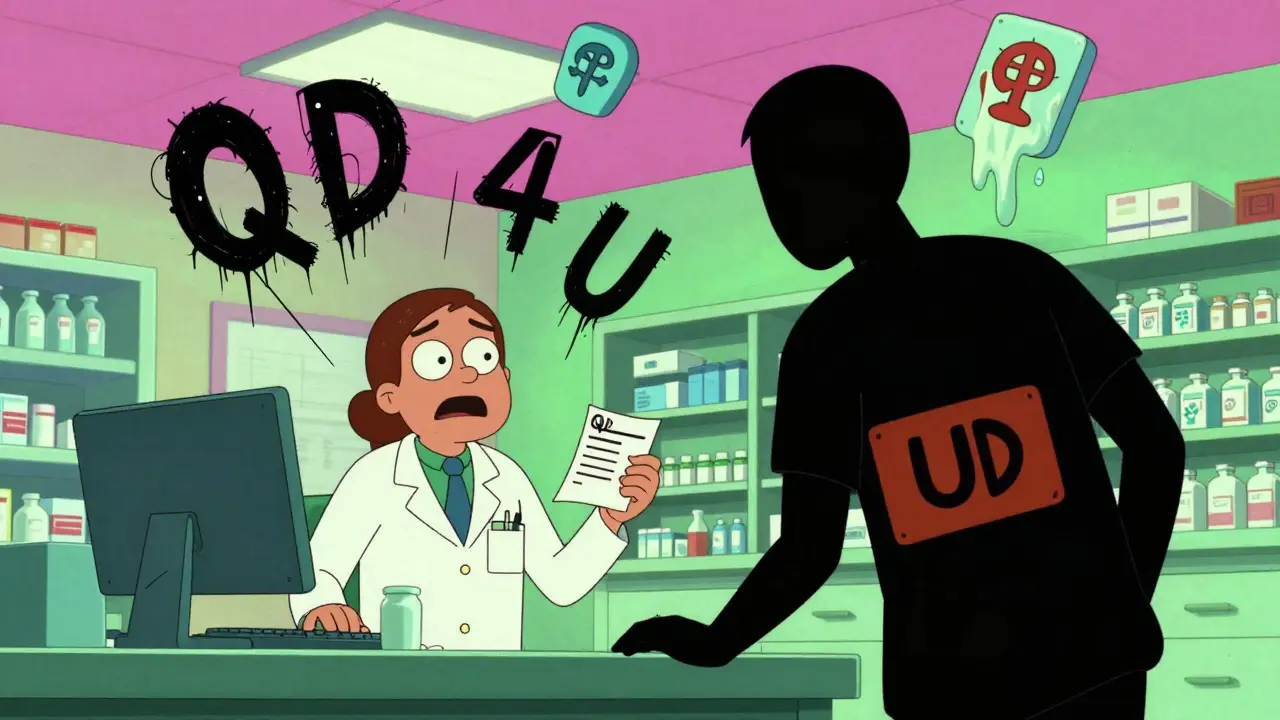
It’s not about laziness. It’s about ambiguity. When a doctor writes "QD" for "once daily," they mean one thing. But a pharmacist might read it as "QID" - four times a day. That’s a fourfold overdose. That’s not a small mistake. That’s a life-threatening error.
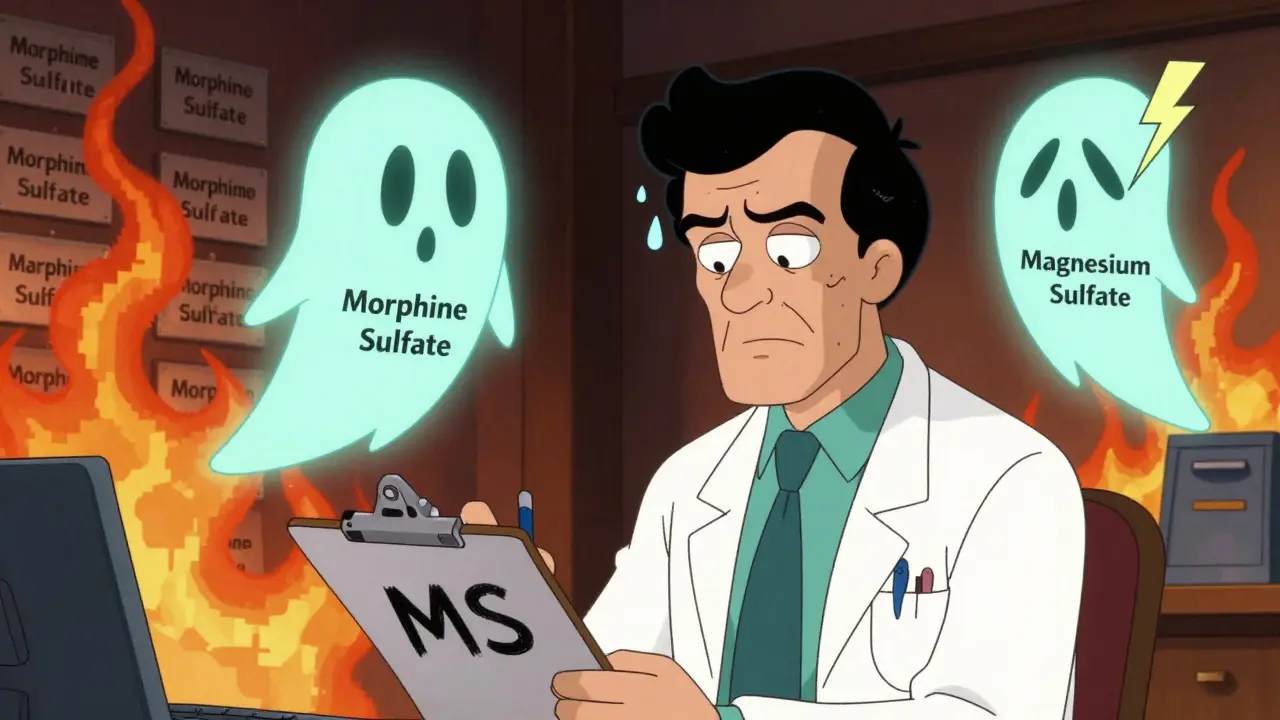
The same goes for "MS." To some, it means morphine sulfate. To others, it means magnesium sulfate. These are completely different drugs. One calms pain. The other treats seizures and high blood pressure during pregnancy. Give the wrong one, and you could stop someone’s heart.
These aren’t hypotheticals. In 2022, a study of 1,843 pharmacists found that over 60% had intercepted at least one dangerous abbreviation error in the past year. The top three? "QD," "U," and "MS." These are the usual suspects. And they’re still out there.
The Official "Do Not Use" List - What’s Banned
In 2001, The Joint Commission - the group that accredits hospitals in the U.S. - created a mandatory list of abbreviations that can no longer be used. This isn’t a suggestion. It’s a rule. If your hospital doesn’t enforce it, they risk losing accreditation. That means no Medicare payments. No insurance contracts. No patients.
Here are the most dangerous ones you must stop using right now:
- QD - Never use this for "once daily." Write out "daily" or "every day." "QD" looks too much like "QID" (four times daily) or "QOD" (every other day).
- QOD - "Every other day" is too easily misread as "QD" or "qid." Always spell it out.
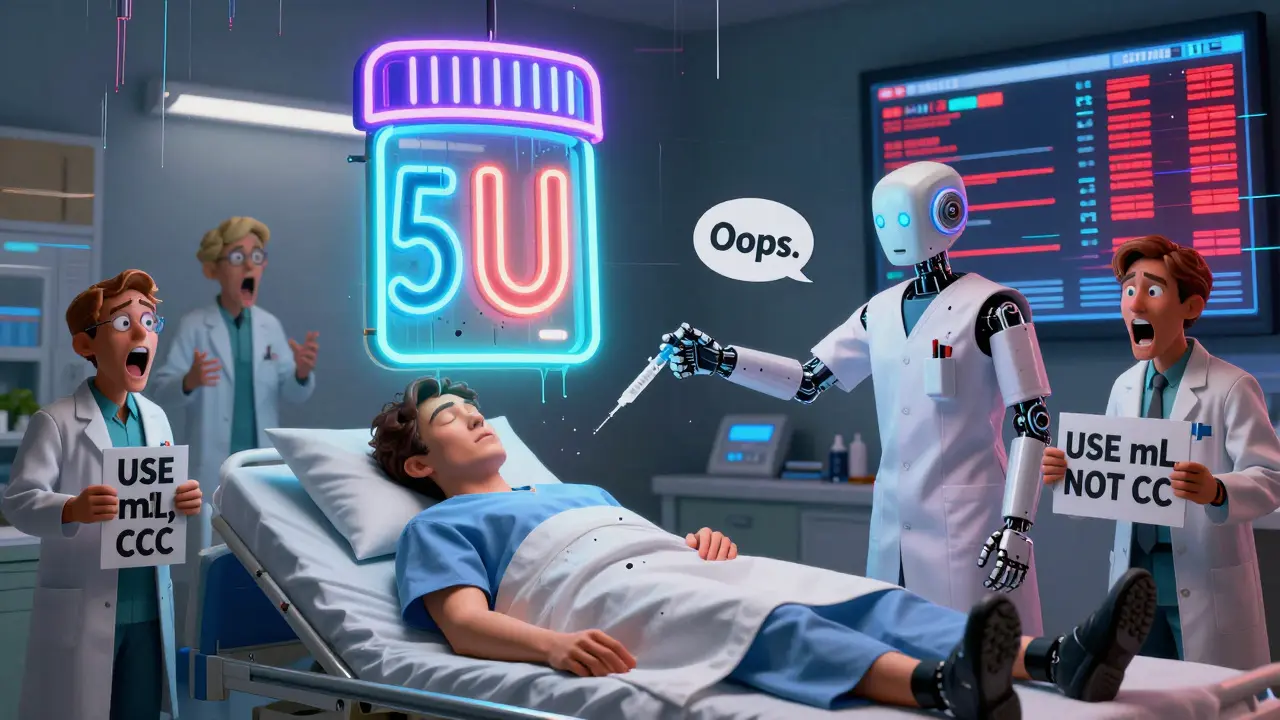
- U - Stands for "unit." But it looks like "0," "4," or even "cc." A dose of "10 U" could be read as 100, 104, or 10 cc. Write "units" every time.
- IU - "International unit." Sounds fine, right? But it’s often mistaken for "IV" (intravenous) or "10." Use "international units."
- MS and MSO4 - Morphine sulfate. Magnesium sulfate. The same letters. Opposite effects. Never abbreviate. Write "morphine sulfate" or "magnesium sulfate." Full names only.
- cc - Cubic centimeters. Sounds medical. But it’s confused with "U" (units) or "mL." Use "mL" instead. It’s clearer, and it’s the international standard.
- TIQ - "Three times a week." Too easy to misread as "TID" (three times daily). Just say "three times a week."
- HS - "At bedtime"? Or "half strength"? Or "hour of sleep"? Ambiguous. Write "at bedtime" or "at night."
- SC and SQ - Both mean subcutaneous. But "SC" can be misread as "SL" (sublingual). Use "subcutaneous."
- BIW - "Twice a week." Mistaken for "twice daily." Write it out.
That’s 12. But the Institute for Safe Medication Practices (ISMP) lists over 120 more. These are the ones that kill.
Real Cases - What Happens When You Ignore the Rules
In 2019, a patient in a long-term care facility was given "TAC 0.1% cream." The doctor meant triamcinolone - a steroid for eczema. The pharmacist read it as "Tazorac," a psoriasis drug. The patient got the wrong treatment for weeks. Skin damage followed.
In 2022, a Reddit thread from r/Pharmacy shared a near-miss: "MS 10 mg SC." The prescriber meant morphine sulfate. The pharmacy system flagged it because "MS" was blocked. The pharmacist called the doctor. Turned out, the doctor had written "MgSO4" by accident. They caught it before the nurse even touched the vial.
Another case: a woman with kidney disease was prescribed "U-100 insulin." The order said "5 U." The nurse read it as "50." She gave five times the dose. The patient went into a coma. She survived - but barely.
These aren’t rare. They’re routine. And they’re preventable.
How Technology Helps - But Doesn’t Fix Everything
Electronic health records (EHRs) cut abbreviation errors by nearly 70%. That’s huge. But they’re not magic. Many systems still allow free-text entries. A doctor types "MS" in a note. The system doesn’t stop them. The pharmacist sees it. And they have to guess.
Some EHRs now have smart alerts. If you type "QD," the system auto-corrects to "daily." If you type "U," it pops up: "Did you mean 'units'?" Epic Systems rolled this out to over 70% of U.S. hospitals by late 2023. It’s working.
But here’s the problem: older doctors still write by hand. Or dictate. And voice-to-text systems sometimes mishear "magnesium sulfate" as "morphine sulfate." New tools are coming. By 2026, most major EHRs will auto-correct dangerous abbreviations during voice dictation. But until then? You still have to be careful.
What You Can Do - Even If You’re Not a Doctor
You don’t need to be a pharmacist to save a life. If you’re a patient, here’s what to do:
- Ask: "Can you write that out in full?" If they say "MS," ask: "Is that morphine or magnesium?"
- Check your prescription label. Does it say "mL" or "cc"? If it says "cc," ask why.
- If you’re given a new drug, ask: "What does this treat? What does it look like?"
- Take a photo of your prescription. Compare it to the bottle. If something looks off - speak up.
If you’re a nurse, pharmacist, or medical assistant:
- Never assume. Always verify.
- Use the "Do Not Use" list as a checklist. Print it. Tape it to your desk.
- If you see "QD," "U," or "MS" - stop. Call the prescriber. Don’t guess.
- Report every near-miss. Even if no one got hurt. That data saves lives later.
Why This Still Happens - And How to Change It
Why do people still use "U" or "MS"? Because they’ve always done it. Many doctors trained before these rules existed. They learned "MS" in medical school in the 1980s. Changing habits takes time.
A 2022 survey found that 44% of doctors over 50 still use banned abbreviations. Only 18% of those under 40 do. That’s a generational gap. But it’s not just about age. It’s about culture.
Successful hospitals don’t just ban abbreviations. They train. They enforce. They reward. One clinic in Brisbane cut errors by 89% in 18 months. How? They:
- Blocked "QD," "U," and "MS" in their EHR system - no way around it.
- Required every prescriber to complete a 90-minute safety module.
- Added real-time feedback: if someone typed "cc," the system said: "Use mL. Click here to learn why."
- Posted monthly reports: "We caught 12 errors last month. No one got hurt. Thanks for being vigilant."
That’s what works. Not fear. Not punishment. Clarity. Consistency. Community.
The Bottom Line
Medication errors aren’t accidents. They’re systems failures. And the simplest fix is also the most powerful: write it out.
Don’t write "QD." Write "daily."
Don’t write "U." Write "units."
Don’t write "MS." Write "morphine sulfate" or "magnesium sulfate."
It takes two extra seconds. But those two seconds? They’re the difference between a patient going home - and a patient not.
The data doesn’t lie. Facilities that fully enforce this list cut abbreviation-related errors by over 89%. That’s not a guess. That’s science. And it’s happening right now - in hospitals, clinics, and pharmacies across Australia and beyond.
Don’t wait for someone else to fix it. Fix it today. For your patient. For your team. For yourself.

Greg Scott
February 18, 2026 AT 18:48Ashley Paashuis
February 18, 2026 AT 20:03Arshdeep Singh
February 19, 2026 AT 19:29Oana Iordachescu
February 20, 2026 AT 07:15Robert Shiu
February 20, 2026 AT 21:27Caleb Sciannella
February 21, 2026 AT 08:42Davis teo
February 22, 2026 AT 05:55madison winter
February 24, 2026 AT 04:32Chris Beeley
February 25, 2026 AT 13:46Michaela Jorstad
February 27, 2026 AT 10:41Danielle Gerrish
February 28, 2026 AT 12:33Jeremy Williams
February 28, 2026 AT 21:45