 Dec, 24 2025
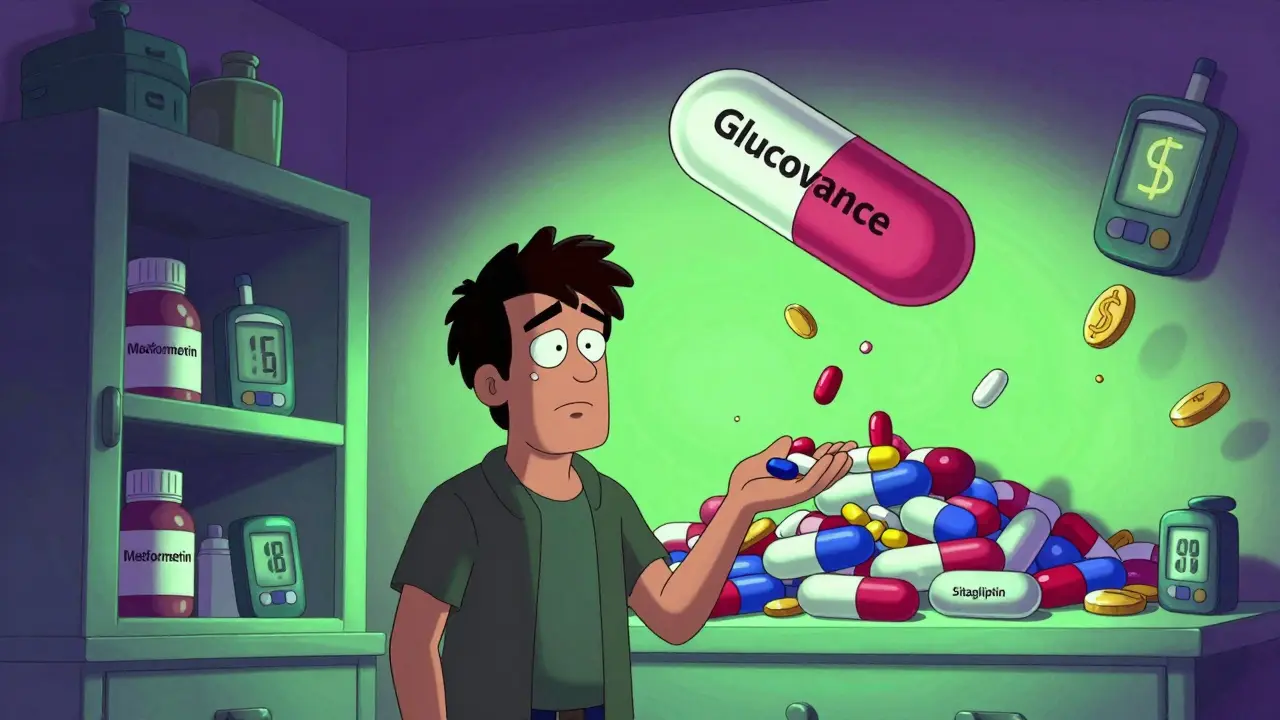
Managing Type 2 diabetes often means taking more than one pill a day. For many, that means juggling metformin, a sulfonylurea, and maybe a DPP-4 inhibitor-three separate pills, three different times. It’s confusing. It’s expensive. And it’s easy to miss a dose. That’s where diabetes combination medications come in. They pack two drugs into one tablet, cutting pill burden and improving adherence. But here’s the catch: not all combinations have generic versions. And when they do, switching isn’t always simple.
What Are Diabetes Combination Medications?
Diabetes combination medications are single pills that contain two different blood sugar-lowering drugs. Most commonly, they pair metformin with another agent like a DPP-4 inhibitor, an SGLT2 inhibitor, or a sulfonylurea. Metformin is in 80% of these combos because it’s effective, safe, and cheap. The second drug adds a different way to lower glucose-either by helping the pancreas release more insulin, blocking sugar reabsorption in the kidneys, or improving how the body uses insulin.The goal? Better control with fewer pills. Studies show people on combination therapy drop their HbA1c by 1.2 to 1.8 percentage points on average-much more than with one drug alone. And because each drug is given at a lower dose in the combo, side effects like stomach upset or low blood sugar can be less severe.
Why Generic Versions Matter
Brand-name combo drugs can cost over $500 a month. That’s not sustainable for most people. Generic versions can drop that cost to $15-$20 for a 30-day supply. For example, Metaglip (glipizide + metformin) and Glucovance (glyburide + metformin) have been generic since 2010 and 2012, respectively. Today, you can buy these generics for under $20 cash at most pharmacies.But only 5 out of the 25 available diabetes combination medications in the U.S. have generic versions. The rest-like Janumet (sitagliptin/metformin), Synjardy (empagliflozin/metformin), and Jentadueto (linagliptin/metformin)-are still brand-only. Why? Patents. Newer drugs get extended patent protection, sometimes through formulation tricks like extended-release coatings. That means even if the active ingredients are off-patent, the way they’re delivered can still be protected for years.
Which Combinations Have Generics? Here’s the Real List
Not all combo pills are created equal when it comes to generics. Here’s what’s actually available right now:
- Metaglip (glipizide + metformin): Generic since 2012. Available in 2.5/500mg and 5/500mg. Cash price: ~$18.75 for 60 tablets.
- Glucovance (glyburide + metformin): Generic since 2010. Available in 1.25/250mg, 2.5/500mg, and 5/500mg. Cash price: ~$15.20 for 60 tablets.
- Janumet (sitagliptin + metformin): Brand only. No generic yet. Price: $500+ for 30 tablets.
- Janumet XR (extended-release version): Brand only. No generic. Expected around 2026.
- Jentadueto (linagliptin + metformin): FDA approved generic in May 2023, but market entry delayed until 2025 due to litigation.
- Synjardy (empagliflozin + metformin): Brand only. Patent protection lasts until at least 2026.
Notice a pattern? The generics are all older combos with sulfonylureas. The newer ones with DPP-4 or SGLT2 inhibitors? Still locked behind patents. That’s why cost savings are huge-but only for certain patients.
When Switching to Generic Works
Switching from brand to generic isn’t just about saving money. It can be safe-if done right. Patients on Metaglip or Glucovance for years often report no difference in blood sugar control after switching. A 2022 Joslin Diabetes Center survey found 76% of users had seamless transitions with these older combos.
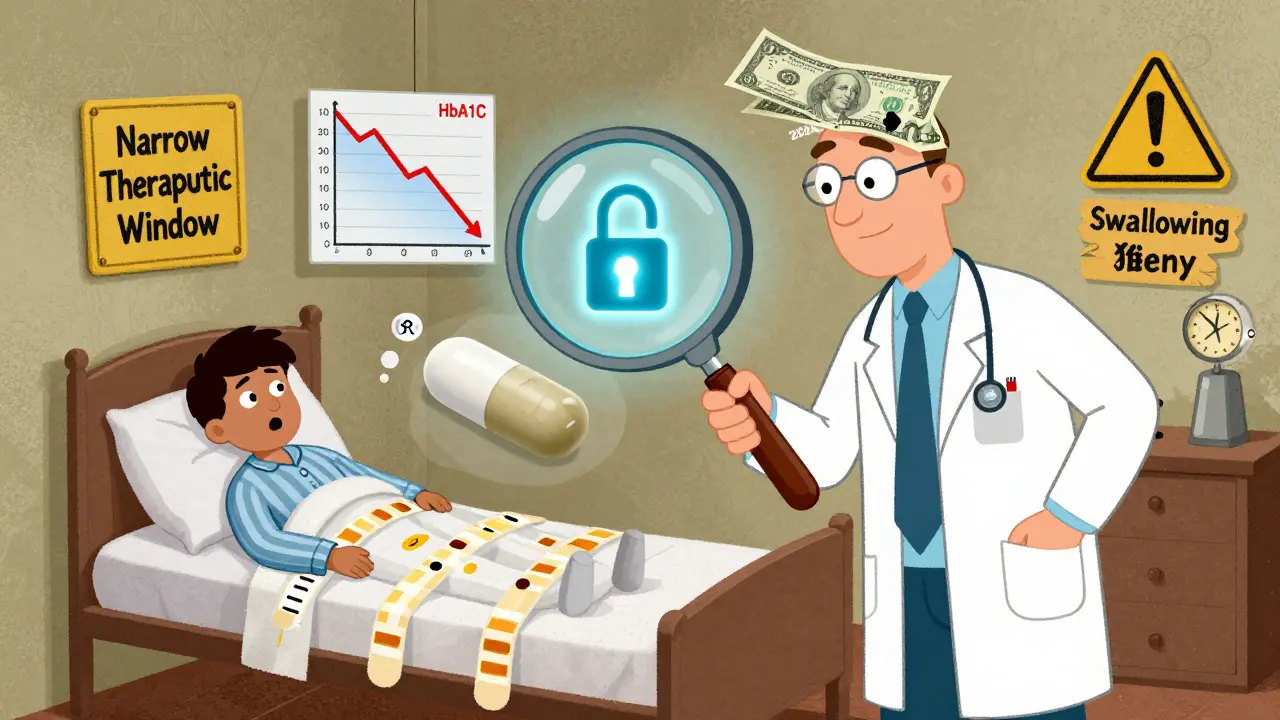
Why? Because the components-glipizide, glyburide, metformin-are well-understood. Their absorption and metabolism don’t vary much between brands and generics. Plus, these drugs have wide therapeutic windows: small changes in blood levels don’t trigger big side effects.
Doctors often recommend generic substitution for patients who:
- Have stable blood sugar levels for 6+ months
- Are on a long-term maintenance plan
- Don’t need extended-release formulations
- Have no history of hypoglycemia or kidney issues
For these people, the savings are massive. One patient on Reddit shared that switching from brand Glucovance to generic saved him $420 a month. He tested his glucose four times daily for three weeks after switching and saw no change.
When Switching Can Backfire
But not all combos are this forgiving. The problem comes with drugs that have a narrow therapeutic index-where even a small difference in blood concentration can cause side effects or loss of control.
Take glyburide, for example. It’s in Glucovance. A 2023 case on the Diabetes Daily forum described a patient who started having frequent low blood sugar after switching to generic Glucovance. The issue? The generic version released glyburide faster than the brand. That led to a spike in insulin right after meals, followed by a crash. He had to go back to the brand.
Experts like Dr. John Buse from UNC Diabetes Center point out that FDA bioequivalence rules allow generics to be 80-125% as potent as the brand. That’s a 45% range. For insulin or thyroid meds, that’s too wide. For some diabetes drugs, it can matter.
Also, extended-release (XR) versions are rarely available as generics. If you need the slow release of Janumet XR to avoid stomach upset, a generic immediate-release combo won’t help. You’ll still get the same side effects-and you’ll be taking two pills instead of one.
What You Need to Know Before Switching
If your doctor suggests switching to a generic combo, don’t just say yes. Ask these questions:
- Is the generic version the same formulation? (Immediate-release vs. extended-release)
- Are the dosages equivalent? (Some generics come in different strengths)
- Will I need to change how often I take it?
- Do I need to monitor my blood sugar more closely after switching?
The American Association of Clinical Endocrinology recommends checking your blood sugar 4 times a day for 2-4 weeks after switching. That’s not optional. It’s how you catch problems early.
Also, check your insurance. Many plans force you to try the generic first. If you’ve been on brand and it’s working, you can appeal. Some manufacturers offer copay cards-even for brand-name drugs-that cut your cost to $0. Don’t assume you’re stuck paying full price.
Why Some Generics Feel Different
Even if the active ingredients are identical, generics can look and feel different. Pill size, color, coating, and fillers vary. Some people report:
- Swallowing difficulty because the generic is larger
- More bloating or gas due to different inactive ingredients
- Changes in how quickly they feel the effect
One GoodRx review said: “The generic pill is twice as big as the brand. I have to cut it in half just to swallow it.” Another wrote: “I didn’t have stomach issues with Janumet, but the generic made me feel nauseous for two weeks.”
These aren’t “side effects” in the clinical sense-they’re physical differences in how the pill is made. But they matter. If you can’t take the pill, you won’t take it.
What’s Coming Next
The next few years will see a flood of new generics. Janumet XR’s main patent expired in January 2024. Generic versions should hit the market by 2026. Jentadueto’s generic is expected in 2025. And by 2027, multiple DPP-4/metformin combos could be generic.
That’s good news. The Congressional Budget Office estimates that when these generics arrive, annual costs for combination meds could drop from $2,850 to just $420 per patient. That’s an 85% savings.
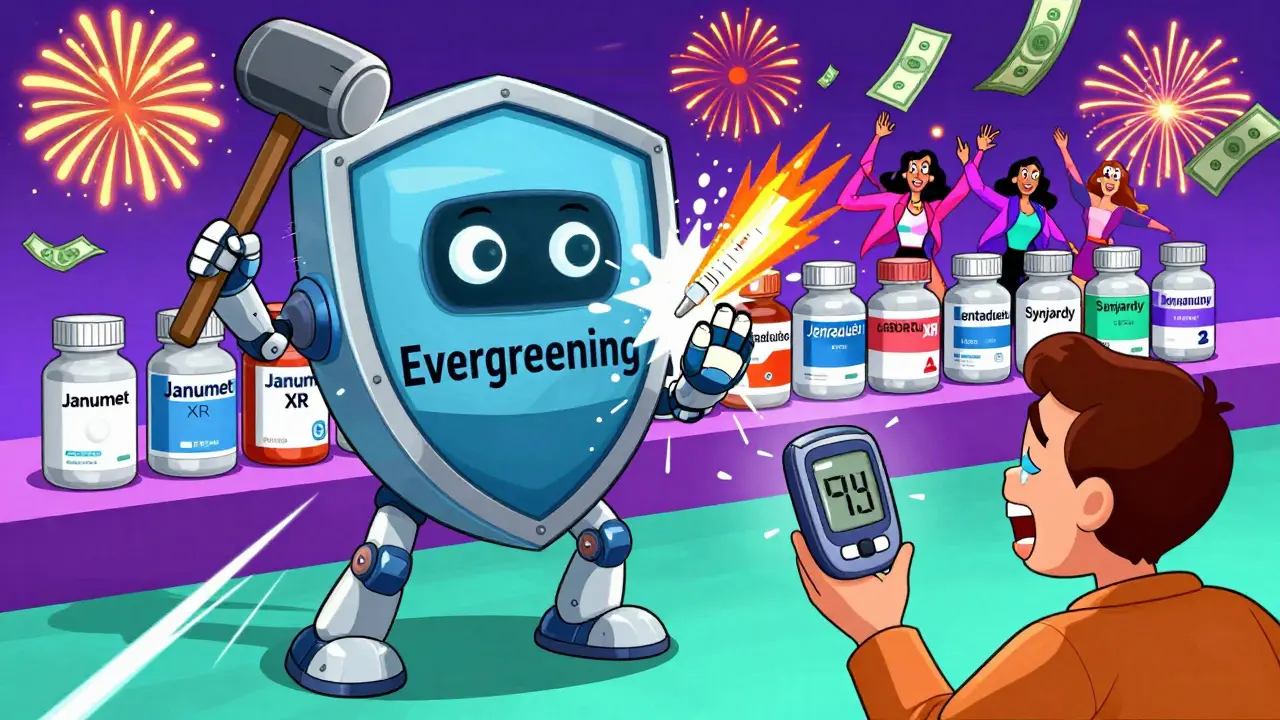
But it’s not all smooth sailing. Drugmakers are using “evergreening” tactics-slight reformulations, new delivery systems, or combo patents-to delay generics. And insurers may push the cheapest option, even if it’s not the best fit.
Bottom Line: Generics Are Great-But Not Always the Right Choice
Generic diabetes combination medications save money. They improve adherence. And for many people, they work just as well as the brand.
But they’re not a one-size-fits-all solution. If you’re on an older combo like Metaglip or Glucovance, switching is likely safe and smart. If you’re on a newer drug like Synjardy or Janumet XR, generics aren’t available yet-and when they are, you’ll still need to monitor closely.
Always talk to your doctor before switching. Don’t let a pharmacy change your meds without your consent. And never skip blood sugar checks during the transition. Your health isn’t a cost center. It’s your foundation.

Winni Victor
December 26, 2025 AT 01:16So let me get this straight - we’re supposed to be thrilled that some generics cost $15 when the brand was $500? Meanwhile, my cousin switched to generic Glucovance and ended up in the ER with a sugar crash so bad she thought she was dying. The pill looked the same. Tasted the same. Felt the same. But her body? It went full rebellion. No one warned her. No one even asked. Just ‘here’s your coupon.’ Thanks, capitalism.
Bailey Adkison
December 27, 2025 AT 05:58The FDA allows 80-125% bioequivalence. That’s not a feature. It’s a flaw. For drugs like glyburide where therapeutic window is narrow, this isn’t substitution - it’s Russian roulette. And calling it ‘generic’ implies equivalence. It’s misleading. The FDA should require tighter standards for antidiabetics. Period.
Katherine Blumhardt
December 27, 2025 AT 05:59i just switched to the generic janumet last month and now i have to take 3 pills instead of 1 because the generic isnt xr 😭 my stomach is screaming and my bank account is crying but at least i got a free lollipop from the pharmacist?? 🍭
Rick Kimberly
December 27, 2025 AT 10:14While the economic implications of generic substitution are significant, the clinical implications demand a more nuanced approach. Bioequivalence standards, as currently defined, may not adequately account for pharmacokinetic variability in chronic disease states. Furthermore, patient-reported outcomes - including adherence and quality of life - are often overlooked in formulary decisions. A one-size-fits-all policy risks compromising long-term glycemic stability in vulnerable populations.
Lindsay Hensel
December 27, 2025 AT 14:10Every pill tells a story. The size. The color. The way it sits in your throat. For some, it’s just chemistry. For others? It’s dignity. Don’t reduce a person’s health to a spreadsheet. If the brand keeps you alive and sane - fight for it.
Mussin Machhour
December 29, 2025 AT 13:59Yo I switched to generic Glucovance last year and my A1c dropped from 8.1 to 6.9. No side effects. Saved me $300 a month. My doctor said go for it. Why are people making this so complicated? If it works, it works. Don’t overthink it.
Carlos Narvaez
December 30, 2025 AT 08:00Only people who think ‘generic’ means ‘cheap’ don’t understand pharmacology. Real medicine isn’t Walmart-brand. If you want efficacy, pay for the brand. Your pancreas deserves better than filler-heavy knockoffs.
Harbans Singh
December 31, 2025 AT 13:31Back home in India, we use metformin + glibenclamide generics for years. No issues. But we don’t have fancy extended-release versions. Maybe the problem isn’t the generic - it’s that we over-engineer everything here. Simple works. Keep it basic.
Zabihullah Saleh
January 1, 2026 AT 22:01It’s funny how we treat medicine like a product. We want it cheap, fast, and uniform. But bodies aren’t assembly lines. You can’t swap out a soul and expect the same result. Maybe the real issue isn’t the pill - it’s that we’ve stopped listening to what our bodies say.
Oluwatosin Ayodele
January 1, 2026 AT 23:00You all are overcomplicating this. The data is clear: generics work 90% of the time. If you have a reaction, you’re either a hypochondriac or you’re not monitoring properly. The FDA doesn’t approve junk. Stop whining. Take your pill, check your glucose, and move on. This isn’t a personal drama - it’s public health.