 Feb, 3 2026
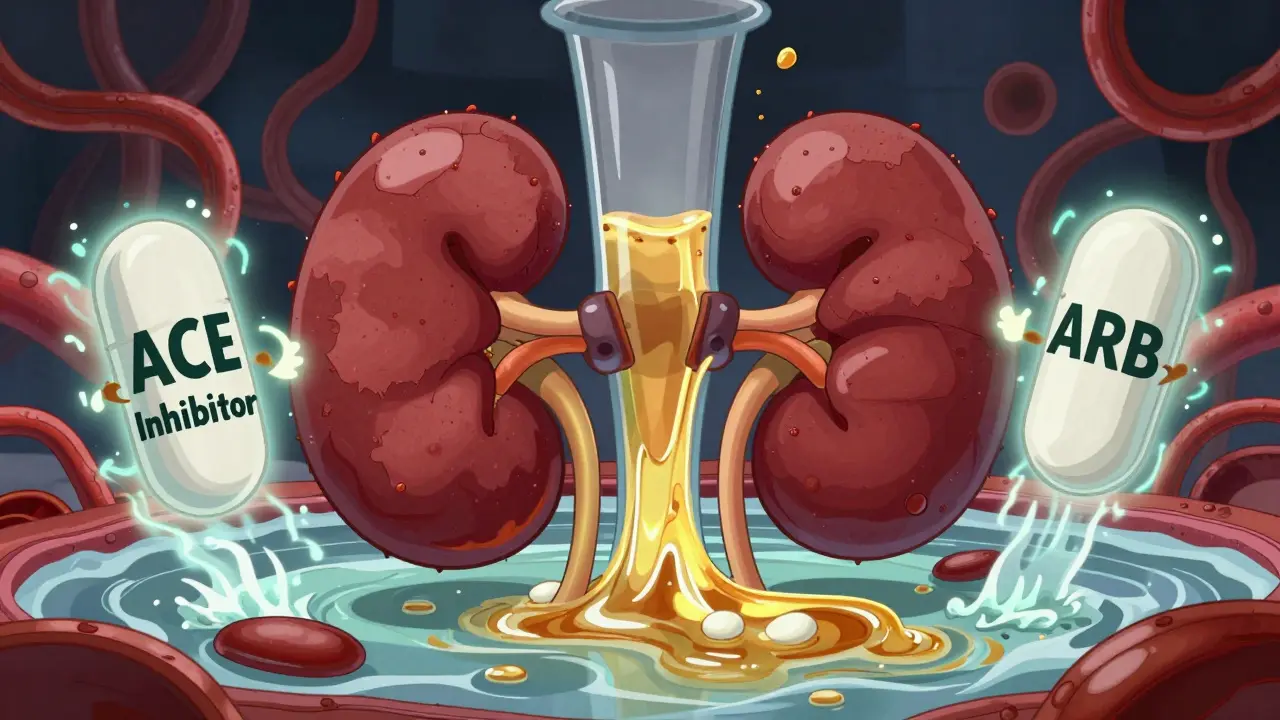
When diabetes damages the kidneys, it doesn’t happen overnight. It starts quietly-with tiny amounts of protein leaking into the urine. This is the first sign of diabetic nephropathy, the leading cause of kidney failure in people with diabetes. Left unchecked, it can lead to dialysis or transplant. But there’s a proven way to slow it down: ACE inhibitors and ARBs, used correctly, along with strict control of protein in the urine.
What Diabetic Nephropathy Really Means
Diabetic nephropathy isn’t just high blood pressure or high blood sugar. It’s a specific kidney injury caused by decades of uncontrolled diabetes. The tiny filters in the kidneys, called glomeruli, get damaged. They start letting protein-especially albumin-pass into the urine. This isn’t normal. Healthy kidneys hold onto protein. When they don’t, it’s a red flag.
Doctors diagnose it with two tests over three months: a urine albumin-to-creatinine ratio (UACR) and an estimated glomerular filtration rate (eGFR). If UACR is over 300 mg/g, that’s severely increased albuminuria. If eGFR drops below 60 mL/min/1.73 m², kidney function is already impaired. Both mean you’re at high risk for kidney failure.
And it’s not just about the kidneys. People with diabetic nephropathy have a much higher chance of heart attack, stroke, or dying from heart disease. The damage to the kidneys and blood vessels goes hand in hand.
Why ACE Inhibitors and ARBs Are First-Line
For over 20 years, ACE inhibitors and ARBs have been the go-to medications for diabetic nephropathy. Why? Because they do two things at once: lower blood pressure and directly protect the kidneys.
Both work by blocking the renin-angiotensin-aldosterone system (RAAS). This system normally tightens blood vessels and increases pressure. In diabetic kidneys, that pressure crushes the delicate filters. ACE inhibitors stop the body from making angiotensin II. ARBs block angiotensin II from binding to receptors. Either way, pressure inside the glomeruli drops. Less pressure means less protein leaks out.
Studies like RENAAL and IDNT showed that ARBs like losartan and irbesartan cut the risk of ending up on dialysis by up to 30% in people with severe proteinuria. ACE inhibitors like captopril, enalapril, and ramipril showed similar results. These aren’t small effects. These are life-changing.
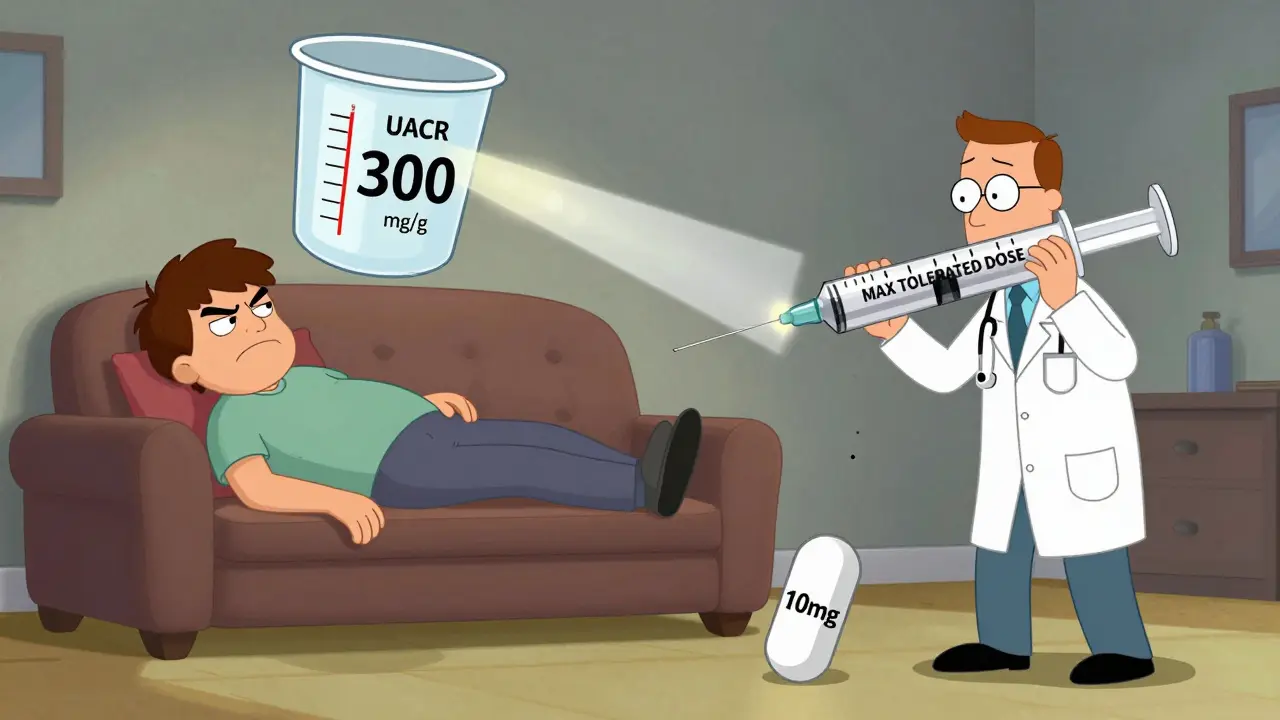
But here’s the catch: they only work if taken at the maximum tolerated dose. Many doctors start low-10 mg of benazepril, or 25 mg of captopril once a day. That’s not enough. The trials that proved these drugs work used doses like 150 mg of losartan daily or 50 mg of captopril three times a day. If you’re not hitting those levels, you’re not getting the full protection.
The Protein Control Connection
Reducing protein in the urine isn’t just a lab result. It’s the key to slowing kidney damage. Every time protein leaks out, it triggers inflammation and scarring in the kidney tissue. The more protein, the faster the damage piles up.
ACE inhibitors and ARBs reduce proteinuria by 30-50% in most patients. That’s not a coincidence. It’s the mechanism. Studies show that the greater the drop in urine protein, the slower the decline in eGFR. Patients who get their UACR below 100 mg/g have a much lower risk of kidney failure than those who stay above 300 mg/g.
That’s why doctors track UACR not just at diagnosis, but every 3-6 months. If protein doesn’t drop after 3 months on a full dose, it’s time to check adherence, rule out other causes, or consider adding another medication.
Dosing: What Actually Works
Not all ACE inhibitors and ARBs are the same. Here’s what the guidelines say about dosing:
- Captopril: 25 mg three times daily (FDA-approved specifically for diabetic nephropathy)
- Enalapril: 10-40 mg daily
- Ramipril: 5-10 mg daily (up to 20 mg if tolerated)
- Benazepril: 20-40 mg daily
- Losartan: 50-150 mg daily
- Irbesartan: 150-300 mg daily
Start low if the patient is on diuretics or has low blood pressure. But don’t stay low. Titrate up every 2-4 weeks until you hit the maximum tolerated dose-or until side effects like dizziness, cough, or high potassium stop you.
And here’s something many doctors miss: a rise in serum creatinine by up to 30% in the first two months is normal. It doesn’t mean the drug is hurting the kidneys. It means the pressure inside the glomeruli is dropping-exactly what you want. Stopping the medication because creatinine went up is one of the biggest mistakes in diabetes care.
What Not to Do: The Dangerous Combinations
Combining ACE inhibitors and ARBs sounds logical. Two drugs blocking the same system should be better, right? Wrong. Trials like VA NEPHRON-D, ONTARGET, and ALTITUDE proved this idea wrong. When patients took both, they didn’t get extra kidney protection. Instead, they had twice the risk of acute kidney injury and three times the risk of dangerously high potassium levels.
Same goes for adding direct renin inhibitors like aliskiren. No benefit. More harm.
And don’t forget NSAIDs-ibuprofen, naproxen, celecoxib. These drugs cut blood flow to the kidneys. When paired with an ACE inhibitor or ARB, they can cause sudden kidney failure, especially in older adults or those with low blood volume. Even occasional use can be risky.
Diuretics like furosemide (Lasix) are sometimes needed for swelling or high blood pressure. But they must be used carefully. Too much, too fast, and you risk dehydration. That’s when creatinine spikes and kidney function crashes.

When ACE Inhibitors or ARBs Aren’t Enough
Newer drugs like SGLT2 inhibitors (empagliflozin, dapagliflozin) and nonsteroidal MRAs (finerenone) are changing the game. They reduce kidney failure and heart death on top of ACE inhibitors and ARBs.
But here’s the key: every major trial that showed benefit from SGLT2 inhibitors or finerenone did so in patients already on a maximally tolerated ACE inhibitor or ARB. These aren’t replacements. They’re add-ons.
If someone can’t tolerate an ACE inhibitor because of a cough, switch to an ARB. If they can’t take either due to high potassium or low blood pressure, then SGLT2 inhibitors become the next best option. But don’t skip the RAAS blocker unless you have to.
Why So Many Patients Are Still Underserved
Despite decades of evidence, only 60-70% of people with diabetic nephropathy get these drugs. Why?
- Doctors fear rising creatinine and stop the medication
- Patients don’t take them because they feel fine
- Cost or access issues in some regions
- Assumption that blood sugar control alone is enough
But proteinuria doesn’t care how well your A1C is. It cares about pressure in the glomeruli. And that pressure is lowered by ACE inhibitors and ARBs-not by insulin or metformin.
Every person with diabetes, hypertension, and albuminuria should be on one of these drugs. Not just for blood pressure. For kidney survival.
What the Guidelines Say Now (2025)
The American Diabetes Association, Kidney Disease: Improving Global Outcomes (KDIGO), and the American Academy of Family Physicians all agree:
- Start ACE inhibitors or ARBs in anyone with diabetes, hypertension, and UACR ≥300 mg/g or eGFR <60
- Use the highest tolerated dose-not the lowest
- Don’t stop the drug for creatinine increases under 30%
- Use diuretics, calcium channel blockers, or beta blockers as add-ons, not replacements
- Do NOT combine ACE inhibitors with ARBs
The goal isn’t just to slow kidney decline. It’s to prevent dialysis. To keep people alive longer. To reduce heart attacks. And that’s only possible if these drugs are used the way they were tested-in full doses, consistently, and without fear.

Alex LaVey
February 5, 2026 AT 02:00Just wanted to say this post hit home. My dad’s been on losartan for 12 years now since his UACR spiked. He’s 72, still hikes every weekend, and his kidneys? Stable. No dialysis. No transplant. Just consistent meds, low-sodium meals, and zero NSAIDs. It’s not glamorous, but it works. People need to hear this more.
Jhoantan Moreira
February 6, 2026 AT 15:41Love this breakdown 😊 Seriously, if you have diabetes + protein in urine, don’t wait. I’ve seen friends ignore it ‘cause they ‘feel fine’… then boom, eGFR drops in 6 months. ACE/ARBs aren’t magic, but they’re the closest thing we got. Also-yes, creatinine rise is normal. Don’t panic. Talk to your nephrologist.
Joseph Cooksey
February 7, 2026 AT 12:25Let’s be real-this is one of those rare medical topics where the evidence is so overwhelmingly consistent it borders on boring. ACE inhibitors and ARBs? Proven since the 90s. Max doses? Not optional. The fact that 30-40% of patients are still on subtherapeutic doses speaks to a systemic failure in primary care. We’re not talking about experimental stuff here. We’re talking about the equivalent of prescribing aspirin for a heart attack and calling it a day. And don’t get me started on the ‘I feel fine’ crowd. You don’t feel kidney damage until it’s too late. The glomeruli don’t care about your mood. They care about pressure. And if you’re not hitting 150mg of losartan or 50mg of captopril three times a day, you’re just delaying the inevitable. Also-NSAIDs? No. Just… no. Not even ‘occasional.’ Not if you’re on RAAS blockers. That’s not a risk. That’s a suicide pact with your nephrons.
Sherman Lee
February 8, 2026 AT 05:23Wait… so you’re telling me the pharmaceutical industry didn’t invent this? 😏 Like… who *really* benefits from people being on lifelong meds? I’m not saying they’re useless-but why did it take 20 years to get this widely adopted? And why are SGLT2 inhibitors suddenly the ‘new miracle’ when the old ones work better? Coincidence? Or is this just how the system works? Also-why do they never mention the cost? Losartan’s cheap. But if you’re on a high dose? Insurance won’t cover it unless you jump through 17 hoops. And don’t even get me started on the ‘high potassium’ excuse. They just don’t want to monitor you. It’s easier to say ‘you’re not a candidate’ than to do the work.
Lorena Druetta
February 9, 2026 AT 14:02Thank you for this incredibly clear and thoughtful explanation. As a nurse who works in diabetes education, I see too many patients stop their medications because they’re told to ‘take it for life’ and panic. This post gives them real, actionable hope. Please keep sharing this kind of science. It matters.
Coy Huffman
February 10, 2026 AT 11:25man i wish my doc woulda told me this 5 years ago. i was on 10mg benazepril for like 3 years thinking it was enough. turns out my uacr was at 450. i switched to 40mg and now it’s under 120. my creatinine spiked at first but i didn’t panic. now i feel like a new person. also… no more ibuprofen. ever. even for headaches. learned that the hard way.
Kunal Kaushik
February 10, 2026 AT 12:58Bro this is gold. I’m from India and we don’t have great access to nephrologists here. But my cousin has type 2 and he’s on irbesartan 300mg now. His UACR dropped from 600 to 180 in 6 months. He still eats rice like crazy though 😅 But hey, meds + some effort = better than nothing. Thanks for the clarity!
Nathan King
February 11, 2026 AT 13:46The clinical data presented here is both robust and commendable. However, one must not overlook the socioeconomic heterogeneity in patient populations. Adherence to maximally tolerated dosing regimens is contingent upon healthcare infrastructure, pharmaceutical accessibility, and patient literacy-all variables that are frequently under-addressed in guideline-driven literature. One may question the generalizability of RENAAL and IDNT findings to populations without consistent access to laboratory monitoring. While the pharmacologic mechanism is sound, the implementation model remains elitist in practice.
Geri Rogers
February 12, 2026 AT 10:37THIS. This. This. I’ve been saying this for years. My mom has diabetes and we got her on losartan 150mg after her UACR hit 500. She’s 68. She’s alive. She’s walking. She’s not on dialysis. And guess what? She didn’t even know what albumin was. We just told her: ‘This pill protects your kidneys. Take it.’ No jargon. No confusion. Just consistency. If you have diabetes and protein in urine-take the pill. Don’t wait for symptoms. They won’t come until it’s too late. 💪❤️
Janice Williams
February 13, 2026 AT 20:09Oh please. Let’s not pretend this is science. The ‘guidelines’ are written by pharmaceutical consultants with ties to AstraZeneca, Merck, and Novo Nordisk. SGLT2 inhibitors cost $900/month. ARBs cost $10. Why are we pushing ‘add-ons’ when the original drugs work? And why is every study funded by the same companies? The creatinine rise is ‘normal’? Tell that to the 12% of patients who actually develop acute kidney injury on dual RAAS blockade. This isn’t medicine. It’s marketing dressed in white coats.
Rachel Kipps
February 14, 2026 AT 19:08thank you for this info. i had no idea about the creatinine thing. my doctor stopped my ramipril because it went up 25% and i was so confused. now i’m restarting it. also… no more tylenol? i thought that was safe. guess not. i’ll call my doc tomorrow.
Wendy Lamb
February 15, 2026 AT 01:32Take the pill. Don’t wait. Protein in urine = silent killer. Done.
Antwonette Robinson
February 16, 2026 AT 00:47Wow. So let me get this straight. You’re saying the entire medical establishment got it right for once? No pharmaceutical conspiracy? No hidden agenda? No ‘don’t ask questions, just comply’ vibe? I’m… almost impressed. Almost.