 Jan, 16 2026
Dose Titration Calculator
Calculate Your Titration Schedule
Find the safest, most effective way to adjust your medication dose based on FDA guidelines.
Your Titration Schedule
Estimated Progress
Tip: This schedule follows FDA-approved guidelines. Always consult your doctor before making any dose changes.
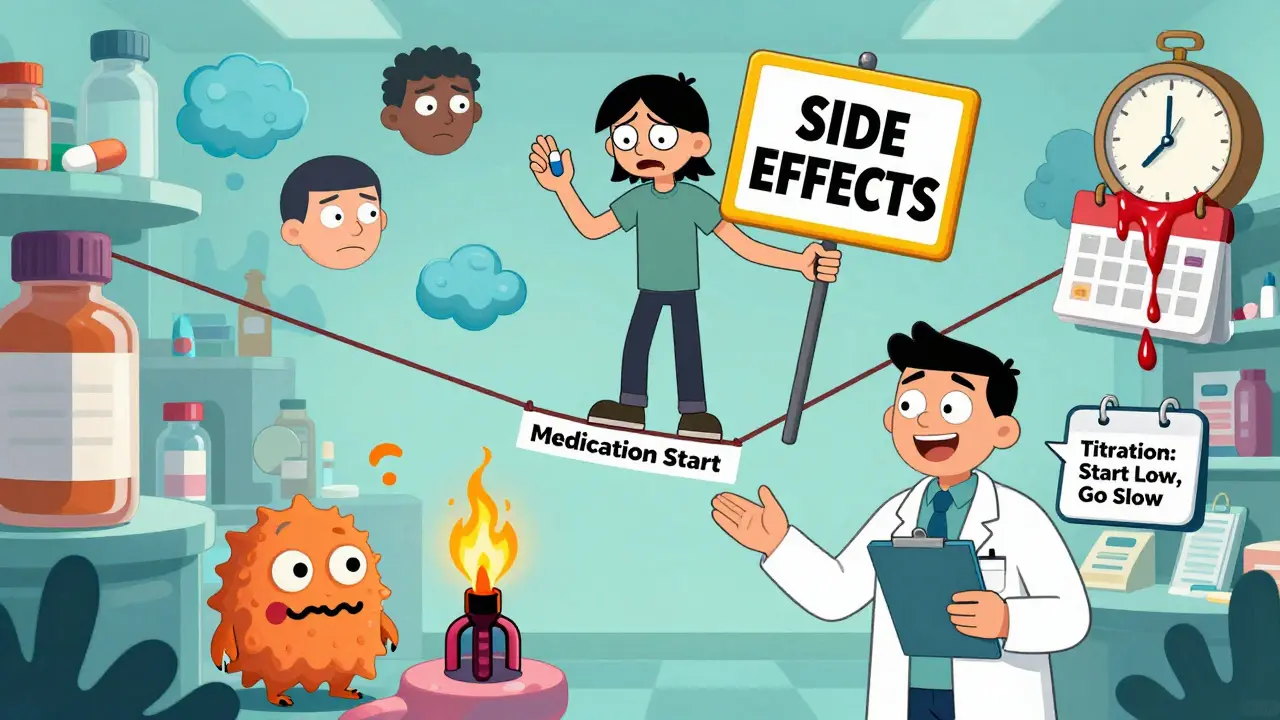
Starting a new medication can feel like walking a tightrope. You want it to work-really work-but you’re terrified of the side effects. Headaches. Nausea. Insomnia. Dizziness. Sometimes, the side effects are so bad you quit before the medicine even has a chance to help. What if there was a better way? There is. It’s called dose titration.
What Is Dose Titration, Really?
Dose titration isn’t just a fancy medical term. It’s a simple, proven method: start low, go slow. Instead of jumping straight to the full prescribed dose, your doctor slowly increases (or decreases) the amount over days or weeks. The goal? Find the smallest dose that controls your symptoms without wrecking your day.
This approach isn’t new. It’s been used since the 1970s, when doctors realized some drugs-like antidepressants, seizure meds, and blood thinners-have a razor-thin line between helping and harming. Too little? No effect. Too much? Dangerous side effects. Titration finds that sweet spot.
Today, 87% of prescription drugs with serious side effects include official titration guidelines from the FDA. That’s not a suggestion. It’s a requirement.
Why Does Starting Low Work So Well?
Your body isn’t a machine that flips a switch when you hit the right dose. It adapts. When you start with a low dose, your system gets time to adjust. Think of it like turning up the volume on a speaker. If you blast it to 100 right away, your ears ring. But if you turn it up one notch at a time, you barely notice the change.
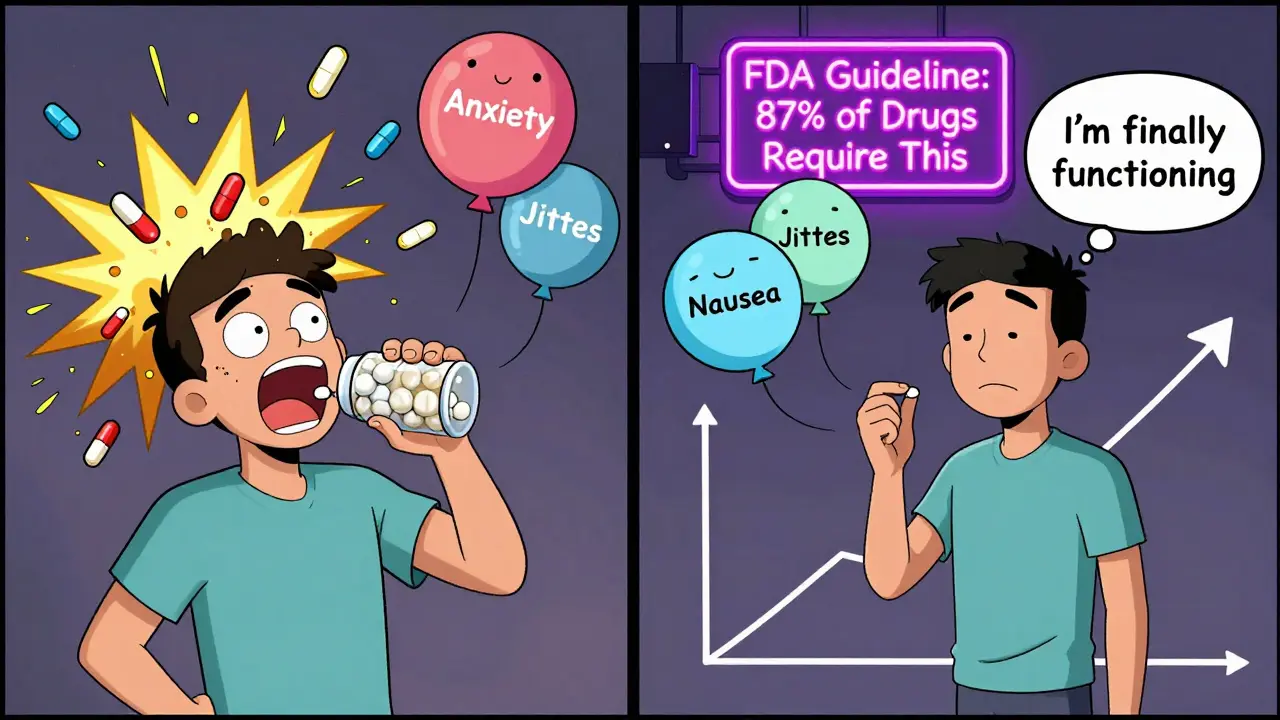
A 2021 meta-analysis found that proper titration reduces initial side effects by 40-60%. That’s huge. For example, people taking ADHD meds like Adderall or Vyvanse who start at 5mg instead of 10mg report far less anxiety, appetite loss, and jitteriness. One Reddit user wrote: “Starting at 5mg saved me from horrible anxiety. I stayed on it. I’m functioning now.”
It’s not just ADHD. For antidepressants like sertraline, starting at 25mg instead of 50mg cuts nausea and dizziness in half during the first two weeks. For epilepsy drugs like lamotrigine, slow titration reduces the risk of life-threatening skin reactions like Stevens-Johnson syndrome by over 80%.
How Titration Works for Different Medications
Not all drugs are titrated the same way. Timing and increments depend on how fast the drug works and how risky the side effects are.
- Stimulants (ADHD meds): Start at 25-50% of the target dose. Increase by 10-25% every 3-7 days. Full titration takes 4-6 weeks.
- Non-stimulants (e.g., atomoxetine): Slower. Increase every 1-2 weeks. Takes 8-12 weeks to reach full dose.
- Lamotrigine (epilepsy): Starts at 25mg daily, increases by 25mg every 1-2 weeks. Takes 5+ weeks to reach target.
- Venetoclax (leukemia): Follows a strict 5-week ramp-up: 20mg → 50mg → 100mg → 200mg → 400mg. Skipping steps can cause tumor lysis syndrome.
- Warfarin (blood thinner): Requires weekly blood tests (INR) to adjust. 67% of patients need changes in the first month.
- Levothyroxine (thyroid): Start at 25-50mcg, increase by 25mcg every 4-6 weeks. Blood tests guide each step.
Some drugs, like apixaban (a newer blood thinner), have wider safety margins. They don’t need tight titration. But for the ones that do-like most psychiatric, neurological, and cancer meds-getting the schedule right is life-changing.
What Happens If You Skip Titration?
Skipping titration isn’t just risky-it’s common. A 2021 study found 32% of patients don’t follow their titration plan. Why? Doctors rush. Patients get impatient. Or they think, “If a little helps, a lot must help more.”
The results? A patient starts on 20mg of sertraline instead of 25mg. They feel dizzy. They quit. Two years later, they’re still depressed. Another person takes full-dose lamotrigine and ends up in the ER with a skin rash. These aren’t rare cases. They’re preventable.
ADDitude Magazine’s 2022 survey of 1,200 ADHD patients showed a stark contrast: 74% who followed titration had manageable side effects. Only 41% of those who didn’t could tolerate the medication.
How to Make Titration Work for You
Titration isn’t passive. You have to be involved.
- Track everything. Use a simple journal. Note your dose, time taken, symptoms (good and bad), sleep, appetite, mood. Rate severity on a 1-10 scale. One patient said, “My journal showed my headaches only happened after 10mg. My doctor cut the dose. Problem solved.”
- Wait it out. Don’t panic after one bad day. Side effects often fade in 3-7 days. Give each new dose at least a week before deciding it’s too much.
- Take meds consistently. Take your pill at the same time every day, within a 30-60 minute window. Irregular timing messes with your body’s adjustment.
- Communicate. Don’t wait for your appointment. Call your doctor if you feel worse. Text updates. Use apps. Your doctor needs real-time data.
- Ask for help. If your doctor doesn’t offer a titration plan, ask for one. Say: “I’ve heard starting low helps with side effects. Can we follow a schedule?”
Some meds come with detailed guides-Vyvanse’s manufacturer provides a 12-page titration chart. Others? Not so much. Don’t assume you know the rules. Ask.
Technology Is Making Titration Smarter
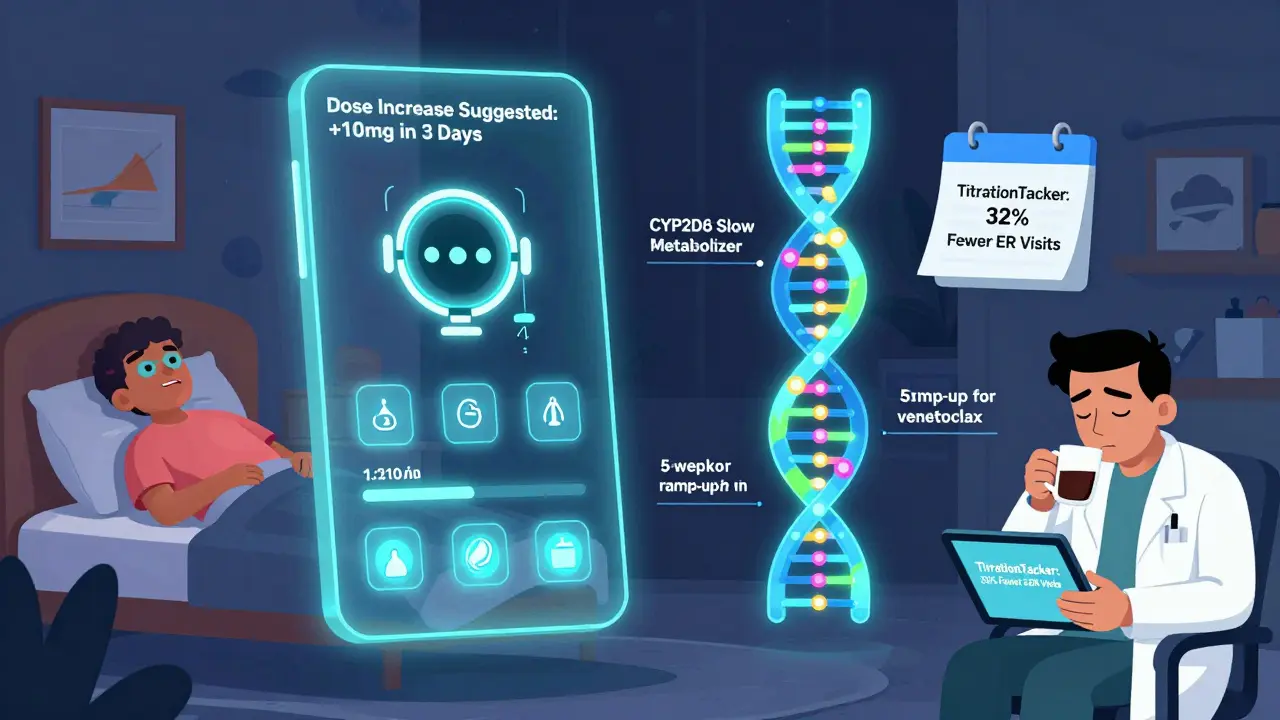
The FDA cleared the first AI-powered titration app, TitrationTracker, in January 2023. It asks you daily questions about your symptoms and uses patterns to suggest dose changes. In a 1,200-patient trial, it cut side effects by 32% compared to standard care.
Soon, genetic testing will take this further. Right now, 28 medications-like certain antidepressants and blood thinners-have known genetic markers that predict how you’ll respond. Testing before you start can tell your doctor whether you need half the usual dose, or maybe even double it. By 2030, the American College of Clinical Pharmacology predicts this will be standard for 75% of high-risk drugs.
When Titration Isn’t the Answer
Titration isn’t magic. It won’t help in emergencies. If you’re having a heart attack, a seizure, or anaphylaxis-you need the full dose now. No waiting.
It also doesn’t work well if you can’t commit. Weekly doctor visits? Daily journaling? That’s a lot if you’re juggling work, kids, or transportation issues. In low-income countries, only 22% have access to structured titration. That’s a gap the system still hasn’t fixed.
And sometimes, being too cautious backfires. Dr. Alan Schatzberg warns that overly slow titration can delay relief in severe depression. If you’re suicidal or can’t get out of bed, waiting 8 weeks for a full dose isn’t an option. In those cases, faster protocols exist-but they’re still guided, not rushed.
The Bottom Line
Dose titration isn’t about being slow. It’s about being smart. It’s the difference between quitting a medicine because you felt awful, and sticking with it because you finally found your balance.
For chronic conditions-ADHD, depression, epilepsy, heart failure, cancer-it’s the gold standard. It’s backed by decades of science, real patient stories, and now, AI tools. It’s not perfect. But skipping it? That’s the real risk.
If you’re starting a new medication with known side effects, ask your doctor: “What’s the titration plan?” If they don’t have one, ask why. You deserve a treatment that works without making you feel worse.
How long does dose titration usually take?
It depends on the drug. Stimulants like Adderall usually take 4-6 weeks. Non-stimulants like atomoxetine can take 8-12 weeks. Blood thinners like warfarin need weekly adjustments for the first month. Cancer drugs like venetoclax follow strict 5-week schedules. The goal isn’t speed-it’s safety.
Can I adjust my dose myself if I feel side effects?
No. Never change your dose without talking to your doctor. Side effects can be signs of something serious, or they might fade on their own. Self-adjusting can lead to overdose, withdrawal, or dangerous interactions. Always use your symptom journal to report changes, then let your provider decide.
What if my doctor won’t titrate my medication?
Ask why. If they say, “It’s not necessary,” request the FDA-approved prescribing guidelines for your drug. Most have titration instructions. If they still refuse, consider getting a second opinion. You have the right to a safe, personalized treatment plan.
Do all medications need titration?
No. Only those with a narrow therapeutic index-where the difference between a helpful dose and a harmful one is small. That includes most psychiatric, neurological, cancer, and heart medications. Antibiotics, pain relievers, and allergy meds usually don’t need it.
Is titration covered by insurance?
Yes. Most insurance plans cover the office visits and lab tests required for titration, especially for FDA-approved protocols. If you’re being charged for routine check-ins during titration, ask if they’re considered preventive care. Many are.
Can I use an app to help with titration?
Yes. Apps like TitrationTracker (FDA-cleared in 2023) help track symptoms and suggest dose changes based on your input. They’re not a replacement for your doctor, but they make communication easier and reduce side effects by up to 32%. Ask your provider if they recommend one.

waneta rozwan
January 17, 2026 AT 06:37Okay, but let’s be real-how many doctors actually follow this? I’ve been on three different SSRIs, and every single time, they handed me a 50mg pill and said, ‘Take one daily.’ No titration. No chat. Just ‘good luck.’ I ended up in the ER because I thought I was having a heart attack-it was just serotonin syndrome from going full throttle on day one. 🤯
Nicholas Gabriel
January 18, 2026 AT 14:44Yes! Yes! YES!!! This is the most important thing no one talks about!!! Start low, go slow-it’s not just medical advice, it’s survival strategy!!! Your body isn’t a car you can just floor the gas pedal on!!! You need to warm it up!!! Let it breathe!!! I went from suicidal to stable in six weeks because I followed the 25mg sertraline ramp-up-my doctor almost didn’t believe me when I said I didn’t have nausea, jitteriness, or brain zaps!!!
Cheryl Griffith
January 19, 2026 AT 23:56I started lamotrigine at 25mg and honestly, it changed my life. I had no rash, no dizziness, no panic attacks. My neurologist said most people skip the ramp-up because they think it’s ‘too slow,’ but I’m glad I didn’t. I’ve been on it for three years now and I’ve never felt more stable. It’s not about speed-it’s about staying alive and feeling like yourself.
Kasey Summerer
January 21, 2026 AT 17:35Oh wow, so now we’re using AI to babysit our pill schedules? 🤖💊 Next thing you know, my Fitbit will be calling my psychiatrist saying, ‘Hey, she took her 10mg at 3am, she’s clearly having a breakdown.’
Meanwhile, my doctor still thinks ‘titration’ is a type of yoga. 😅
Samyak Shertok
January 22, 2026 AT 14:06You speak of titration like it’s divine revelation-but have you ever considered that capitalism invented this? Doctors don’t ‘care’ about side effects-they care about compliance. If you quit your med because you puked for a week, they lose revenue. So they ‘recommend’ titration to keep you on the drug longer. It’s not medicine-it’s monetized patience.
And don’t get me started on ‘FDA guidelines.’ The same FDA that approved OxyContin’s 12-hour dosing as ‘safe.’
Titration is a band-aid on a bullet wound.
Stephen Tulloch
January 24, 2026 AT 05:48Lmao I took Vyvanse at 70mg on day one because I ‘needed to crush it’ for a project. Ended up in the psych ward for 3 days. My heart was doing the cha-cha. Now I start at 10mg like a normal human. Also, AI apps? Bro, I use Google Sheets. I track my mood, sleep, and whether I cried during a commercial. It’s called being human, not outsourcing your brain to an algorithm 🤖
Joie Cregin
January 25, 2026 AT 02:58My sister started sertraline at 25mg and said it felt like someone turned down the volume on her anxiety. She didn’t even know she was screaming until it got quiet. Titration isn’t slow-it’s sacred. It’s the difference between surviving and thriving. And honestly? The journaling part? Game changer. I started writing one sentence a day: ‘Today, I didn’t want to die.’ That’s all. But it kept me anchored.
Nick Cole
January 26, 2026 AT 10:34My psychiatrist refused to titrate my venetoclax because ‘it’s not standard.’ I had to print the FDA guidelines and walk into his office with them. He apologized. Don’t let anyone tell you titration is optional for high-risk meds. It’s not a suggestion-it’s a safety protocol. Fight for it.
Riya Katyal
January 27, 2026 AT 11:34Wait-so you’re telling me my doctor didn’t give me a plan because he’s lazy? Or worse… he doesn’t care? I thought doctors were supposed to be healers. Now I’m wondering if they’re just pill pushers with stethoscopes. 🤔
Henry Ip
January 29, 2026 AT 04:37Love this. I’m a nurse and I’ve seen too many patients quit meds because they got hit with side effects on day one. Titration isn’t weakness-it’s strategy. I tell my patients: ‘Your body isn’t broken, it’s just surprised.’ Give it time. Track it. Talk about it. You’ve got this.
swarnima singh
January 30, 2026 AT 10:09i dont think any of this matters. the pharma companies made all these rules so we keep buying meds. they dont want us to heal. they want us to be dependent. i tried titration and still felt numb. maybe the problem isnt the dose… maybe its the whole system.
Isabella Reid
February 1, 2026 AT 07:45I’m from India and we don’t have access to this level of care. My cousin got prescribed 100mg of sertraline because the clinic was out of 25mg pills. She ended up in the hospital. No one apologized. No one followed up. Titration isn’t just medical-it’s a privilege. We need global standards, not just FDA guidelines.
Jody Fahrenkrug
February 2, 2026 AT 01:47I started at 10mg of Adderall and still felt like a zombie. Took me 3 weeks to get to 20mg. But now? I’m productive. I sleep. I don’t hate myself. I didn’t know it could be this easy. Just… slow down. Seriously.
kanchan tiwari
February 2, 2026 AT 18:08AI titration apps? LOL. They’re tracking your every move. Next thing you know, your insurance company will see you had a ‘bad mood day’ and raise your rates. Or worse-your employer finds out you’re on antidepressants. This isn’t progress. It’s surveillance with a side of pills.