 Dec, 7 2025
Macrolide QT Risk Assessment Tool
Based on current clinical guidelines, this tool helps determine whether you should have an ECG before starting macrolide antibiotics (azithromycin, clarithromycin). It calculates your risk score based on key factors mentioned in medical research.
Your risk score will appear here after calculation
What this means:
Based on current medical guidelines, patients with high risk should have an ECG before starting macrolide therapy. This tool helps identify who may need screening.
When you’re prescribed an antibiotic like azithromycin or clarithromycin for a stubborn chest infection, you probably don’t think about your heart. But here’s the thing: these common drugs can mess with your heart’s electrical rhythm - and in rare but deadly cases, trigger a dangerous arrhythmia called Torsades de Pointes. The good news? You don’t need an ECG every time you get a prescription. The bad news? Many people who are at real risk never get screened at all.
Who’s Actually at Risk?
Not everyone taking macrolides needs an ECG. But some people are walking into a hidden danger zone. The biggest red flags? Being over 65, being female, having kidney problems, or already taking other drugs that stretch out your heart’s QT interval - like certain antidepressants, antifungals, or even some stomach meds. If you’re on two or more of these, your risk jumps dramatically. A 2025 study in Biomedicines found that for every 10 milliseconds your QTc goes above 500 ms, your chance of a life-threatening rhythm problem goes up by 5-7%.Even more telling: a 2012 New England Journal of Medicine study showed azithromycin users had a 2.7 times higher risk of cardiovascular death than those taking amoxicillin. That’s not a small number. But here’s the catch - most of those deaths happened in people with existing risk factors. Healthy 30-year-olds with no other meds? Their risk is tiny. So why screen everyone?
The ECG Guidelines Don’t Match Reality
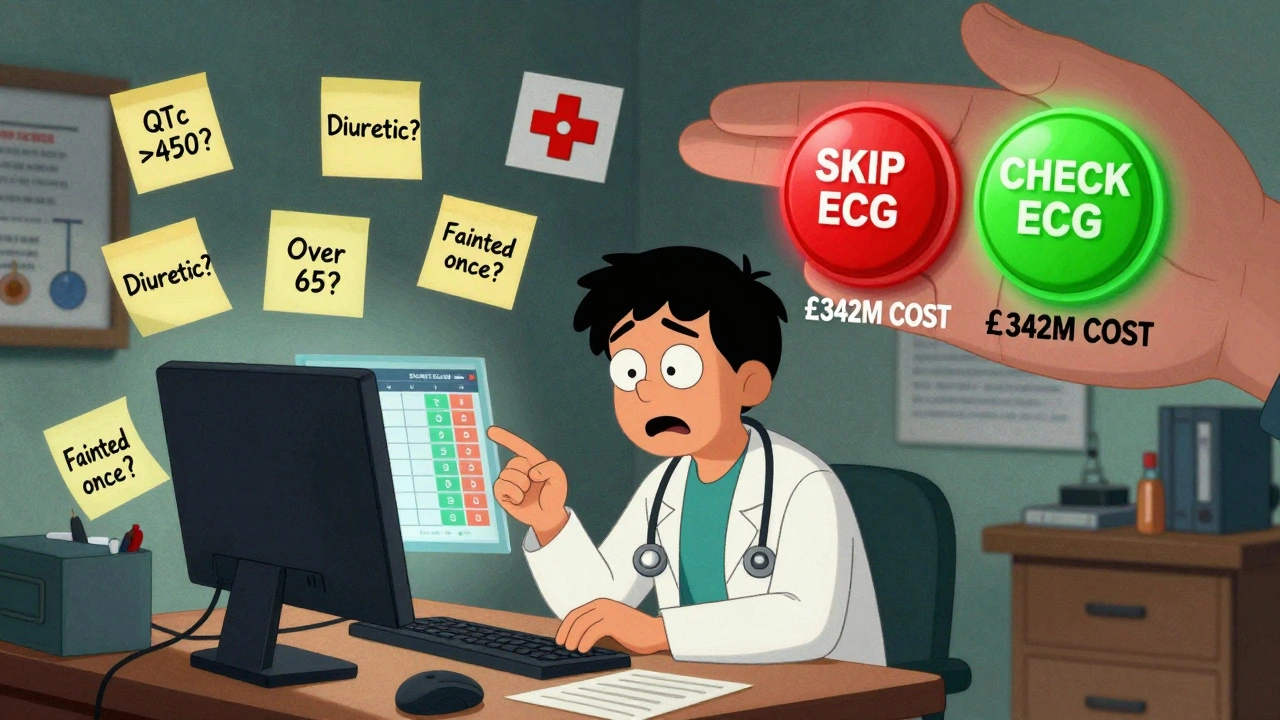
The British Thoracic Society says: screen everyone before starting long-term macrolide therapy - think months of treatment for bronchiectasis or cystic fibrosis. Their cutoff? QTc over 450 ms for men, 470 ms for women. That’s strict. And it works - clinics following it saw a 34% drop in adverse events.But in primary care? Almost no one does it. A 2024 survey of 247 family doctors found only 22% routinely ordered baseline ECGs. Why? Time. Cost. Confusion. Most GPs aren’t treating chronic lung disease - they’re handing out azithromycin for a sinus infection. The NHS estimates that screening all 12 million annual macrolide prescriptions in the UK would cost £342 million. That’s not feasible. And it’s not necessary.
The real problem? Guidelines are split. The FDA and EMA say monitor high-risk patients. The BTS says screen everyone. The American Heart Association now leans toward a 9-point risk score: age, sex, kidney function, meds, heart history. That’s smarter. It’s not about blanket rules - it’s about smart targeting.
What Happens If You Skip the ECG?
In most cases? Nothing. You take the pills, feel better, move on.But in a small number of cases - often older women with multiple risk factors - it’s catastrophic. There’s a documented case from Reddit’s r/medicalschool where a 68-year-old woman with a baseline QTc of 480 ms (borderline, but dangerous) started clarithromycin for pneumonia. Five days later, she went into Torsades de Pointes. Emergency cardioversion saved her life. She had no known heart disease. No prior symptoms. Just a silent QT prolongation waiting to explode.
That’s not a rare outlier. A 2024 UK study found that 1.2% of patients screened before long-term macrolide therapy had previously undiagnosed Long QT Syndrome. That’s one in every 80 people. Imagine missing that. That’s why specialists insist on screening - it catches hidden conditions.
When You Should Definitely Get an ECG
Here’s your simple checklist. If you answer yes to any of these, ask your doctor for an ECG before starting a macrolide:- You’re over 65
- You’re female
- You’re taking more than one drug that can prolong QT (check your med list)
- You have kidney disease or electrolyte imbalances (low potassium or magnesium)
- You’ve had fainting spells, unexplained seizures, or a family history of sudden cardiac death
- You’re on long-term macrolide therapy (three weeks or more)
If you’re under 50, healthy, on no other meds, and getting a 5-day course for a sore throat? You’re fine. No ECG needed. The risk is negligible.
What About Short-Term Use?
For a 3-5 day course of azithromycin for bronchitis or a sinus infection? Routine ECG screening isn’t recommended - even by the most cautious experts. The absolute risk of Torsades in this group is less than 1 in 100,000. The cost and hassle of screening outweigh the benefit.But here’s the twist: if you’re on a short course and you have two or more risk factors? That’s when you should speak up. A 70-year-old woman with diabetes, on a diuretic, and now prescribed azithromycin? She’s in the gray zone. Her doctor should consider an ECG - not because of the drug alone, but because of the combination.
What Happens If the ECG Shows a Long QT?
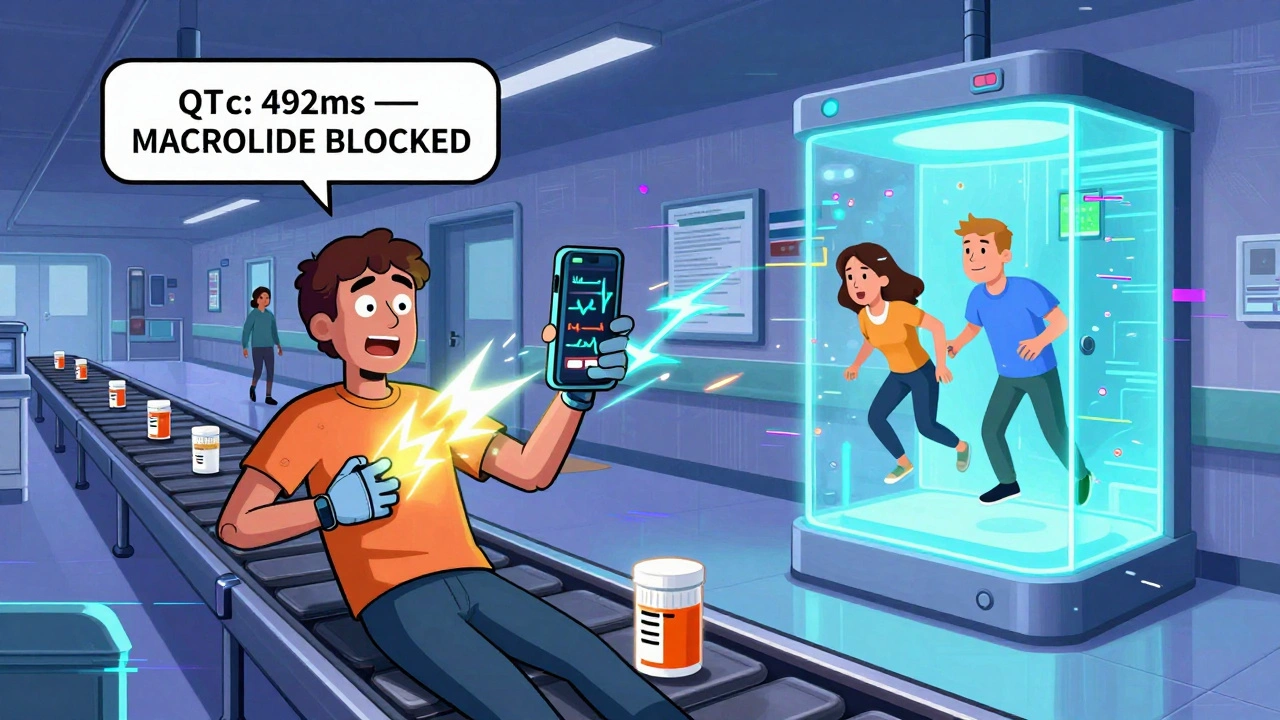
If your QTc is above 450 ms (men) or 470 ms (women), your doctor should pause the macrolide. Not because you’re doomed - but because there are safer options. Amoxicillin, doxycycline, or cephalexin usually work just as well for common infections.If your QTc is above 500 ms? Macrolides are off the table. Period. Even if you’re desperate. There’s no safe dose. The risk is too high.
And if you’re already on the drug and your QTc starts to creep up? Stop it. Right away. The REMAP-CAP ICU guidelines are clear: if new QT prolongation develops, discontinue the drug. It’s not a suggestion - it’s a lifesaving protocol.
The Future: Smarter, Faster, Safer
The good news? Things are changing. Hospitals are starting to integrate automated alerts into electronic health records. Epic Systems now flags macrolide prescriptions for patients with high QT risk in 43% of US hospitals. That’s a game-changer.In the UK, pilot programs are testing handheld ECG devices that give results in 90 seconds - cutting the wait for screening from five days to less than one. That’s huge for patients on long-term therapy.
The NIH’s 2025 algorithm is pushing for personalized risk scoring - not blanket rules. It’s not about fearing macrolides. It’s about knowing who’s vulnerable and protecting them without overburdening the system.
Bottom Line: Don’t Panic, But Don’t Ignore the Signs
Macrolides are safe for most people. But they’re not risk-free. The key is context. If you’re young, healthy, and getting a short course - you’re fine. If you’re older, on multiple meds, or have kidney issues - ask for an ECG. It takes five minutes. It could save your life.Doctors aren’t ignoring the risk. They’re overwhelmed. You have to be your own advocate. Know your risk factors. Know your meds. And if something doesn’t feel right - speak up. Your heart is worth it.

ian septian
December 8, 2025 AT 14:45Just got prescribed azithromycin for my sinus infection. I’m 42, no other meds, no heart issues. This post calmed me down. No ECG needed. Thanks for the clarity.
Chris Marel
December 9, 2025 AT 11:01I’m from Nigeria and we rarely get ECGs before antibiotics here. But I’ve seen older patients collapse after taking these drugs. This makes so much sense - we need better awareness, not more tests for everyone. Maybe community health workers can flag high-risk cases?
Elliot Barrett
December 11, 2025 AT 06:56So we’re gonna screen 12 million people for a 1 in 100,000 risk? That’s not medicine, that’s fear-based bureaucracy. Doctors are already burnt out - now add paperwork for every Z-Pack? Please.
Ajit Kumar Singh
December 12, 2025 AT 17:51Listen here in India we give azithromycin like candy for fever cough cold and nobody checks QT and still people survive why because we dont have money for ECG every time but we have common sense if old person on diuretics and feels dizzy stop the drug simple no need for fancy algorithms or 9 point scores just use your eyes and ears
Maria Elisha
December 14, 2025 AT 12:20I’m 67, on a diuretic, got azithromycin last week. Didn’t think twice. Now I’m kinda freaking out. Should’ve asked. Ugh.
Lisa Whitesel
December 14, 2025 AT 14:52If you’re over 65 and on meds and still taking antibiotics without an ECG you’re playing Russian roulette with your heart. Stop being lazy. This isn’t a suggestion. It’s survival.
Larry Lieberman
December 14, 2025 AT 16:16So if I’m a 70-year-old woman with kidney issues and on a diuretic… I should get an ECG? 😅🙏 I’m gonna call my doc tomorrow. This post just saved me from a nightmare. Thanks!!
Sabrina Thurn
December 16, 2025 AT 03:48The shift from blanket screening to risk-stratified approaches is clinically sound. The QTc interval is a dynamic biomarker - context matters. When combined with polypharmacy, renal impairment, and sex-based pharmacokinetic differences, the risk profile becomes non-linear. Automated EHR flags with validated algorithms (like the one from NIH 2025) reduce both false positives and missed cases. This isn’t overmedicalization - it’s precision medicine in action.
Simran Chettiar
December 16, 2025 AT 14:23It is interesting to contemplate the metaphysical implications of cardiac vulnerability in the context of pharmaceutical intervention, for when we administer macrolides, are we not also administering a silent existential gamble upon the delicate rhythm of life itself? The human body, that intricate symphony of bioelectrical pulses, trembles at the edge of imbalance - and yet, in our modern haste, we reduce profound biological complexity to checkboxes on a form, forgetting that the soul, too, has a frequency, and when it is disrupted, no algorithm can restore it.
Richard Eite
December 18, 2025 AT 03:11UK spending £342 million on ECGs? That’s why America wins. We don’t coddle people with tests. If you’re old and on meds, don’t take the drug. Simple. No bureaucracy. No waste. US healthcare is efficient because we don’t overthink everything.
Katherine Chan
December 18, 2025 AT 06:10Just shared this with my mom. She’s 71, on a water pill, and just got a Z-pack. She’s gonna call her doctor tomorrow. You’re right - it’s not about fear. It’s about being smart. You made me feel empowered not scared. Thank you 💪❤️