 Jan, 10 2026
Ever feel like no matter how little you eat, the scale won’t budge? You’re not alone. But what if the problem isn’t how much you’re eating-it’s what kind of food you’re eating? One of the most overlooked tools for weight control isn’t a supplement, a shake, or a new diet trend. It’s fiber. Specifically, the difference between soluble and insoluble fiber.
Why Fiber Matters More Than You Think
Fiber isn’t just about preventing constipation. It’s a silent player in your hunger signals, your metabolism, and even your gut bacteria. And not all fiber is created equal. Two main types-soluble and insoluble-do completely different things in your body. One helps you feel full longer. The other keeps things moving. If you’re trying to lose weight, knowing which is which isn’t just helpful-it’s essential.The USDA recommends 25-38 grams of total fiber per day for adults. But here’s the catch: most people get less than half that. And even if you’re hitting your total fiber goal, you might be missing the type that actually helps with weight control. That’s where soluble fiber comes in.
Soluble Fiber: The Satiety Secret
Soluble fiber dissolves in water. It doesn’t just pass through your gut-it turns into a thick, gooey gel. Think of it like oatmeal turning into porridge when you add hot water. That’s exactly what happens inside your digestive system.This gel does three powerful things for weight control:
- It slows down how fast your stomach empties-by about 25-30%. That means food stays with you longer, and you don’t feel hungry again for 1-2 extra hours.
- It blocks about 15-20% of dietary fat from being absorbed. Not a ton, but over time, that adds up.
- It feeds good gut bacteria, which produce chemicals that help reduce inflammation and fat storage.
Not all soluble fiber is the same. The most effective kind is called viscous soluble fiber. These include:
- Psyllium husk (the most studied for weight loss)
- Beta-glucans (found in oats and barley)
- Glucomannan (from konjac root)
- Pectin (in apples and citrus fruits)
- Guar gum
A 2023 study in PMC10253086 found that people who took 10 grams of psyllium daily lost 3.2% of their body weight over 8 weeks-nearly three times more than the placebo group. Another study showed that 7 grams of viscous fiber per day led to an average loss of 0.75 pounds and a 0.25-inch smaller waist after just 10 weeks.
Why does this work? These fibers trigger hormones like peptide YY and GLP-1, which tell your brain, “You’re full.” At the same time, they lower ghrelin-the hunger hormone. It’s like your body gets a natural off-switch for snacking.
Insoluble Fiber: The Digestive Support System
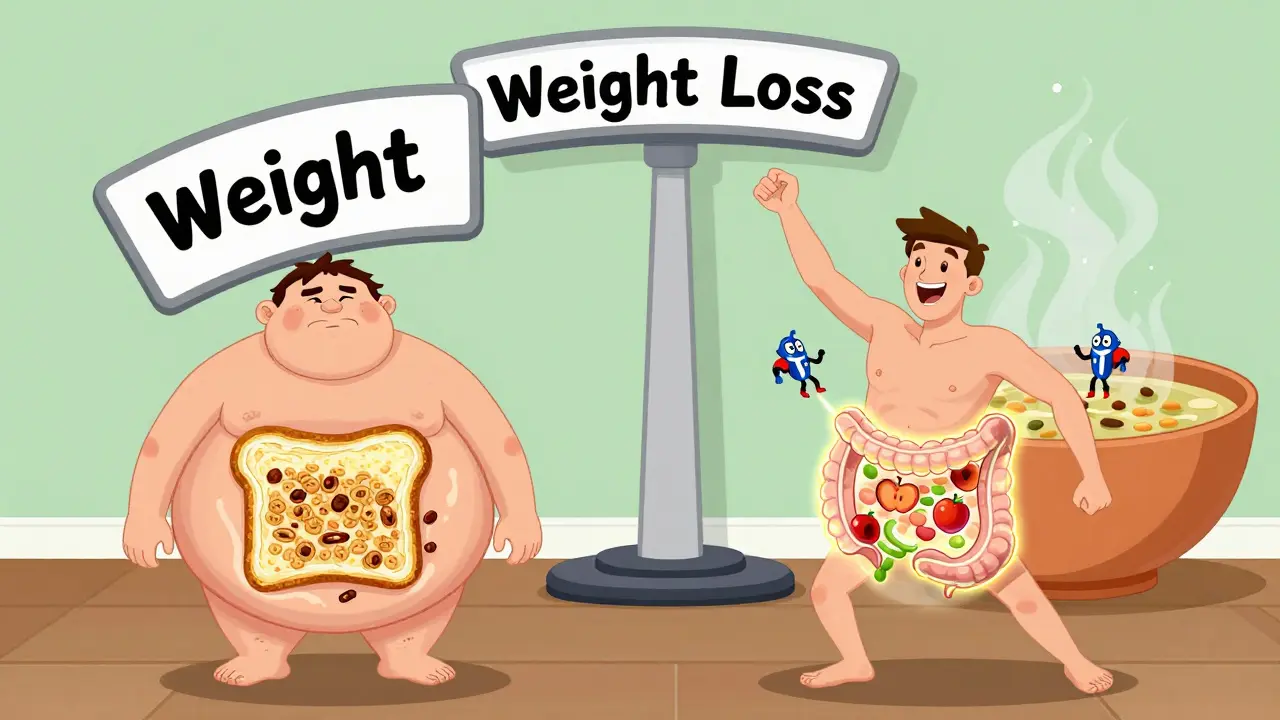
Insoluble fiber doesn’t dissolve. It doesn’t turn into gel. It’s more like a sponge that soaks up water and adds bulk. Think whole wheat bread, bran, nuts, seeds, and the skins of fruits and vegetables.Its job? Speed things up. It increases stool weight by 30-50% and cuts transit time by 24-48 hours. That’s great for regularity-but it doesn’t directly reduce hunger or block fat absorption.
So does it help with weight loss? Indirectly, yes. If your gut is sluggish, you’re more likely to retain water, feel bloated, and crave carbs. Insoluble fiber fixes that. But if you’re only eating insoluble fiber-say, lots of bran cereal and whole wheat toast-you’re missing the real weight-control powerhouse: soluble fiber.
Here’s a quick comparison:
| Feature | Soluble Fiber | Insoluble Fiber |
|---|---|---|
| Water Interaction | Dissolves, forms gel | Does not dissolve, adds bulk |
| Primary Weight Benefit | Reduces hunger, slows digestion | Prevents bloating, improves regularity |
| Effect on Fat Absorption | Blocks 15-20% | No effect |
| Impact on Satiety Hormones | Increases PYY, GLP-1; lowers ghrelin | No direct effect |
| Best Food Sources | Oats, beans, apples, psyllium, flaxseeds | Whole wheat, brown rice, nuts, vegetable skins |
| Recommended Daily for Weight Loss | 10-15 grams | Not specifically needed, but aim for 15-20 grams total |
Whole Foods Beat Supplements-Every Time
You’ll see ads for psyllium pills, glucomannan capsules, and fiber gummies promising quick weight loss. And yes, they work-sort of.But here’s what the science says: fiber from whole foods is better. Why? Because food isn’t just fiber. It’s also vitamins, antioxidants, phytonutrients, and water-all of which work together to support metabolism and reduce cravings.
One study found that people who got their fiber from beans, lentils, oats, and apples stuck with their plan 82% of the time after six months. Those relying on supplements? Only 54% stayed consistent.
Plus, supplements can cause bloating, gas, and even constipation if you don’t drink enough water. That’s not a recipe for long-term success.
Real food is the real deal. Try this:
- Start your day with ½ cup of oats (4g soluble fiber)
- Add 1 apple (with skin) to your lunch (2.4g total fiber, 1.7g soluble)
- Have a bowl of lentil soup for dinner (7g fiber, mostly soluble)
That’s 13.4 grams of fiber-with 8+ grams being the kind that actually helps you lose weight.
How to Actually Use Fiber to Lose Weight
It’s not enough to just eat more fiber. You need to do it right.1. Increase slowly. Jumping from 10g to 30g in a week will make you bloated and miserable. Add 5 grams per week until you hit your goal. Your gut bacteria need time to adjust.
2. Drink water. Soluble fiber needs water to work. For every 5 grams of fiber you take (especially from supplements), drink 16-24 ounces. No water? You’ll get constipated.
3. Take soluble fiber before meals. A 2023 Cleveland Clinic study showed that taking 3-5 grams of viscous fiber 15-30 minutes before eating cuts your calorie intake by 10-15%. That’s like skipping a snack without even trying.
4. Don’t ignore insoluble fiber. You still need it. Aim for a 3:1 ratio of insoluble to soluble fiber. That means if you’re getting 12g of soluble, get about 36g of insoluble. Most whole plant foods naturally give you this balance.
5. Be patient. Weight loss from fiber isn’t fast. It’s steady. You won’t drop 10 pounds in a week. But over 3-6 months, people who stick with high-fiber diets lose 5-10 pounds more than those who don’t-even without changing anything else.

The Bottom Line
Fiber isn’t magic. But it’s one of the few weight-loss tools that actually works without making you hungry, broke, or miserable. Soluble fiber is your secret weapon for reducing appetite and fat absorption. Insoluble fiber keeps your system running smoothly so you don’t feel bloated or backed up.Forget pills. Focus on real food: oats, beans, lentils, apples, chia seeds, flaxseeds, and vegetables. Add them to every meal. Drink water. Be consistent.
And if you’re wondering why you’re not losing weight despite eating “clean”? Maybe you’re not eating enough of the right kind of fiber.
Can fiber supplements help me lose weight?
Yes-but only if they contain viscous soluble fiber like psyllium, glucomannan, or beta-glucans. Studies show psyllium can lead to 3-4% body weight loss over 8-10 weeks. But supplements alone aren’t enough. They work best when paired with whole foods and reduced calorie intake. Most people get better results-and stick with it longer-by eating fiber-rich foods instead of relying on pills.
How much soluble fiber do I need daily to lose weight?
Aim for 10-15 grams of viscous soluble fiber per day. That’s about 2 servings of oats, 1 apple with skin, and 1 cup of cooked lentils. Studies show this amount leads to measurable weight loss-around 0.75 pounds and a quarter-inch smaller waist over 10 weeks. More than 15 grams doesn’t add much benefit, and too much can cause bloating.
Does insoluble fiber help with weight loss?
Not directly. Insoluble fiber doesn’t reduce hunger or block fat. But it helps indirectly by keeping your digestion regular. If you’re constipated or bloated, you’re more likely to crave carbs and feel sluggish. So while it won’t burn fat, it creates the right environment for weight loss to happen.
Why do I get bloated when I eat more fiber?
It’s usually because you increased your intake too fast or didn’t drink enough water. Your gut bacteria need time to adapt. Start with 5 extra grams per week and drink at least 2 liters of water daily. If bloating persists, try psyllium instead of inulin or chicory root-those are more likely to cause gas.
Is psyllium the best fiber for weight loss?
Based on clinical trials, yes. Psyllium husk has the strongest evidence for reducing body weight, waist size, and visceral fat. It’s also the most studied soluble fiber in weight-loss research. But you don’t need to take it as a supplement. You can get it from flaxseeds, chia seeds, and certain whole grains. Just make sure you’re drinking enough water with it.
Can I get enough fiber on a low-carb diet?
Absolutely. Low-carb doesn’t mean low-fiber. Focus on non-starchy vegetables (broccoli, spinach, Brussels sprouts), nuts, seeds, avocados, and berries. Flaxseeds and chia seeds are especially high in soluble fiber and work well in low-carb meals. A daily serving of chia pudding (2 tablespoons) gives you 10g of fiber-5g soluble-with only 2g net carbs.
What to Do Next
Start today. Add one high-fiber food to each meal. Not because you’re on a diet-but because your body needs it. Track your energy, your hunger, and your cravings for two weeks. You might be surprised how much better you feel.Fiber isn’t a quick fix. But it’s one of the few tools that works without side effects, without cost, and without hype. And if you’re serious about lasting weight control, it’s not optional. It’s the foundation.

Madhav Malhotra
January 11, 2026 AT 17:37Man, I never thought fiber could be this cool. In India, we’ve been eating dal and oats for generations, but no one ever told us it was a weight-loss secret. Thanks for breaking it down like this - feels like my grandma knew more than all the diet gurus combined.
Matthew Miller
January 12, 2026 AT 11:28This is the most basic, surface-level garbage I’ve read all week. You’re acting like soluble fiber is some magical weight-loss elixir. Have you looked at the effect sizes? 0.75 pounds in 10 weeks? That’s barely more than water weight. Stop selling snake oil disguised as nutrition science.
Roshan Joy
January 12, 2026 AT 15:52Love this breakdown! 🙌 I’ve been adding chia seeds to my morning yogurt and honestly, the difference in my afternoon cravings is insane. Also, psyllium husk is a game-changer - but yeah, drink water or it’s a disaster. I learned that the hard way 😅
Michael Patterson
January 12, 2026 AT 23:29Okay so first off you say soluble fiber blocks 15-20% of fat absorption but then you say it’s not magic? Wait what? Also you mention PMC10253086 like its some big deal but i googled it and its just a pubmed id not a journal name. Also you say whole foods are better but then you recommend psyllium which is a supplement? Contradictions everywhere. And why no mention of resistant starch? You left out the whole third type of fiber. This post is full of holes.
Vincent Clarizio
January 14, 2026 AT 16:40Think about it - fiber isn’t just a nutrient, it’s a conversation between your gut and your soul. The gel it forms? That’s not just a physical barrier - it’s a metaphysical pause button on the chaos of modern consumption. We’ve been conditioned to equate fullness with quantity, but true satiety is a quiet hum, a resonance between your microbiome and your intention. You’re not eating to fill a stomach - you’re aligning with an ancient rhythm. Psyllium? It’s not a supplement. It’s a spiritual reset. Drink water? That’s not hydration - it’s communion.
Alex Smith
January 15, 2026 AT 20:29Wow, someone actually wrote something useful for once. I’m shocked. But let’s be real - if you’re not eating at least 30g total fiber a day, you’re just playing with carbs. And if you think you can out-fiber a pizza, you’re in for a rude awakening. Also, who’s the genius who thinks ‘lentil soup’ is a realistic dinner for most Americans? Try telling that to someone working two jobs and living in a food desert.
Priya Patel
January 17, 2026 AT 05:12OMG I tried adding flax to my smoothie last week and I swear I didn’t snack after dinner for 3 days straight. I thought it was just luck but now I get it 😭 thank you for this!!
Sean Feng
January 18, 2026 AT 12:14Just eat less carbs
Priscilla Kraft
January 19, 2026 AT 10:09So many people get scared of fiber because of bloating - but it’s usually just too fast, too soon. I always tell my clients: start with half a banana and a tablespoon of chia. Give it 5 days. Then add a cup of lentils. Your gut will thank you. And yes, psyllium works wonders - but only if you pair it with real food. Supplements are the backup plan, not the hero.
Sam Davies
January 19, 2026 AT 22:15How quaint. You’ve discovered what Ayurveda called ‘tridoshic balance’ centuries ago. But let’s not pretend that ‘oats and apples’ are some groundbreaking revelation. In London, we’ve known this since the 18th century. Still, I suppose for the American masses, it’s novel enough to warrant a viral post. How darling.
Christian Basel
January 20, 2026 AT 10:19The efficacy of viscous soluble fiber in modulating postprandial glycemic response and amplifying GLP-1 secretion is well-documented in meta-analyses, but the clinical significance of 0.75 lb/10wk is marginal when contextualized against energy expenditure and insulin sensitivity dynamics. The dietary adherence metric cited (82% vs 54%) reflects behavioral economics more than physiological superiority. Recommend stratifying by baseline microbiome diversity before prescribing fiber interventions.