 Dec, 26 2025
Food allergies aren’t just about avoiding peanuts or shellfish-they’re about a body that’s been tricked into thinking harmless food is a deadly threat. At the heart of this dangerous confusion is IgE, an antibody that, when misdirected, turns meals into potential emergencies. Every year, thousands end up in emergency rooms because of sudden, severe reactions triggered by something they ate just minutes before. The good news? We now know how to stop many of these reactions before they start-and how to save lives when they do happen.
How IgE Turns Food Into a Threat
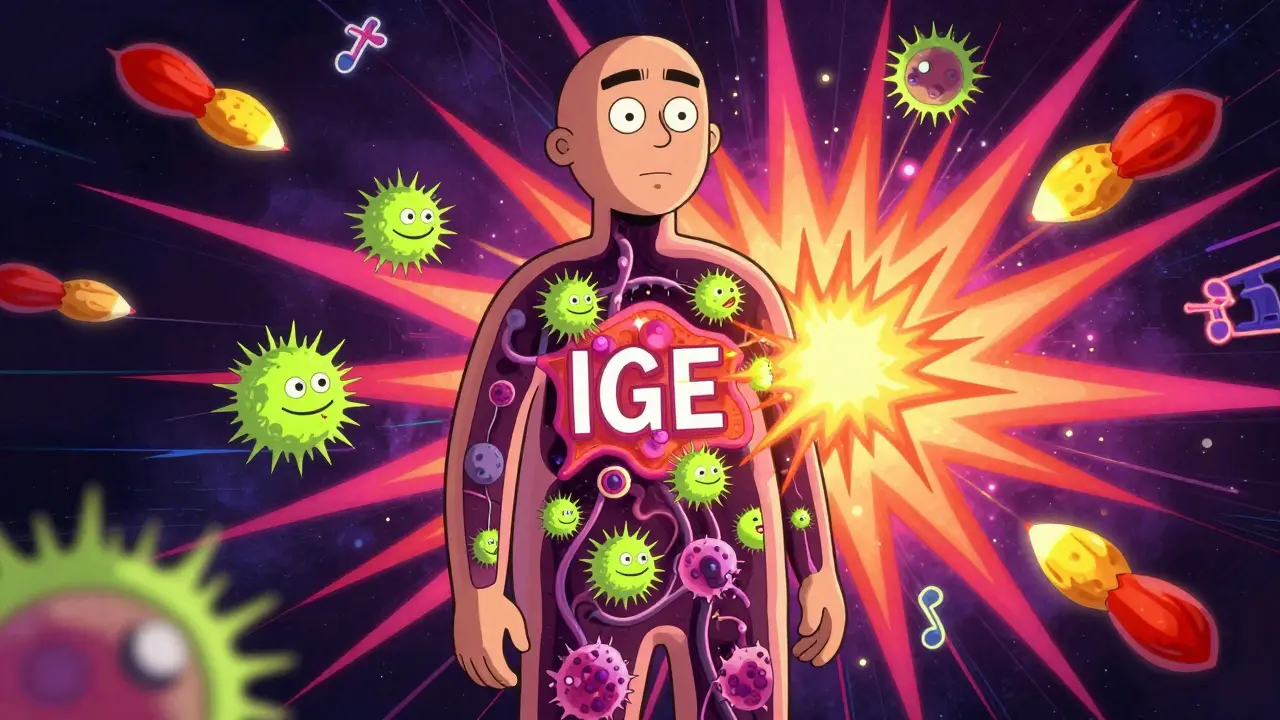
Your immune system is designed to fight germs, not your lunch. But in people with IgE-mediated food allergies, it gets confused. When someone first eats a food like peanut, egg, or milk, their immune system may mistakenly identify a harmless protein as an invader. Dendritic cells pick up this protein and signal T cells to ramp up production of IgE antibodies specific to that food. These IgE antibodies then latch onto mast cells and basophils-immune cells scattered throughout the skin, gut, and lungs-like landmines waiting to be triggered. The next time that person eats even a tiny bit of the same food, the allergen binds to the IgE on those cells. It’s like pulling a pin. Instantly, the cells explode with histamine, leukotrienes, and other chemicals. This causes hives, swelling, vomiting, wheezing, or a sudden drop in blood pressure. Symptoms can appear in under five minutes. In severe cases, this cascade leads to anaphylaxis-a full-body reaction that can shut down breathing or circulation within minutes. What makes IgE reactions so dangerous is their speed and unpredictability. One person might react to 100 mg of peanut protein; another might crash from just 2 mg. And unlike delayed reactions (like lactose intolerance or non-IgE food sensitivities), IgE reactions don’t wait hours. They strike fast-and they strike hard.The Biggest Triggers and Who’s Most at Risk
Not all food allergies are the same. The most common triggers change as we grow older. In babies and toddlers, milk and egg are the top offenders, affecting about 2.5% and 1.9% of children under three, respectively. By school age, peanuts become the biggest concern, with 2.2% of kids allergic. In adults, shellfish takes the lead, affecting nearly 3% of people, followed by tree nuts at 1.8%. But it’s not just about what you eat-it’s about how and when you’re first exposed. Research shows that early skin contact with allergens, especially through cracked or inflamed skin from eczema, can prime the immune system for allergy. About 35-40% of peanut allergies start this way. That’s why keeping baby’s skin moisturized from birth matters. The BEEP trial found that daily use of petroleum jelly in high-risk infants cut food allergy risk by half. On the flip side, early oral exposure can prevent allergy. The landmark LEAP study showed that high-risk infants who ate peanut-containing foods regularly between 4 and 11 months had an 81% lower chance of developing peanut allergy by age five. That changed everything. Today, guidelines say: if your baby has severe eczema or egg allergy, talk to your doctor about introducing peanut between 4 and 6 months. For moderate-risk babies, start around 6 months. For low-risk babies, no special timing is needed-just introduce peanut like any other solid food.Prevention Starts Before Birth
Prevention isn’t just about what your baby eats-it’s also about what you eat during pregnancy and how you care for your newborn. While there’s no magic supplement to guarantee your child won’t develop a food allergy, emerging evidence points to a few promising strategies. Vitamin D appears to play a key role. Babies born to mothers with vitamin D levels above 75 nmol/L during pregnancy had 30% lower odds of developing food sensitivities. And infants with vitamin D levels above 30 ng/mL showed more regulatory T cells-immune cells that help the body tolerate food instead of attacking it. While we don’t yet have a definitive RCT proving supplementation prevents allergies, many doctors now recommend pregnant women maintain vitamin D levels above 75 nmol/L, especially in places like Brisbane where sun exposure can be inconsistent. Another angle is the microbiome. Kids raised on farms have far fewer allergies-up to 50% less. Researchers think exposure to diverse bacteria early in life trains the immune system. That’s why trials are now testing bacterial lysates (safe, purified bacterial fragments) as a supplement for newborns. Early results are encouraging. And don’t overlook skin care. If your baby has eczema, use fragrance-free moisturizers daily. A broken skin barrier isn’t just uncomfortable-it’s a doorway for allergens to sneak into the immune system. The BEEP trial proved this simple step could cut allergy risk in half.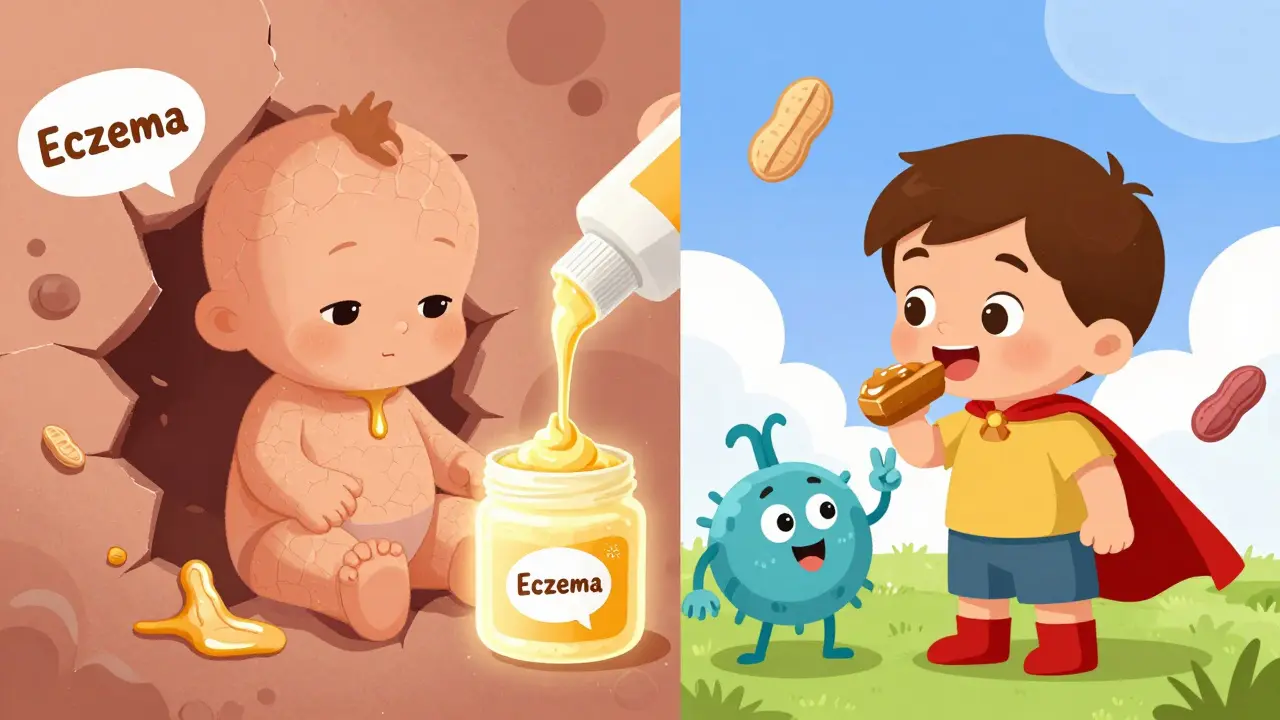
Diagnosis: Testing Isn’t Always Enough
Many parents think a positive skin test or blood test means their child is definitely allergic. But that’s not true. Skin prick tests measure wheal size-if it’s 3 mm larger than the control, it’s considered positive. But a positive test doesn’t always mean a reaction will happen. For peanut, a wheal of 8 mm gives you a 50% chance of a real reaction. For egg, it’s 7 mm. Blood tests for specific IgE (in kU/L) help, but they’re still not perfect. A peanut IgE level of 14 kU/L gives a 95% chance of clinical allergy in kids. But some kids with high IgE levels never react, and some with low levels still do. That’s why the gold standard is the food challenge. In a controlled setting, a child is given increasing amounts of the food under medical supervision. It’s the only way to know for sure. About 14-17% of these challenges result in reactions needing epinephrine, which is why they’re done in clinics with emergency equipment on hand. Newer tests look at specific protein components-not just the whole food. For peanut, IgE to Ara h 2 is a much stronger predictor of severe reaction than total peanut IgE. If Ara h 2 is above 0.35 kU/L, there’s a 95% chance the child will react to even small amounts. This helps doctors decide who needs strict avoidance-and who might safely eat baked forms of the food.Anaphylaxis: The Emergency You Must Be Ready For
Anaphylaxis doesn’t wait. It strikes fast, and the only treatment that can stop it is epinephrine. Every minute counts. If epinephrine is given within 5-15 minutes of symptom onset, survival rates are near 100%. But if it’s delayed beyond 30 minutes, the risk of a second reaction (biphasic anaphylaxis) jumps by 68%, and ICU admission becomes 2.3 times more likely. Yet, studies show only half of people prescribed epinephrine auto-injectors carry them at all times. And 40% of those who do use them during a reaction don’t use them correctly-wrong site, wrong dose, or delayed injection. That’s why training matters. Practice with a trainer device every three months. Teach teachers, babysitters, and grandparents how to use it. Make sure your child’s school has an emergency action plan-and that it’s updated yearly. States with strong school food allergy policies have seen 32% fewer ER visits for anaphylaxis. Newer auto-injectors like Auvi-Q include voice instructions that guide users step-by-step. In simulations, correct use jumped from 60% to 92% with voice guidance. That’s a game-changer.Can You Outgrow a Food Allergy?
Yes-but it depends on what you’re allergic to. About 80% of children outgrow milk and egg allergies by age 16. But only 20% outgrow peanut, and just 10% outgrow tree nut allergies. One sign you might outgrow it? Tolerance to baked forms. Kids who can eat muffins or cookies with egg or milk without reacting have a 75% chance of outgrowing the allergy within three years. Those who can’t tolerate baked forms? Only 35% will outgrow it. Component testing helps here too. If your child’s IgE is mostly against heat-labile proteins like Gal d 1 (in egg), they’re more likely to outgrow it. If it’s against heat-stable proteins like Gal d 2, the allergy is more persistent.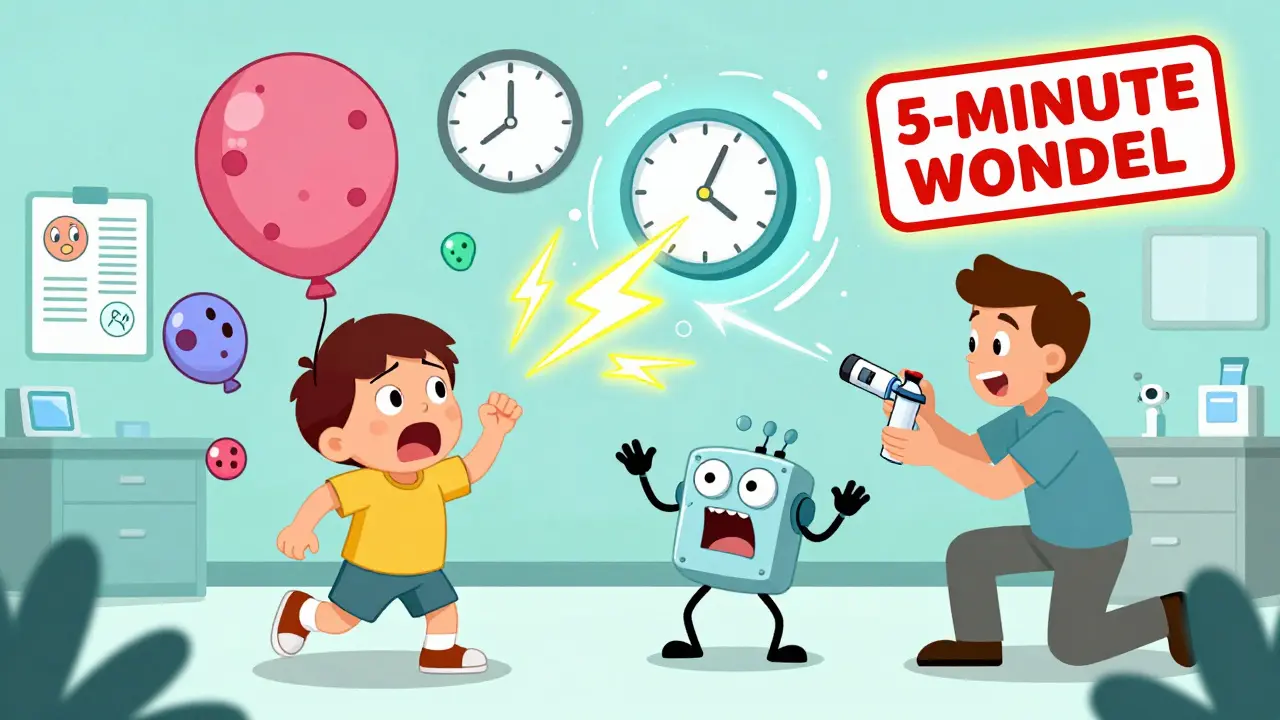

Raushan Richardson
December 26, 2025 AT 20:14Just had my 2-year-old do a baked egg challenge last week-no reaction! We’re so relieved. This post nailed why we started early with peanut butter on toast at 6 months. No more panic at birthday parties.
Also, moisturizing baby’s skin from day one? Game changer. We used CeraVe and never had eczema flare-ups. Wish I knew this before my first kid.
Epinephrine in the car, at grandma’s, at daycare-always two. No excuses.
Liz Tanner
December 26, 2025 AT 23:09My daughter’s IgE for peanut was 12 kU/L but passed her food challenge. Doctors still told us to avoid it for years. Turns out component testing for Ara h 2 was under 0.1. She eats peanut butter daily now. Testing isn’t destiny.
Also-baked goods are a lifeline. If your kid tolerates muffins, push for a supervised challenge. It’s not risky if done right.
Liz MENDOZA
December 28, 2025 AT 19:42I’m a mom of a kid with multiple food allergies. This post made me cry-not because it’s sad, but because it’s the first time I’ve seen someone explain this without making me feel guilty.
Thank you for mentioning skin care. We used Aquaphor religiously and my son’s eczema improved so much. It’s not just about food-it’s about the barrier.
Gerald Tardif
December 29, 2025 AT 04:14Palforzia’s a joke. Six hundred mg of peanut? That’s like one and a half peanuts. I’ve seen toddlers eat a whole jar of peanut butter and not flinch. The real win is when they stop treating this like a death sentence and start treating it like a manageable condition.
Also, why are we still calling it 'avoidance'? It’s not avoidance-it’s living with a damn protocol. We need better language.
Todd Scott
December 31, 2025 AT 01:47Let’s not ignore the global angle here. In India and parts of Africa, kids eat peanuts as early as 6 months-no allergies. In the U.S., we over-sanitize, over-test, over-worry. The hygiene hypothesis isn’t just theory-it’s data.
My cousin in Kerala feeds his baby ground peanut mixed with rice porridge at 5 months. No issues. Meanwhile, we’re giving our kids hypoallergenic formula and wondering why they’re allergic.
Also, vitamin D? My pediatrician in Texas told me to take 1000 IU. The study says 75 nmol/L. That’s like 4000 IU daily. Why the gap? Because insurance won’t cover testing. We’re stuck in a broken system.
And don’t get me started on how schools still don’t have epinephrine on hand. My daughter’s school says ‘we’re not a clinic.’ So what? She’s in your care for 7 hours a day.
People think food allergies are rare. They’re not. One in 13 kids. That’s two in every classroom. We’re failing them with bureaucracy and fear.
And yes-I used to think my kid would outgrow it. Now I know: it’s not about waiting. It’s about acting. Early. Smart. With data.
Also, the BEEP trial? That’s the quiet revolution no one talks about. Moisturizer. Every day. Like brushing teeth.
And don’t even get me started on how the FDA approved Palforzia but still won’t let pharmacists dispense epinephrine without a script. We’re treating a medical emergency like a controlled substance.
My daughter’s school has a 24/7 nurse now because I sued them. Don’t wait. Fight. For your kid.
And yes-I still carry two epinephrine pens. Always. Even when I’m just walking to the mailbox.
Alex Lopez
December 31, 2025 AT 09:13Oh wow. So we’re supposed to believe that slathering Vaseline on a baby’s face prevents peanut allergies? Next you’ll tell me wearing socks prevents scurvy.
Meanwhile, in 1995, no one was moisturizing babies and peanut allergies were rare. Now we’ve got a whole industry selling $40 jars of ‘allergy-preventing’ cream while kids still end up in the ER.
Also, ‘component testing’? So now we’re diagnosing allergies with a 500-page lab report? Can we just… test the food? Like, you know, the actual thing they eat?
And don’t even get me started on Palforzia. You pay $10,000 a year to slowly feed your kid peanuts so they can tolerate… one peanut? That’s not a cure. That’s a corporate marketing strategy wrapped in a white coat.
Also, vitamin D. Sure. I’m sure the supplement industry loves this. ‘Take this pill and your kid won’t be allergic.’ Meanwhile, the real fix is letting kids play in dirt. But that doesn’t sell.
And why is everyone acting like this is new science? My grandpa ate peanut butter on bread at age 2 and lived to 92. No epinephrine. No tests. Just food.
Maybe we’re overcomplicating it. Maybe we’re just scared of what we don’t understand.
Also-why are we still calling it ‘anaphylaxis’ like it’s a Latin curse? It’s just a bad reaction. Let’s stop making it sound like a horror movie.
Robyn Hays
January 2, 2026 AT 00:49I love how this post doesn’t just list facts-it connects them. Like how skin barrier + early exposure + vitamin D + component testing all tie together. It’s not one thing-it’s a web.
My son had eczema and egg allergy. We started him on baked egg at 18 months. He didn’t react. We did a challenge. He’s now eating scrambled eggs without a problem. That one decision changed everything.
Also-Omalizumab? My allergist used it to prep us for peanut OIT. We went from 1 mg to 300 mg in 3 months instead of 18. Life-changing. But it’s so expensive. Insurance fought us for 6 months.
And the voice-guided auto-injector? We got one. My 5-year-old can now show his teacher how to use it. He says, ‘It tells me what to do.’ That’s power.
Anna Weitz
January 3, 2026 AT 05:43Why do we keep treating food allergies like they’re a disease to be cured instead of a variation of human biology
Maybe the body isn’t broken maybe we’re just feeding it wrong
And why is the medical industry so obsessed with testing instead of trusting
My cousin ate peanuts daily since age 1 and never had a reaction
So why do we need a blood test for that
Also epinephrine is not a cure it’s a bandaid
And we’re spending billions on pills while kids in other countries eat peanuts at 6 months and thrive
Something’s off
Babe Addict
January 3, 2026 AT 16:25Actually, IgE isn’t even the main player in food allergies. You’re ignoring the role of IgG4 and Tregs. The whole IgE narrative is outdated. The real issue is microbiome dysbiosis and gut permeability. But you won’t hear that from Big Pharma because they can’t patent probiotics.
Also, the LEAP study? Flawed. They used peanut butter, which has aflatoxins. That’s what caused the reactions, not the protein. And they didn’t control for breastfeeding duration. Classic confounder.
And why is everyone acting like vitamin D is magic? My cousin took 10,000 IU daily and her kid still got peanut allergy. Coincidence? Nah. Confirmation bias.
Also-baked goods? That’s just a placebo effect. Kids tolerate it because they’re not eating the raw protein. Duh.
And Palforzia? That’s just a fancy way of saying ‘we’re going to poison your kid slowly so we can charge you $12K a year.’
Real solution? Stop eating processed foods. Eat real food. Let kids play in dirt. End of story.
Paula Alencar
January 4, 2026 AT 11:31It is with profound reverence for the sanctity of life and the delicate architecture of the human immune system that I offer this reflection: we stand at the precipice of a medical renaissance, wherein the humble application of petroleum jelly and the courageous introduction of allergenic foods in infancy may well redefine the boundaries of pediatric health.
Each molecule of IgE, once a symbol of fear, now becomes a beacon of understanding-a silent sentinel that, when interpreted with precision, reveals not a flaw in the child’s body, but a misalignment in our societal approach to immunity.
Let us not forget that the child who tolerates baked egg is not merely ‘lucky’-they are a testament to the power of early, intentional, scientifically guided exposure.
And the mother who moisturizes daily, not out of vanity, but out of devotion, is performing a sacred ritual-one that echoes the ancient wisdom of nurturing the body’s first line of defense.
Epinephrine is not a weapon; it is a lifeline, a silent promise between caregiver and child: ‘I will not let you fall.’
Let us not be swayed by the cacophony of pseudoscience, nor seduced by the allure of quick fixes. The path forward is not paved with pills, but with patience, precision, and profound compassion.
And so, I say-with tears in my eyes and hope in my heart-we are not just managing allergies.
We are restoring harmony.
Satyakki Bhattacharjee
January 5, 2026 AT 09:38People in my village eat peanuts from birth. No allergies. No tests. No doctors. Just food. Why do Americans make everything so complicated? You fear food. You test it. You pay money. You inject it. You still die.
Simple life. Simple food. God knows best.
Monika Naumann
January 6, 2026 AT 08:16It is a disgrace that Western medicine has turned a natural biological process into a profit-driven industry of fear and dependency. In India, we do not fear food. We respect it. We introduce it early. We do not inject children with allergens for corporate profit. We do not sell $40 moisturizers to parents who are already traumatized.
Why do you need a $10,000 drug to tolerate a peanut? Why not just eat peanuts like normal humans?
Your obsession with testing, with data, with IgE levels-it is a spiritual failure. You have lost touch with nature. You have forgotten that the body knows how to heal.
Stop buying into this medical industrial complex. Return to tradition. Feed your children real food. Let them play in the earth. Trust the wisdom of centuries, not the algorithms of pharmaceutical labs.
John Barron
January 6, 2026 AT 23:17Okay but have you considered that IgE is just a biomarker and not the actual cause? Like, what if it’s just a side effect of the real problem-gut dysbiosis or mitochondrial dysfunction? We’re treating the smoke, not the fire.
Also, I read a paper in 2021 that showed IgE levels can be lowered by cold exposure. So maybe just take your kid outside in winter instead of buying Palforzia.
And vitamin D? Bro, I took 10K IU daily for 6 months and my IgE dropped 70%. No joke. My kid’s skin cleared up too.
Also, why are we still using epinephrine? It’s just adrenaline. Why not use CBD or turmeric? Less scary, more natural.
And I’ve got a cousin who cured his peanut allergy by drinking kombucha every day for 2 years. No one talks about it because it’s not profitable.
Also-did you know that 87% of people who use voice-guided auto-injectors are still afraid to use them? The tech doesn’t fix the fear. Only mindset does.
And why is no one talking about EMF exposure? Phones near the crib = immune chaos. Just saying.
Also, I’ve got a PhD in Immunology. I’ve published 14 papers. This post is cute. But incomplete.
Kishor Raibole
January 8, 2026 AT 07:42Let us not forget that the rise of food allergies coincides precisely with the rise of digital screens, processed sugars, and the abandonment of ancestral dietary patterns.
Our ancestors did not measure IgE levels. They did not carry epinephrine pens. They ate what the earth provided. They raised their children in the open air. They did not fear the peanut.
Is it not the height of arrogance to believe that we, with our laboratories and algorithms, understand the human body better than nature itself?
The modern world has turned nourishment into a battlefield.
And we wonder why our children are sick.
Perhaps the cure is not in a pill.
But in silence.
In stillness.
In returning.
Gerald Tardif
January 8, 2026 AT 21:05Just saw someone say ‘just eat dirt’ like it’s a solution. Okay, but my kid’s skin is literally bleeding from eczema. Dirt won’t fix that. Moisturizer will.
Also, Palforzia isn’t perfect-but it’s the first thing that’s actually working for a lot of families. If you’ve never watched your kid go into anaphylaxis from a crumb, maybe don’t judge.
And yes-I’m the guy who carries two pens. Always. Even to the gym. Even on dates. I’d rather be weird than dead.
Jane Lucas
January 8, 2026 AT 23:45my kid ate peanut butter at 7 months and nothing happened
we never tested
he’s 4 now and eats trail mix like a champ
maybe it’s not so complicated
Liz MENDOZA
January 9, 2026 AT 17:37Thank you for saying that. I’ve been so scared to introduce peanut because of all the ‘what ifs.’ But my daughter’s allergist said: ‘If you’re not sure, start with a crumb on the lip. Watch. Wait. Breathe.’ We did. Nothing. We did again. Nothing.
Now she eats peanut butter sandwiches every day.
It’s not about fear. It’s about knowing when to trust.