 Dec, 12 2025
Ever opened your pill bottle and thought, Wait, this isn’t the same pill? You’re not alone. If you’ve ever been handed a generic version of your medication and noticed it looked totally different - maybe it used to be white and oval, now it’s blue and round - you’ve run into one of the most common but rarely talked about issues in modern healthcare: generic pill appearance changes.
It’s not a mistake. It’s not a mix-up. It’s completely legal. And it’s happening to millions of people every month.
Why Do Generic Pills Look Different?
Generic drugs are chemically identical to their brand-name versions. Same active ingredient. Same strength. Same way your body absorbs it. But they look different. And that’s by law.
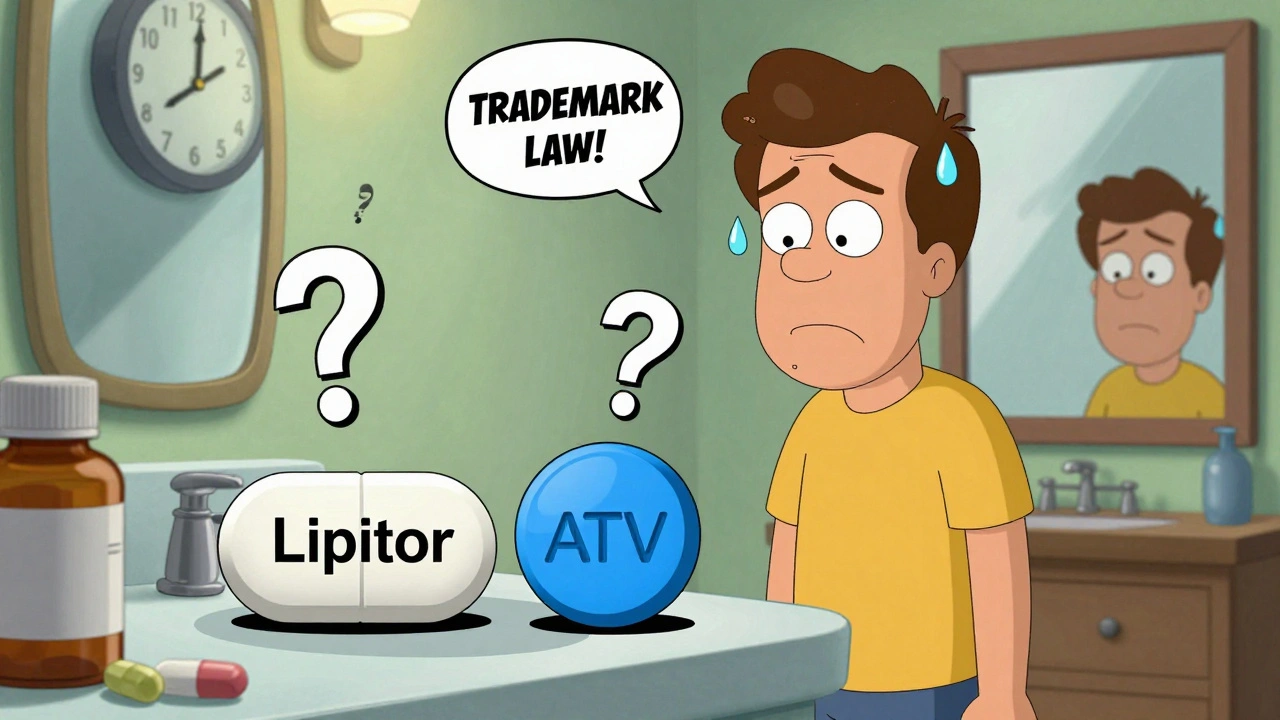
In the U.S., trademark rules under the Hatch-Waxman Act of 1984 say generic manufacturers can’t copy the exact color, shape, or markings of brand-name pills. Why? To avoid confusing consumers and protect the brand’s intellectual property. So even if your blood pressure pill is still atorvastatin, the generic version might be a different color, size, or shape - even if it’s made by the same company.
The FDA doesn’t require generics to match the brand’s appearance. In fact, they encourage differences. That’s why you might get a white round tablet one month, then a pale yellow oval the next - even if your prescription hasn’t changed.
What Exactly Changes?
It’s not just color. Four things can shift between refills:
- Color: From pink to white, blue to beige. Manufacturers use different dyes, and there’s no standard. One company’s "white" might look slightly gray compared to another’s.
- Shape: Round, oval, caplet, oblong - all are allowed. Lipitor’s brand version is a pink oval. Generic versions can be round, oval, or even diamond-shaped.
- Size: Pills can range from 3mm to over 20mm in diameter. A smaller pill might be easier to swallow, but if you’re used to a larger one, it can feel wrong.
- Markings: Letters or numbers stamped on the pill (like "10" or "ATV") help identify it. But those can change too. One generic might have "10" on one side, another might have "ATV" on both.
These changes are controlled by the manufacturer’s choice of inactive ingredients - fillers, coatings, dyes - which don’t affect how the drug works, but absolutely affect how it looks and feels.
Why This Matters More Than You Think
Most people assume that if the pill works the same, the look doesn’t matter. But research says otherwise.
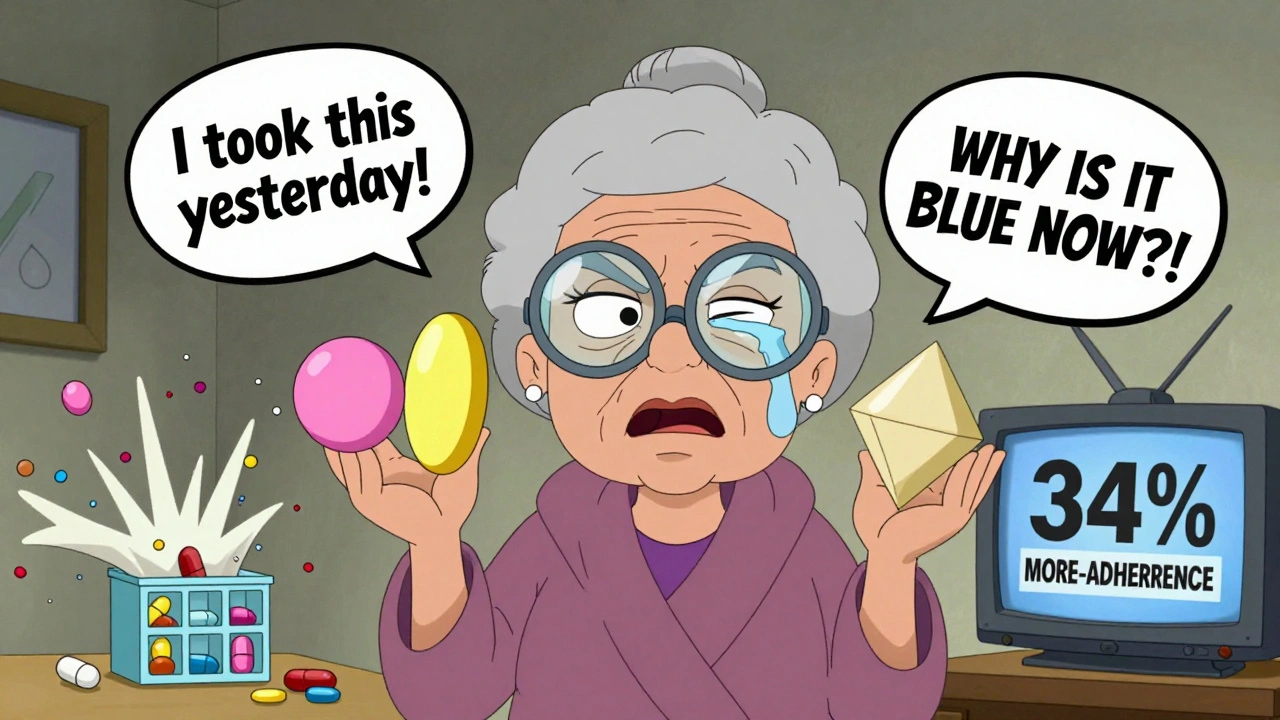
A landmark 2014 study from Brigham and Women’s Hospital tracked over 38,000 patients taking heart medications. When their pills changed color or shape, the chance they stopped taking them jumped by 34%. That’s not a small number. It means nearly 1 in 6 people quit their meds after a visual change.
Why? Because people rely on appearance to know what they’re taking. Especially if they’re on five or six different pills a day. One patient on Reddit said: "My blood pressure med changed from white oval to blue round. I almost didn’t take it - I thought it was something else. I was scared."
Older adults are hit hardest. A 2022 AARP survey found 37% of people over 65 had trouble recognizing their meds after a change. For someone with memory issues, diabetes, or high blood pressure, that’s dangerous. Skipping a dose can lead to hospital visits, strokes, or worse.
Pharmacists report that 18.3% of generic refill complaints are about appearance. And 67% of those complaints come from patients over 65.
How Often Does This Happen?
More than you’d guess.
A 2022 study in the American Journal of Managed Care found that 32.7% of patients refilling chronic meds like diabetes or hypertension drugs saw a change in pill appearance. That’s more than 1 in 3 people.
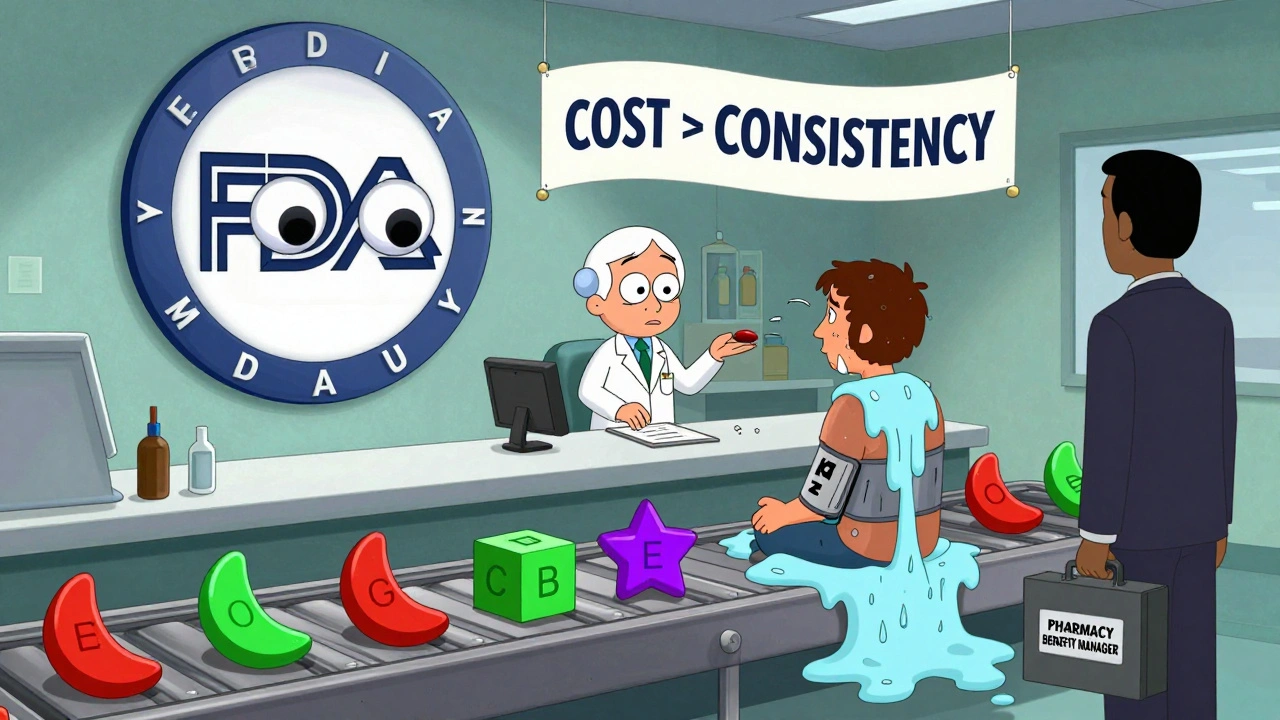
Why so often? Because pharmacies switch manufacturers based on cost. Your insurer might have a deal with Manufacturer A this month, then switch to Manufacturer B next month because they’re cheaper. Even if both are generics for the same drug, they’ll look different.
The FDA lists over 9,800 approved generic drugs. Over 41% of them have multiple manufacturers. That means for your metformin, your levothyroxine, or your lisinopril - you could get a different version every time.
What Can You Do?
You can’t stop appearance changes. But you can protect yourself.
- Ask your pharmacist: Before you leave the pharmacy, ask: "Is this the same pill I got last time?" They can show you a photo of your last refill or explain the difference.
- Take a photo: Use your phone. Snap a picture of each pill when you get it. Save it in a folder labeled "My Medications." When the next refill looks different, pull up the photo and compare. A Johns Hopkins study showed this cuts medication errors by 27% in older adults.
- Use a pill organizer: Keep your meds sorted by day and time. Even if the pill looks different, you’ll know it’s supposed to be in the "morning" slot.
- Request a consistent manufacturer: Tell your doctor and insurer you want the same generic brand every time. It’s not guaranteed - 78% of pharmacy benefit managers don’t lock in manufacturers - but it’s worth asking.
- Keep a written list: Write down the drug name, dose, and what it looks like (color, shape, markings). Carry it in your wallet or keep it on your phone.
Some pharmacies now use digital tools like Surescripts to show you past pill images. But only 42.7% of pharmacies use them. Don’t wait for them to catch up - take control yourself.
What’s Being Done?
The FDA knows this is a problem. In 2016, they released official guidance saying manufacturers should consider pill appearance when designing generics - especially for high-risk drugs. In 2023, they started working on "Visual Medication Equivalence Standards" as part of their GDUFA program. Draft guidelines are expected in mid-2024.
Other countries are ahead. The European Medicines Agency requires generics for chronic conditions to match the brand’s appearance when possible. That simple rule cut medication errors by 18.3% across the EU.
Right now, the U.S. still prioritizes cost over consistency. But patient safety advocates are pushing for change. The cost of non-adherence? $1.3 billion a year in avoidable hospital visits and complications.
It’s Not About the Pill - It’s About Trust
When your pill looks different, it’s not just confusing - it’s unsettling. It makes you doubt: Is this the right drug? Is it safe? Did they give me the wrong thing?
That doubt is real. And it’s dangerous.
Generic drugs save billions and make life-saving meds affordable. That’s good. But we need to fix the gap between what’s scientifically true - that the drug works the same - and what patients experience - that the pill feels wrong.
The solution isn’t to ban generics. It’s to make them predictable. To let patients recognize their meds without second-guessing. To treat appearance not as a legal loophole, but as a patient safety issue.
Until then, stay informed. Stay observant. And never assume a pill is safe just because it’s cheap. Your health depends on knowing exactly what you’re taking - even if it doesn’t look the way it used to.
Why do generic pills look different from brand-name pills?
U.S. trademark laws require generic drugs to look different from brand-name versions to avoid confusion and protect intellectual property. The FDA allows these differences in color, shape, size, and markings, even though the active ingredient and effectiveness are identical.
Can changing the appearance of my pill affect how well it works?
No. The FDA requires generic drugs to be bioequivalent - meaning they deliver the same amount of active ingredient at the same rate as the brand-name version. Changes in color or shape don’t alter how the drug works in your body.
Why do I keep getting different-looking pills even though I’m on the same medication?
Pharmacies often switch between generic manufacturers to get the lowest price. Each manufacturer uses different inactive ingredients and designs, so the pill’s appearance changes even though the drug is the same. Over 41% of generic drugs have multiple manufacturers, making frequent changes common.
What should I do if my pill looks different and I’m not sure it’s safe?
Don’t skip your dose. Call your pharmacist and ask if this is the same medication. Show them your previous pill or a photo you took. If you’re still unsure, contact your doctor. Never guess - it’s better to confirm than to risk taking the wrong medication.
Are there any tools to help me track my pill appearance?
Yes. Take a photo of each new pill when you get it and save it on your phone. Use a pill organizer labeled by day and time. Some pharmacies offer digital medication history tools, but not all use them. Keeping a written list with color, shape, and markings is one of the most reliable methods.
Can I ask for the same generic manufacturer every time?
You can ask your doctor and insurer to try to keep you on the same generic manufacturer. But most pharmacy benefit managers don’t guarantee consistency - 78% of them don’t lock in manufacturers. It’s worth asking, but don’t count on it.
Is this problem worse for older adults?
Yes. A 2022 AARP survey found 37% of adults over 65 had trouble recognizing their meds after a change, compared to 22% of adults under 65. Older adults often take multiple pills daily and may have memory or vision challenges, making appearance changes riskier.
How common are medication errors because of pill appearance changes?
A 2023 Healthgrades survey found 14.7% of patients skipped doses because they didn’t recognize their pill. Many report accidentally taking the wrong medication - like confusing metformin with levothyroxine - after a color or shape change.
Is the FDA doing anything to fix this?
Yes. In 2023, the FDA launched a new initiative to develop "Visual Medication Equivalence Standards" under its GDUFA program. Draft guidance is expected in mid-2024. They’re also studying how appearance affects adherence, with $4.7 million allocated for research in 2024.
Why doesn’t the FDA just make all generics look the same?
Trademark laws prevent it. Brand-name companies own the visual design of their pills, and generic makers can’t copy them. Even if the FDA wanted uniformity, the legal system currently requires differences. Changing this would require new legislation.

Bruno Janssen
December 13, 2025 AT 12:48I’ve been on the same generic for three years. Last month, my pill went from white oval to this weird blue diamond. I didn’t take it for four days. Thought I was being poisoned. Turned out it was just a new batch. I cried. Not because I’m dramatic - because I was scared to die over a dye change.
Why does this keep happening? We’re not asking for luxury. Just consistency.
Lauren Scrima
December 13, 2025 AT 20:22So let me get this straight: we’re okay with people dying because of trademark law?
Wow.
Just… wow.
Jade Hovet
December 14, 2025 AT 12:29OMG YES!!! 🙌 I take 5 pills a day and I’ve started taking a pic of every bottle the second I get it. Saved my life last week when my metformin turned from green to yellow. I almost threw it out 😭
Pro tip: name your folder "Med Pics - DO NOT DELETE". I even set a reminder to check it monthly. You’re welcome, future me 💪
Jennifer Taylor
December 15, 2025 AT 20:12This is all part of the Pharma Deep State. They want you confused. Why? So you’ll doubt yourself. So you’ll stop taking your meds. So you’ll go back to the brand-name version. So they can charge you $500 a month again.
They’re not changing the pill for legal reasons - they’re changing it to manipulate you.
And they’re winning. Look at the stats. 34% drop in adherence? That’s not an accident. That’s a business model.
They don’t care if you die. They care if you pay.
Wake up.
They’re watching.
They’re always watching.
Himmat Singh
December 16, 2025 AT 21:42It is a matter of considerable concern that the regulatory framework permits such perceptual variability in pharmaceuticals of ostensibly identical composition. The absence of standardization in visual characteristics, while legally defensible under trademark jurisprudence, constitutes a latent threat to therapeutic adherence, particularly among geriatric populations with diminished cognitive recall capacity.
One might reasonably posit that bioequivalence, while pharmacologically sufficient, is insufficient as a criterion for patient safety in the context of multimorbidity and polypharmacy. A standardized visual lexicon for generic medications would constitute a public health imperative, not a commercial inconvenience.
The FDA’s current approach reflects a prioritization of market efficiency over patient autonomy - a troubling epistemic misalignment.
Willie Onst
December 16, 2025 AT 22:04Hey, I get it - generics save lives and money. But man, I used to know my pills by sight. My grandma used to call them "the little blue one" or "the big white one with the dot." Now? I’m staring at a tiny white circle and wondering if I’m taking my thyroid med or my blood pressure pill.
It’s not just confusing - it’s dehumanizing. We’re not machines. We’re people who need to recognize our own medicine.
Maybe we need a pill ID app? Or a color code system? Like traffic lights? Red = heart, green = thyroid, yellow = sugar? Just saying.
nina nakamura
December 18, 2025 AT 18:03People complain about pill colors but still take random supplements from Amazon. You’re all just lazy. If you can’t remember what your pill looks like, maybe you shouldn’t be managing your own meds. Get a caregiver. Or stop being so entitled.
It’s a pill. Not a wedding ring.
Harriet Wollaston
December 19, 2025 AT 19:04I’m 71 and I’ve been on lisinopril for 12 years. Last year, my pill went from white oval to pale yellow round. I didn’t take it for a week. I thought I was having a stroke. My daughter had to come over and check the bottle.
But you know what? I started writing down what each pill looks like on a sticky note and taping it to the bottle. Now I’m fine. It’s not hard. It just takes a second.
You don’t need a fancy app. You just need to care enough to write it down.
And if you’re scared? Call your pharmacist. They’re there to help. Not to judge.
Tommy Watson
December 20, 2025 AT 20:04so like… why do they even make the pills look different? like… its the same damn drug. why not just make them all look like the brand? why are we letting big pharma play monopoly with pill shapes? i swear if i get one more blue pill i’m gonna scream
also my last refill had a weird smell? was that normal? or is this another conspiracy??
nithin Kuntumadugu
December 21, 2025 AT 03:04Of course the FDA doesn’t care. They’re all bought off. The real issue? The generics are made in India and China. The dyes? Contaminated. The fillers? Cheap industrial crap. You think they’re worried about your visual recognition? Nah. They’re worried about profit margins.
And you? You’re just a data point in their algorithm.
Also, did you know that the "white" pill you got last month? It’s actually gray. The brand-name version uses a patented shade. They can’t copy it. So they use the cheapest gray dye they can find. It’s not a coincidence. It’s sabotage.
And the FDA? They know. And they’re silent.
Wake up.
They’re poisoning us. Slowly.
With chalky pills.
And your silence.
❤️
sharon soila
December 21, 2025 AT 22:23It breaks my heart that something so simple - knowing what pill you’re taking - has become so complicated.
But here’s the good news: you can fix this. You don’t need a law change. You don’t need a new app. You just need to write it down.
One sentence. One photo. One sticky note.
That’s it.
And if you help one person do it? You’ve changed a life.
You’re not powerless. You’re the solution.
Start today.
I believe in you.
Constantine Vigderman
December 22, 2025 AT 23:28Just took a pic of my pill today. Looked it up on Drugs.com. It’s the same as last month. Phew.
Also - I started using a pill organizer with days of the week. Now I can tell if I’ve taken it just by where it is. Game changer.
And yeah, I’m 63. But I’m not giving up. I’ve got too much life left to miss a dose because of a color change 😊
Anyone else use a pill box? I got one with a lock. My grandkid thinks it’s cool. I told her it’s my "medicine fortress." She laughed. I cried a little.
Shelby Ume
December 23, 2025 AT 11:56As a pharmacist for 18 years, I see this every day. Patients panic. They think they’ve been given the wrong drug. Sometimes they refuse to take it. Sometimes they take it anyway and then come back terrified.
The worst part? We can’t always tell them what changed. We don’t know who made it next month. The system is broken.
But here’s what works: we keep a binder with photos of every generic version we’ve dispensed for each drug. We show it to patients. We say: "This is what it looked like last time. This is what it looks like now. Same medicine. Different maker."
It takes 30 seconds. But it saves lives.
Pharmacists are not just pill dispensers. We’re safety nets.
And we need better tools.
And more respect.
Michael Gardner
December 24, 2025 AT 15:29Wait - so the FDA says generics have to look different to avoid trademark infringement? But the brand-name drug is also a generic? Like, Lipitor was invented by Pfizer, but now it’s generic? So who owns the color? The first company to make it? That’s ridiculous.
Also, why is it legal for a pill to be blue one month and purple the next? What if someone is colorblind? What if they’re blind? Why isn’t there a tactile standard? A bump? A ridge? A smell? Why only visual?
This isn’t about trademark. It’s about laziness.
And capitalism.
Jade Hovet
December 25, 2025 AT 17:09OMG I just realized - I’ve been taking photos of my pills for 8 months now. I have a whole folder. And guess what? My pharmacist asked me last week if I wanted to try a new generic. I showed her my photos. She said, "You’re the first person who’s ever done this."
She printed out my photos and put them in my file.
She said, "We’re gonna start doing this for everyone."
I cried.
So… yeah.
Take the photo.
It matters.
❤️📱