 Dec, 29 2025
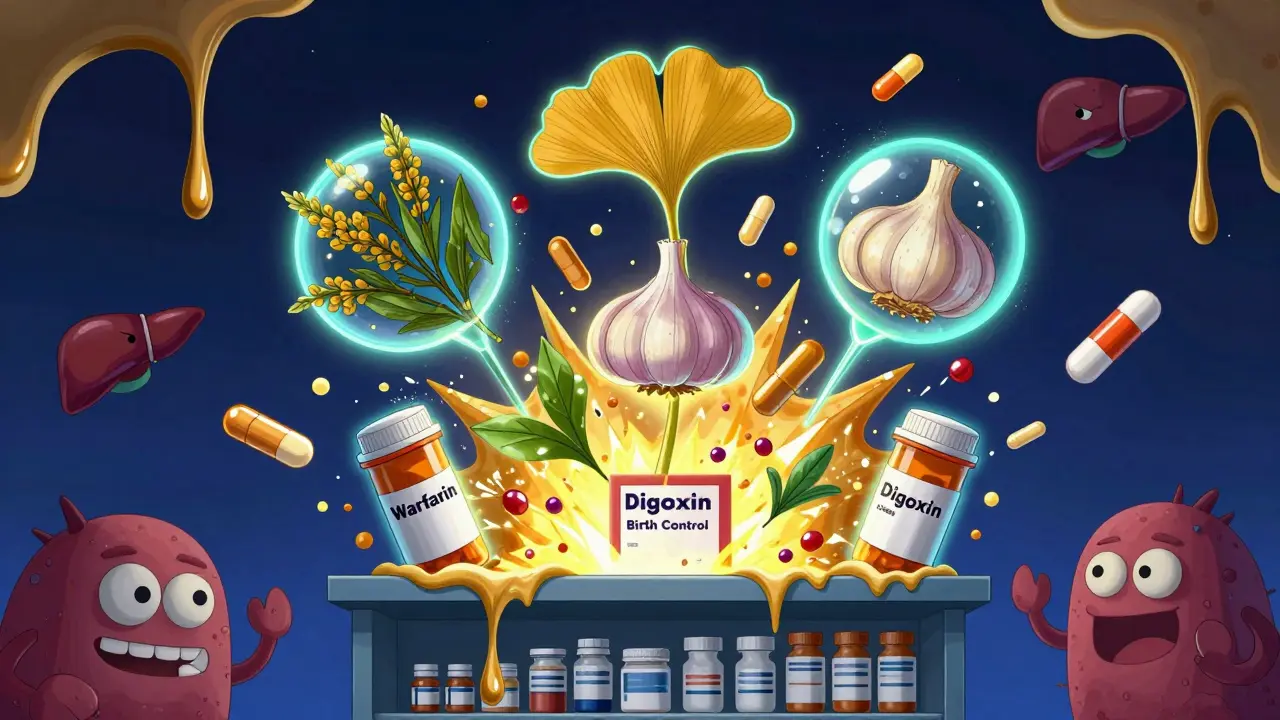
More than 1 in 4 adults in the U.S. take herbal supplements, and nearly 4 in 10 of them are also on prescription medications. That’s not just a coincidence-it’s a ticking time bomb. You might think ‘natural’ means safe, but that’s a dangerous myth. Herbs aren’t harmless teas or harmless powders. They’re potent substances that can mess with your heart meds, blood thinners, antidepressants, and even birth control-sometimes with life-threatening results.
Why Herbal Supplements Aren’t Just ‘Gentle’
Herbal supplements aren’t regulated like prescription drugs. Under the 1994 Dietary Supplement Health and Education Act (DSHEA), companies don’t need to prove their products are safe before selling them. No testing for interactions. No mandatory labeling about risks. You walk into a store, pick up a bottle of St. John’s wort because it’s ‘natural for mood,’ and have no idea it could make your antidepressant useless-or your transplant rejection risk skyrocket.
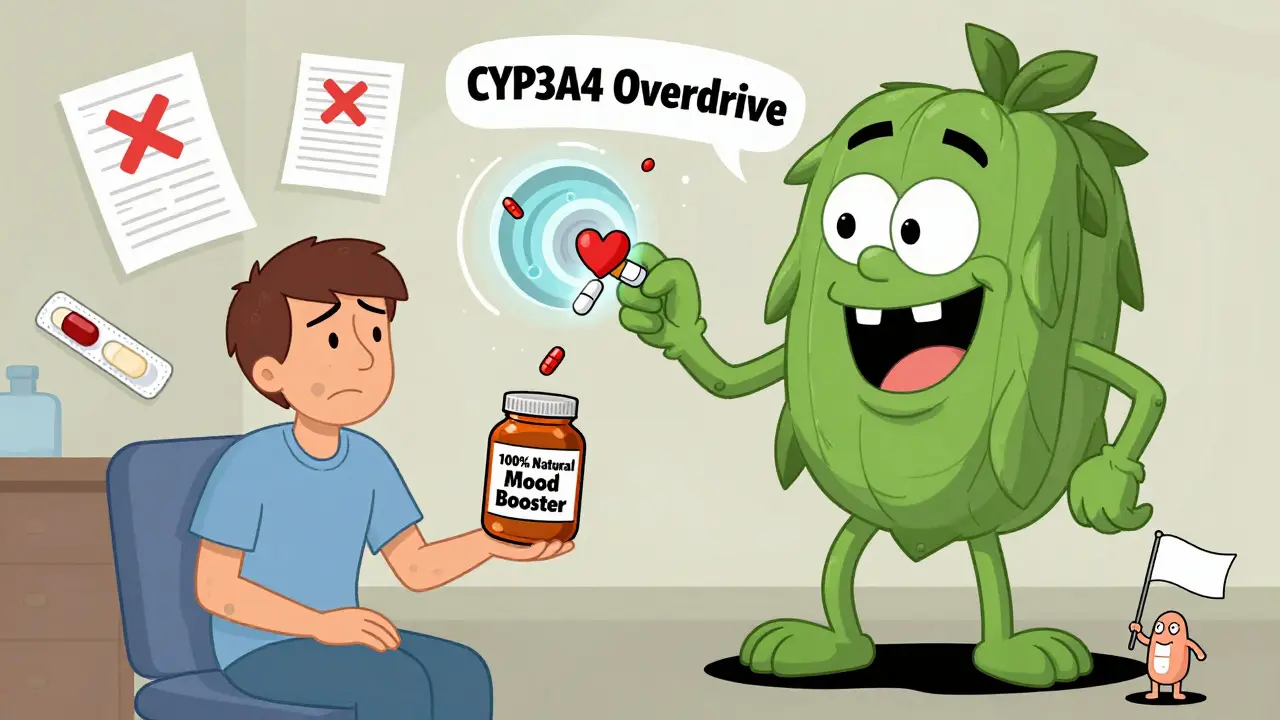
Unlike pharmaceuticals, which go through years of clinical trials, herbal products are sold based on tradition, marketing, and anecdotal claims. Yet their chemical compounds are just as active as drugs. St. John’s wort contains hyperforin and hypericin, which trigger powerful changes in your liver enzymes. These enzymes are the same ones that break down over half of all prescription medications. When herbs interfere, your body either flushes out the drug too fast-or lets it build up to toxic levels.
St. John’s Wort: The King of Dangerous Interactions
If you’re taking just one herbal supplement, avoid St. John’s wort. It’s not just risky-it’s one of the most dangerous botanicals on the market. Research shows it can reduce blood levels of cyclosporine (used after organ transplants) by up to 57%. That’s not a minor drop. That’s the difference between keeping a new kidney alive and losing it.
It doesn’t stop there. St. John’s wort cuts the effectiveness of oral contraceptives so dramatically that over a dozen documented cases of unplanned pregnancy have been linked to it. It lowers levels of HIV medications by 40-80%, making treatment fail. It reduces digoxin-a heart drug-by 25%, which can trigger dangerous arrhythmias. And it doesn’t just affect one pathway. It ramps up CYP3A4 and P-glycoprotein, two major systems your body uses to clear drugs. That means it doesn’t just interfere with one medication-it can wreck dozens.
Doctors at Children’s Hospital of Philadelphia call it the ‘king of drug interactions.’ And they’re not exaggerating. If you’re on any prescription drug, especially for heart, mental health, or immune conditions, St. John’s wort isn’t worth the gamble.
Ginkgo, Garlic, and the Bleeding Risk
People take ginkgo for memory and garlic for heart health. Both seem harmless. But when combined with blood thinners like warfarin or aspirin, they turn dangerous.
Ginkgo biloba inhibits enzymes that break down warfarin, causing it to build up in your blood. A 2009 meta-analysis of 1,200 patients showed a 30% increase in bleeding risk. One hematologist in a Reddit thread reported three bleeding incidents in a single year-all from patients who didn’t tell their doctors they were taking ginkgo. That’s not rare. A 2023 analysis of 4,500 patient reviews on Drugs.com found that 42% of negative warfarin reviews mentioned ginkgo use.
Garlic is worse than most people realize. It doesn’t just thin the blood-it induces CYP3A4, which lowers the concentration of critical drugs like saquinavir (an HIV treatment) by 51%. That’s not a slight dip. That’s treatment failure. And like ginkgo, garlic is often dismissed as ‘just food.’ But when taken in supplement form-capsules, extracts, concentrated doses-it acts like a drug. And it doesn’t care if you’re on blood pressure meds, anticoagulants, or antivirals.
Danshen and Hawthorn: Hidden Heart Risks
Danshen, a traditional Chinese herb used for circulation, sounds like it should help your heart. But when mixed with digoxin, it increases the risk of irregular heartbeat by 35%. That’s not theoretical. It’s documented in a 2012 study published in the Journal of Thrombosis and Haemostasis. Patients who took both developed dangerous arrhythmias that required hospitalization.
Hawthorn is another silent threat. Sold as a natural remedy for high blood pressure, it actually boosts the effects of beta-blockers and digoxin. One patient on the American Heart Association’s forum reported his systolic pressure plummeting to 85 mmHg after combining hawthorn with his blood pressure pill. He ended up in the ER. That’s not an isolated case. Studies show hawthorn can drop blood pressure an extra 10-15 mmHg on top of your meds. For someone already on medication to control hypertension, that’s a recipe for dizziness, fainting, or worse.
Goldenseal and Ginseng: The Silent Saboteurs
Goldenseal is often marketed for immune support. But it’s a potent inhibitor of CYP3A4 and CYP2D6-two enzymes that metabolize over 60% of common drugs. It can spike blood levels of metoprolol (a beta-blocker) by 20-30%, leading to dangerously low heart rate. It can push dextromethorphan (found in cough syrups) into toxic territory, causing seizures or respiratory failure. A 2020 review listed 23 specific drug interactions with goldenseal. Most people have no idea.
American ginseng is trickier. Some studies suggest it reduces the effect of warfarin by acting like vitamin K. One patient saw his INR-a measure of blood clotting-plummet from 4.9 to 1.9 after taking 1,000 mg daily. That’s not a small change. That’s the difference between being protected from clots and being at high risk of stroke. Yet many doctors miss this interaction because they assume ginseng is ‘safe.’ A 2022 assessment found that 62% of healthcare providers failed to identify this risk.
Why You Won’t Hear About This From Your Doctor
Here’s the uncomfortable truth: most doctors don’t ask about herbs. A 2016 study of 299 hospital patients found that 72% of those taking herbal supplements weren’t even known to their medical team. Why? Because doctors assume patients won’t volunteer the info. And patients assume it’s not important.
But it is. When you walk into a clinic and say ‘I take vitamins,’ that’s not enough. Teas, tinctures, powders, capsules-they all count. The Society of Hospital Medicine recommends asking specifically: ‘Do you take any teas, herbs, or natural products?’ That simple change identifies 35% more users than vague questions.
And even when patients do mention herbs, many providers don’t know the risks. A 2021 study showed that using visual aids-photos of common supplements-increased disclosure by 47%. People recognize what they see. They don’t remember what they’re asked.

What You Should Do Right Now
Stop assuming ‘natural’ equals safe. Here’s what you need to do:
- Make a list. Write down every supplement, tea, tincture, or herbal capsule you take-even if you’ve been taking it for years.
- Check your meds. Look at your prescription labels. Are you on blood thinners, heart meds, antidepressants, birth control, or HIV drugs? If yes, you’re at risk.
- Bring the list to your doctor or pharmacist. Don’t say ‘I take supplements.’ Say: ‘Here’s what I’m taking. Can any of this interfere with my prescriptions?’
- Don’t stop meds without talking to your provider. Some interactions are serious, but stopping your drug abruptly can be deadly too.
- Be skeptical of marketing. If a product says ‘100% natural’ or ‘no side effects,’ that’s a red flag. Real medicine has risks. Real herbs have risks too.
There’s no shame in using herbal products. But ignorance is dangerous. You wouldn’t mix bleach and ammonia without knowing the consequences. Why treat herbs any differently?
What’s Changing-and What’s Not
The global herbal supplement market hit $104.8 billion in 2023. Sales are growing. More people are using them. But regulation hasn’t kept up. In the U.S., the FDA issued only 12 warning letters about interaction risks in 2022-despite monitoring over 80,000 products. Only 15% of herbal supplements carry any interaction warning on the label.
Some progress is happening. The FDA released draft guidance in 2023 pushing for mandatory interaction testing for new botanical drugs. The European Medicines Agency now requires full interaction studies for herbal medicines. The NIH spent $12.7 million in 2023 just on herb-drug interaction research.
But here’s the gap: only 3% of primary care providers routinely screen for these interactions. That means the burden is still on you. Your doctor isn’t ignoring you-they’re often just as uninformed as you are. So you have to be the one to speak up.
Final Thought: Natural Doesn’t Mean Safe
Herbs are powerful. They’ve been used for centuries. But modern medicine has changed the game. We’re not taking herbs alone anymore. We’re taking them with pills that keep us alive. That’s a different risk profile. And it’s one we can’t afford to ignore.
If you’re on medication, and you’re taking anything herbal-whether it’s a tea, a capsule, or a tincture-ask. Don’t wait for a crisis. Don’t assume it’s harmless. The data is clear: interactions are real, common, and often deadly. Your safety isn’t up to chance. It’s up to you.

henry mateo
December 31, 2025 AT 02:57i just started taking turmeric for my knees and now i’m paranoid af. i never thought about how it might mess with my blood pressure med. thanks for the wake-up call, this post literally saved me from a hospital trip.
Henry Ward
January 1, 2026 AT 06:30Of course the ‘natural’ crowd thinks they’re above science. You take some ‘herbal magic’ and then wonder why your liver’s failing. It’s not rocket science - if it’s potent enough to change your mood or your heart rhythm, it’s a drug. Stop pretending you’re a yogi and start treating your body like it matters.
Aayush Khandelwal
January 1, 2026 AT 23:06The pharmacokinetic dance between CYP450 isoforms and botanical alkaloids is a beautiful, terrifying symphony. St. John’s wort? A master conductor of hepatic enzyme upregulation - it doesn’t just interfere, it orchestrates a cascade of pharmacodynamic dissonance. We need regulatory frameworks that treat phytochemicals with the same rigor as synthetics. Otherwise, we’re just playing Russian roulette with our cytochrome P450s.
Sandeep Mishra
January 2, 2026 AT 07:20Hey, I get it - we all want to feel better naturally 😊 But if you’re on meds, please, just talk to your pharmacist. They’re the unsung heroes who actually know what’s in that bottle. I used to take ashwagandha with my thyroid med - didn’t realize it was messing with absorption until my TSH went haywire. Now I bring my whole supplement drawer to every appointment. No shame, just safety 💚
Joseph Corry
January 3, 2026 AT 15:13How quaint. The modern West has reduced millennia of Ayurvedic and TCM wisdom to a ‘drug interaction’ spreadsheet. You reduce the holistic to the mechanistic, then pretend you’ve ‘solved’ it. The real danger isn’t the herb - it’s the arrogance of reductionist medicine that assumes it holds a monopoly on truth. Maybe the problem isn’t the supplement. Maybe it’s the system that ignores context, intention, and individuality.
kelly tracy
January 5, 2026 AT 05:12Oh wow, another ‘herbs are dangerous’ fear piece. What’s next? ‘Water can interact with your meds if you take it at the wrong time’? I’ve been taking ginkgo for 8 years with warfarin. My INR’s stable. Your article is just fearmongering dressed up as science.
srishti Jain
January 6, 2026 AT 05:15St. John’s wort ruined my birth control. Got pregnant. Lost the job. Now I’m on welfare. You think that’s ‘natural’? It’s corporate negligence. No one warned me. No label said ‘this will make you a single mom.’
Cheyenne Sims
January 7, 2026 AT 16:57It is imperative that the American public cease treating herbal supplements as benign. The FDA’s lax oversight is a national disgrace. Every capsule sold without standardized potency, interaction testing, or clear labeling is a public health liability. This is not a matter of personal freedom - it is a failure of governance.
Shae Chapman
January 9, 2026 AT 12:42Y’all. I just texted my doctor a pic of my supplement shelf 😭 I had garlic pills, ginkgo, and Danshen all at once with my blood thinner. I didn’t know any of it could be dangerous. I’m crying right now because I almost died. Thank you for posting this. I’m deleting everything until I get the green light. 💔💊🩺
Kunal Karakoti
January 10, 2026 AT 11:28Is safety the absence of risk, or the presence of awareness? We live in an age where we seek control through consumption - pills for sleep, powders for focus, tinctures for peace. But perhaps the real remedy is not more substances, but more questions. Who benefits from your belief that ‘natural’ means harmless? And what are you really trying to heal?
Kelly Gerrard
January 11, 2026 AT 08:23As a healthcare administrator I have seen too many patients come in with unreported herbal regimens. The consequences are preventable. We must institutionalize herb-disclosure protocols. Every intake form must include a checkbox for botanicals. No exceptions. This is not optional. It is medical necessity.
Glendon Cone
January 12, 2026 AT 01:49My grandma took hawthorn for 20 years with her beta-blocker. Never had an issue. But she also didn’t take 3000mg a day - she had a teaspoon of dried berries in tea. Context matters. Dose matters. Quality matters. Not all supplements are created equal. Don’t panic, just be smart. And if you’re unsure? Ask your pharmacist. They love this stuff 🤓
Colin L
January 12, 2026 AT 18:19I’ve been reading this post for 45 minutes because I’m trying to understand if I’m the villain here. I take goldenseal for ‘immune support’ - but I also take metoprolol, lisinopril, and levothyroxine. I didn’t know it could spike my heart meds. I’ve been taking it for three years. I feel like I’ve been sleepwalking through my own health. I just Googled ‘goldenseal metoprolol interaction’ and saw 17 case reports. I’m deleting my bottle right now. I don’t know if I’m angry at myself, the company, or the system. But I’m done pretending this is ‘just a supplement.’
Hayley Ash
January 13, 2026 AT 04:32So the solution is to make everyone a pharmacologist? Because clearly, the only people who should be allowed to live are those who can read a PubMed abstract. Meanwhile, Big Pharma sells you a $5000 pill that causes liver failure and no one bats an eye. But a $12 bottle of garlic? That’s the enemy? How convenient.