 Dec, 16 2025
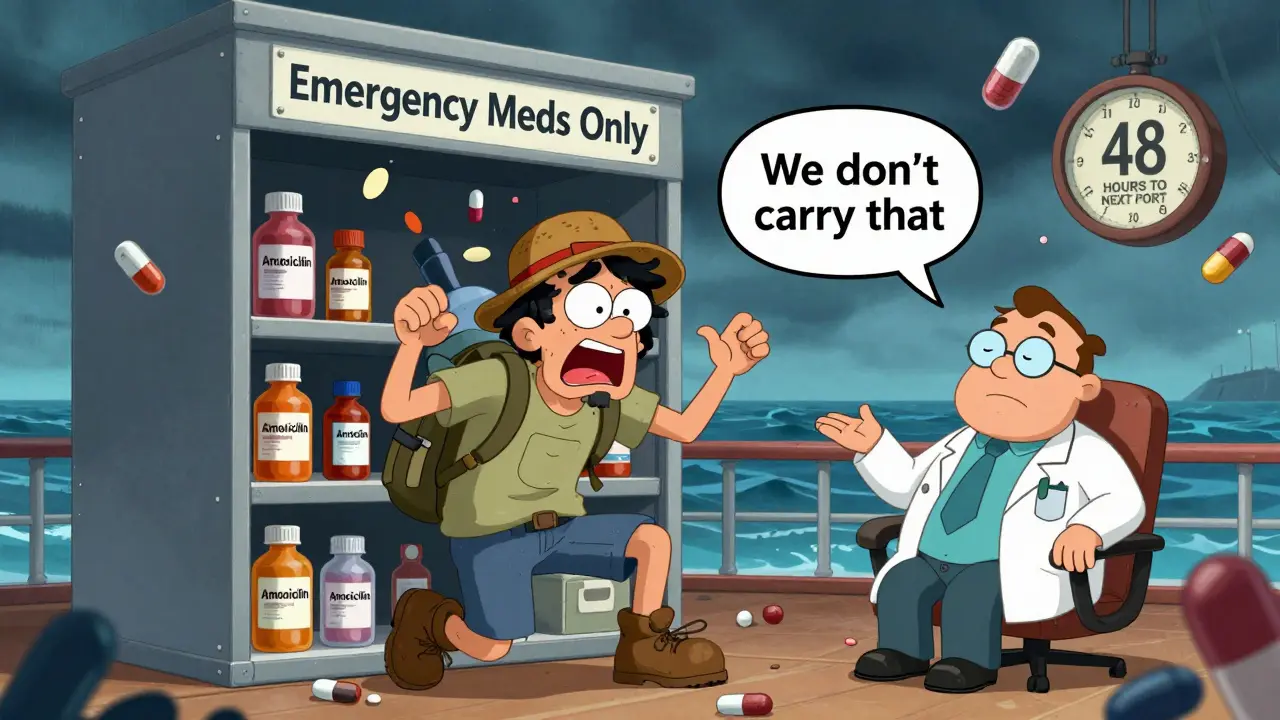
When you're on a cruise, the last thing you want is to run out of your regular medication. But cruise ship medical centers aren’t hospitals. They’re infirmaries - small, understaffed, and stocked with only the most common drugs. If you need a prescription while at sea, you can’t just walk in and expect them to have what you take every day. The truth? Cruise ship pharmacies are designed for emergencies and common illnesses, not your long-term treatment plan.
What You Can Actually Get Onboard
Most cruise ships carry a basic inventory of medications for things like seasickness, stomach bugs, headaches, minor infections, and high blood pressure. Commonly stocked drugs include antacids, antibiotics like amoxicillin, antihistamines, anti-nausea pills, and pain relievers. Some larger ships may have a few diabetes or thyroid medications, but don’t count on it. If you take something unusual - like a specialty biologic, a controlled substance, or a rare hormone - it’s almost certainly not onboard. According to the American College of Emergency Physicians (ACEP), every cruise ship with over 100 passengers must carry a minimum set of emergency medications, including those for heart attacks and severe allergic reactions. But beyond that, stock varies wildly. A 3,000-passenger ship might carry 80 different medications. A smaller vessel? Maybe 40. Storylines, a residential cruise line, is an exception - they offer compounding pharmacies and stock specialty drugs for long-term residents. But for Royal Caribbean, Carnival, Norwegian, or Disney? Don’t assume anything.Why You Shouldn’t Rely on the Ship’s Pharmacy
The biggest problem? Cost. A single antibiotic that costs $10 at your local pharmacy might run you $35-$40 onboard. Insulin? You could pay triple. There’s no price list published, and you won’t know until you’re stuck on the ship with no other option. Even worse, availability is unpredictable. One passenger on Reddit needed a refill of their blood pressure medication after seven days into a 14-day cruise. The ship didn’t carry it. The next port had a pharmacy - but it was closed due to weather. They went without for two days. That’s not rare. Cruise Critic’s 2023 data shows that 23% of medication-related incidents happen because ports are unreachable or pharmacies are closed. And if you’re on a cruise with international stops? Your prescription might be illegal in another country. Even if the ship has it, you could get in trouble if you try to bring it ashore. Always check the laws of every country you’ll visit.What You Must Bring - And How
The only reliable way to avoid a medical crisis at sea? Bring your own meds - and bring enough.- Bring at least a 10-day supply beyond your cruise end date. Delays happen. Storms happen. Your ship might be held in port for repairs.
- Keep all medications in their original, labeled bottles. This isn’t optional. Security and medical staff will ask to see them. Unlabeled pills = suspicion, delays, or confiscation.
- Make sure the name on the bottle matches your passport exactly. If your prescription says “Michael J. Smith” but your passport says “Mike Smith,” you could have problems.
- Pack everything in your carry-on. Checked luggage can get lost. Your meds should be with you at all times.
- Carry a printed list of your medications: name, dosage, frequency, and your doctor’s contact info. Include your condition (e.g., “Type 2 Diabetes,” “Hypertension”).
If you use insulin, CPAP machines, or injectables, bring extra supplies - needles, batteries, distilled water, extension cords. Storylines even recommends bringing your own distilled water for CPAPs. Don’t wait until you’re on the ship to realize you need it.
Special Cases: Narcotics, Insulin, and Chronic Conditions
Narcotics? Forget it. Even if you have a valid prescription for oxycodone or hydrocodone, cruise lines like Storylines state these will only be available in “minimal quantities and prescribed only in emergency or extreme cases.” Most lines won’t refill them at all. If you need pain medication, bring your own - and bring enough. Diabetes patients should carry a doctor’s note explaining insulin use. Some countries require this for entry. Also, bring extra test strips and batteries for your glucose meter. Cold temperatures on deck can ruin insulin. Keep it in a small cooler bag with a cold pack. For chronic conditions like thyroid disease, heart failure, or autoimmune disorders, talk to your doctor before you leave. Ask if you can get a 90-day supply. If you’re on a 10-day cruise, that’s still a good idea. Some insurers allow early refills for travel. Use that.What the Ship Can Do - And What It Can’t
Cruise ship doctors are general practitioners. They’re not specialists. They can treat a bad stomach bug, give you a shot for motion sickness, or prescribe an antibiotic for a sinus infection. They can stabilize you if you have chest pain. But they can’t adjust your antidepressant dose, refill your arthritis biologic, or manage your complex diabetes regimen. If you need something they don’t have, they might call a shore-based pharmacy for advice - but they won’t be able to order it overnight. Telemedicine is becoming more common. Royal Caribbean now offers remote consultations with specialists on land. But even that takes time. You won’t get a new prescription in two hours. The best-case scenario? You have a minor issue - like a yeast infection or mild asthma flare-up - and they have the right meds. In that case, you’ll pay a markup, but you’ll get relief. The worst-case? You’re out of your medication, the ship doesn’t carry it, and the next port is 48 hours away.
Real Stories From the Sea
One traveler on TripAdvisor wrote: “The seasickness pills were free and available 24/7. Saved our first day.” That’s the kind of win you can count on. Another, on Cruise Critic, said: “I forgot my blood pressure pills. They had one brand, but it was a different generic. I took it for two days and felt dizzy the whole time. Ended up paying $45 for a new bottle - and I still didn’t feel right.” A third user on Reddit shared: “I brought my meds in a pill organizer. They wouldn’t let me into the medical center until I showed the original bottles. Took 90 minutes. I was in pain the whole time.” The pattern is clear: people who prepare get through fine. People who assume the ship will help? They struggle.What to Do If You Run Out
If you do run out:- Go to the medical center immediately. Don’t wait.
- Ask if they have a similar medication - even if it’s a different brand or generic.
- Ask if they can contact a pharmacy at the next port to hold a prescription for you.
- If you’re near a port, ask the crew if you can go ashore. Some ships allow short excursions for medical needs.
- If you’re stuck and in real danger (e.g., no insulin), ask for emergency transport. Ships have protocols for urgent evacuations.
But again - this is damage control. It’s not a plan.
Final Rule: Assume Nothing
The cruise industry says it clearly: “View the ship’s medical facility as an infirmary, not a hospital.” That’s not a suggestion. It’s the law. No cruise line guarantees you’ll get your prescription. Even if you call ahead, they’ll tell you they “may be able to help.” That’s code for “we hope you brought your own.” Your job isn’t to hope. Your job is to prepare. Bring enough meds. Bring them in original bottles. Bring a list. Bring extras. Bring backups. If you’re on a two-week cruise, pack 20 days’ worth. If you’re on a month-long voyage? Pack 45 days. And if you’re still unsure? Call your cruise line’s medical department. Ask: “Do you carry [medication name]?” Don’t trust a website. Ask directly. Get a name and email. Write it down. Cruise ships are fun. But your health isn’t a gamble. Don’t risk it.Can I get my regular prescription filled on a cruise ship?
Maybe - but don’t count on it. Cruise ship pharmacies carry only common medications like antibiotics, pain relievers, and seasickness pills. If you take a specialty drug, insulin, or a controlled substance, it’s very unlikely they’ll have it. Always bring your own supply.
How much medication should I bring on a cruise?
Bring at least 10 days’ extra supply beyond your cruise end date. Delays happen due to weather, mechanical issues, or port closures. For longer voyages, pack a 90-day supply if possible. Never rely on refills onboard.
Do I need to keep my meds in original bottles?
Yes. Cruise lines require all medications to be in their original, labeled containers with your name and the pharmacy’s info. Unlabeled pills may be confiscated or cause delays at security. Always keep them in your carry-on.
Are cruise ship medications expensive?
Yes. A single antibiotic that costs $10 at home can cost $35-$40 onboard. Insulin and specialty drugs may cost 200-300% more. There’s no price list, so budget for high costs - or better yet, bring your own.
Can I get narcotics like painkillers on a cruise ship?
Almost never. Narcotics are strictly limited, even for emergencies. Most cruise lines, including Storylines, state they will only provide minimal quantities in extreme cases. Bring your own supply if you need them, and make sure it’s in original bottles with a doctor’s note.
What if I need a refill and the next port has no pharmacy?
Call the medical center immediately. Ask if they can contact a pharmacy at the next port to hold your prescription. If you’re in danger (e.g., no insulin), request emergency evacuation. Prevention is key - always pack extra.
Do cruise ships have telemedicine for prescriptions?
Some, like Royal Caribbean, now offer telemedicine to connect with shore-based doctors. This can help with complex cases, but it doesn’t guarantee a new prescription. It’s a backup, not a solution. Always bring your own meds.

Mike Rengifo
December 18, 2025 AT 09:40Just brought my insulin in a cooler bag with ice packs. Took 3 days to pack. Worth it.
Chris Davidson
December 20, 2025 AT 08:51Bring your meds in original bottles or don't bother boarding. Simple as that. No exceptions. No excuses. The ship doesn't care about your convenience.
Kinnaird Lynsey
December 21, 2025 AT 09:04I once forgot my thyroid med and the ship had a generic. Felt like a zombie for 48 hours. Never again. Now I pack like I'm preparing for a zombie apocalypse.
Glen Arreglo
December 22, 2025 AT 18:33People act like cruise lines are hospitals. They're floating hotels with a nurse on call. If you need more than ibuprofen and Dramamine, you're already doing it wrong. Bring your meds. Pack smart. Or stay home.
shivam seo
December 24, 2025 AT 13:03Why do Americans think they deserve free meds on vacation? In Australia we bring our own and shut up. Also cruise ships are overpriced garbage anyway. Don't waste your money.
benchidelle rivera
December 26, 2025 AT 06:05Let me be clear: if you're on a cruise and you're relying on the ship's pharmacy, you're not just unprepared-you're endangering your life. This isn't a suggestion. It's a medical emergency waiting to happen. Pack your pills. Now.
Andrew Kelly
December 27, 2025 AT 10:31Did you know the government secretly requires cruise lines to stock only placebo pills for chronic conditions? That's why they never have your med. It's all a scam to sell you overpriced generics. I read it on a forum. Trust me.
Isabel Rábago
December 28, 2025 AT 21:55I brought 25 days of my antidepressants. Just in case. You think it's dramatic? I lost my best friend to a missed dose on a cruise. Don't be that person. Don't gamble with your mind.
Anna Sedervay
December 30, 2025 AT 04:28One must consider the epistemological implications of pharmaceutical logistics in transnational maritime environments. The very notion of 'original bottles' is a construct of regulatory hegemony. I carry my meds in glass vials labeled in Latin. The staff was baffled. I felt enlightened.
Matt Davies
December 30, 2025 AT 06:07My buddy took his CPAP on a cruise. Brought extra batteries, distilled water, and even a backup mask. He slept like a king while the rest of us snored like chainsaws. Prep like a pro. You’ll thank yourself at 3am when the ship rocks and your meds are safe.
Ashley Bliss
December 30, 2025 AT 07:52They told me I couldn't bring my biologic on board. I cried. I screamed. I wrote a 10-page letter to the CEO. They finally let me keep it. But I lost my soul that day. This isn't about medicine. It's about control. They want you dependent. Don't let them win.