 Jan, 30 2026
When a drug warning pops up on your screen or in a patient’s chart, it’s easy to assume it applies to everything in that drug family. But that’s not always true. Some safety alerts hit every drug in a class. Others target just one. Mixing them up can lead to unnecessary fear-or worse, missed risks. Knowing the difference between a class-wide and a drug-specific safety alert isn’t just for regulators. It’s critical for doctors, pharmacists, and anyone who prescribes or dispenses meds.
What’s the Real Difference?
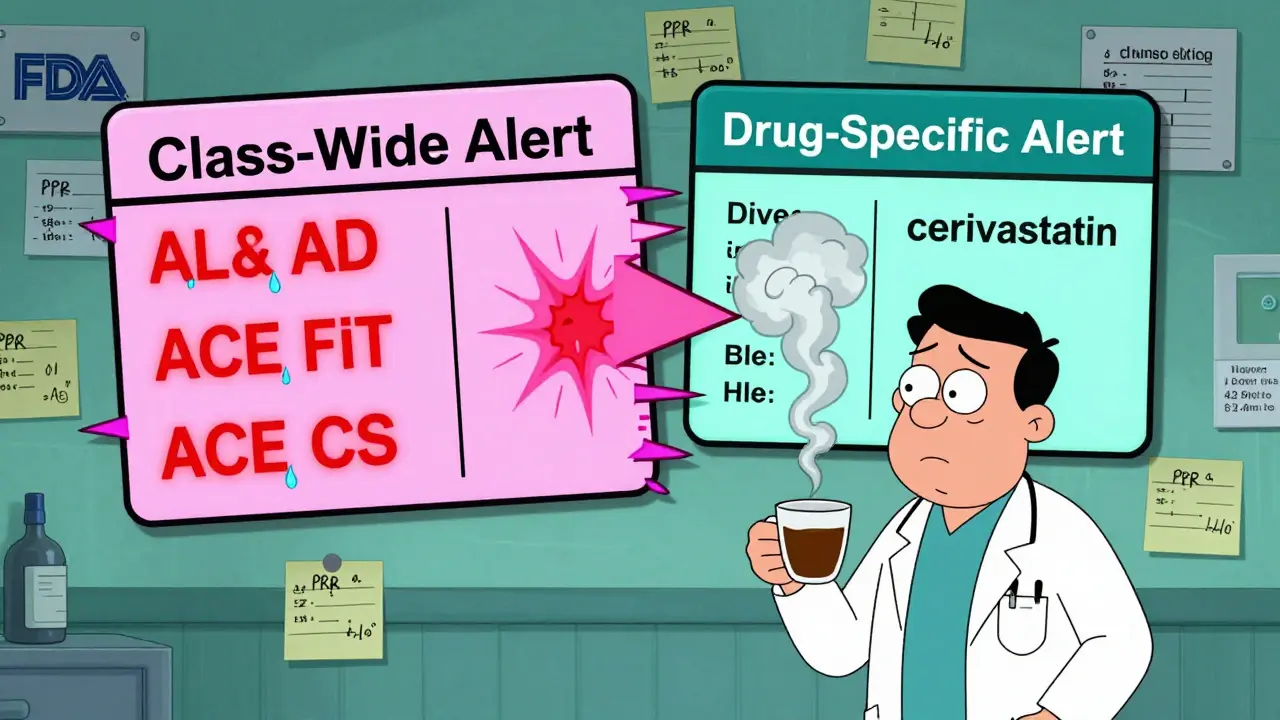
A class-wide safety alert means the risk is tied to how the whole group of drugs works. Think of it like a shared blueprint. For example, all ACE inhibitors can cause angioedema because they block the same enzyme in the body. If one drug in the class shows this side effect, and the mechanism is the same across others, regulators may issue a class-wide warning. A drug-specific alert, on the other hand, is about the unique chemistry of one drug. Take cerivastatin. It was pulled from the market in 2001 because it caused deadly muscle damage (rhabdomyolysis) at rates far higher than other statins. But other statins-like atorvastatin or rosuvastatin-stayed on shelves. Why? Their metabolism, dosage, and molecular structure didn’t carry the same risk. The problem wasn’t the class. It was that one drug.How Regulators Decide: The FDA’s Process
The U.S. Food and Drug Administration doesn’t guess. They dig into millions of reports. The FDA Adverse Event Reporting System (FAERS) holds over 22 million reports as of 2023. When a potential safety signal shows up, they don’t just look at one case. They check:- How many reports are there for this drug versus others in the class?
- Is the signal consistent across multiple databases?
- Is there a biological reason the risk should be shared?
Why It Matters in Real Life
Confusing these two types of alerts has real consequences. In 2018, the FDA warned about disabling side effects-like tendon rupture and nerve damage-with all fluoroquinolone antibiotics. That’s class-wide. Use of these drugs dropped by 17% across the board, even though some patients still needed them for serious infections. Doctors started avoiding them entirely, even when no other options worked. Meanwhile, the 2004 withdrawal of valdecoxib (Bextra) only affected that one drug. Celecoxib (Celebrex), another COX-2 inhibitor, stayed on the market because its risk profile was different. Patients didn’t lose access to a whole class of pain meds-just one risky option. But here’s where things get messy. Sometimes, a drug-specific warning turns out to be class-wide later. Rosiglitazone got a boxed warning for heart risks in 2005. Pioglitazone didn’t. But years later, studies showed pioglitazone carried similar risks. The warning wasn’t updated in time. That confusion left doctors unsure what to prescribe.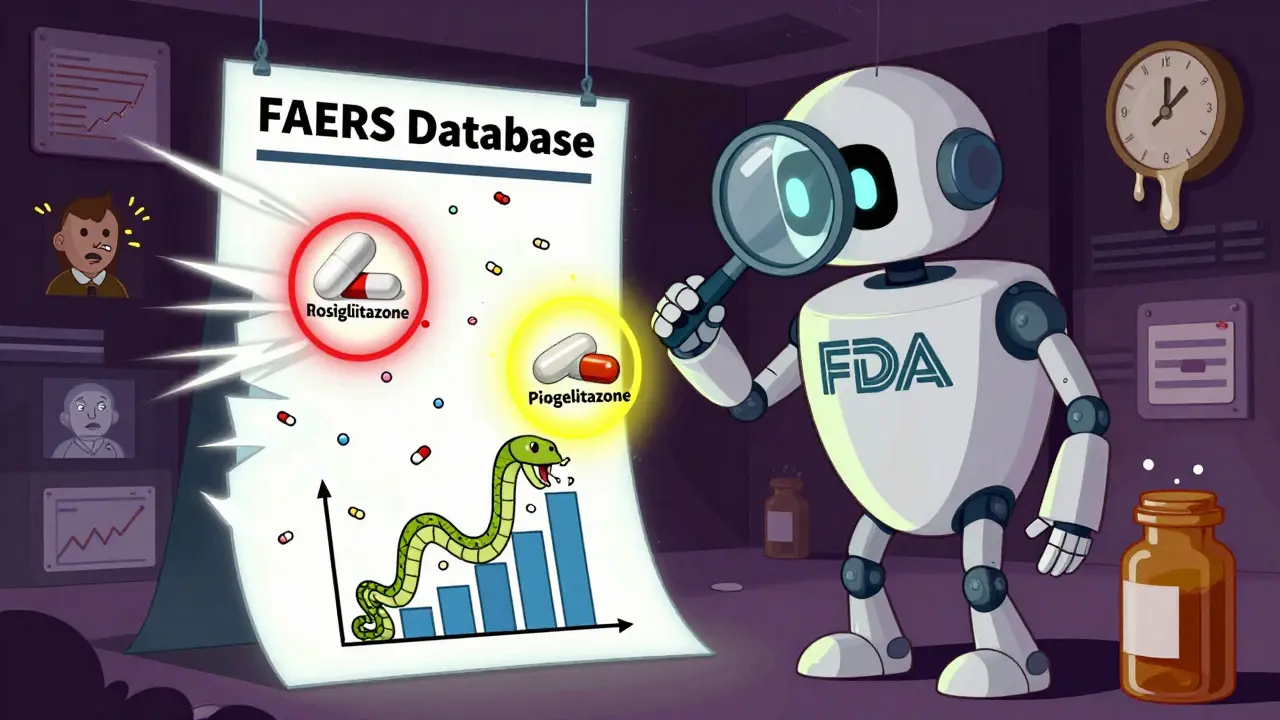
How Clinicians Can Tell Them Apart
You don’t need to be a data scientist to spot the difference. Here’s what to look for:- Check the label wording. If it says “all drugs in this class” or “this class of medications,” it’s class-wide. If it names one drug only, it’s drug-specific.
- Look at the FDA’s Drug Safety Communications. Since 2023, the FDA labels alerts as either “Class Risk” or “Agent-Specific Risk.” That’s a big help.
- Use DailyMed. The National Library of Medicine’s database color-codes warnings. Red = class-wide. Yellow = drug-specific.
- Ask: Is there a plausible biological reason? If the drug shares a metabolic pathway, receptor target, or chemical structure with others in the class, the risk is more likely to be shared.
- Check the evidence base. Class-wide warnings usually come from multiple studies, real-world data, and sometimes post-market trials across several products. Drug-specific ones often come from isolated case reports or one large trial.
Pitfalls Even Experts Miss
Even seasoned clinicians get tripped up. One common mistake? Assuming all drugs with similar names are the same. There are 17 cephalosporin antibiotics with “cef” in their names. But only a few carry a high risk of severe allergic reactions. Just because two drugs sound alike doesn’t mean they share risks. Another? Confusing drug recalls with safety alerts. A Class I recall means the drug could cause serious harm or death. That’s about the product’s safety status, not whether the risk applies to the whole class. You can have a Class I recall on one drug without affecting others. A 2022 survey of 1,200 U.S. physicians found 68% were unsure whether a warning applied to their whole class or just one drug. Primary care doctors were the most confused-73% said they’d prescribed the wrong alternative because of uncertainty.
What’s Changing Now?
The system is getting better. In January 2024, the FDA launched a new standardized warning taxonomy. Every drug label now clearly states whether the risk is “Class Risk” or “Agent-Specific Risk.” That’s a huge step toward clarity. They’re also using AI to predict class effects before they’re obvious. IBM Watson Health’s Drug Safety Intelligence tool analyzes molecular structures and metabolic pathways to flag potential class-wide risks early. In a 2022 study, it correctly identified class signals with 89% accuracy. The FDA’s 2024-2026 plan includes using real-world data from the National Evaluation System for health Technology (NEST), which pulls info from 100+ healthcare systems covering 100 million patients. That’s going to cut down guesswork. But challenges remain. About 72% of drug classes still lack enough post-market data to confidently assign risk scope. And manufacturers push back-PhRMA says 37% of proposed class-wide warnings since 2015 were dropped after companies showed the risk was isolated to one drug.What You Should Do
If you’re prescribing or dispensing:- Always check the latest FDA Drug Safety Communication before making a decision.
- Don’t assume a warning on one drug means all are unsafe.
- Use DailyMed or the FDA’s website to confirm the scope.
- When in doubt, ask a pharmacist. They’re trained to spot these differences.
- Consider alternatives. If a drug has a class-wide warning, is there a safer option with similar effectiveness?
Frequently Asked Questions
How do I know if a safety alert applies to all drugs in a class?
Check the FDA’s Drug Safety Communications or DailyMed. Since January 2024, all new labels clearly label risks as either "Class Risk" or "Agent-Specific Risk." If the warning mentions "all drugs in this class," "this class of medications," or uses broad language like "therapeutic class," it’s class-wide. If it names only one drug, it’s drug-specific.
Can a drug-specific warning become class-wide later?
Yes. That’s happened before. Rosiglitazone got a boxed warning for heart risks in 2005, but pioglitazone didn’t-until later studies showed both carried similar risks. Class-wide warnings often come after more data is collected. What starts as a drug-specific signal can turn into a class-wide concern if evidence builds across multiple agents.
Why do some drugs in the same class have different warnings?
Because not all drugs in a class are the same. They may have different chemical structures, how they’re metabolized, or dosing patterns. For example, cerivastatin was withdrawn because it was broken down by a liver enzyme that other statins didn’t rely on. That made it far more likely to cause muscle damage. Differences like these justify separate warnings.
Are class-wide warnings always accurate?
Not always. Some class-wide warnings are issued due to limited data or precautionary logic. Dr. Janet Woodcock, former FDA Acting Commissioner, noted that 72% of drug classes lack enough post-market data to confidently assign risk scope. That means some warnings may be overbroad. But they’re usually issued when the potential harm is serious enough to warrant caution until more data comes in.
How do pharmacists handle class-wide warnings differently than drug-specific ones?
With a drug-specific warning, they just check if the prescribed drug is the one flagged. With a class-wide warning, they have to review all possible alternatives. Walgreens reported a 22% increase in pharmacist review time after class-wide alerts, because they need to evaluate entire therapeutic categories-not just swap one drug for another.

Eliana Botelho
January 31, 2026 AT 05:55So wait, you're telling me the FDA doesn't just slap a warning on everything that looks like it might be related? Like, what even is the point of having a class if not to treat it as one big dangerous blob? 🤔 I mean, I get the science, but why not just say 'all these drugs are sketchy' and be done with it? Saves time, less confusion, less lawyering.
Darren Gormley
February 1, 2026 AT 17:25Class-wide alerts are just regulatory laziness dressed up as caution. 🤡 They don't want to do the work of analyzing individual pharmacokinetics, so they blanket the whole class. I've seen patients get denied life-saving meds because some idiot at the FDA decided 'all statins = bad' after one outlier. The PRR is garbage when your baseline data is trash.
Natasha Plebani
February 2, 2026 AT 08:14There's an epistemological tension here: the reductionist impulse to categorize vs. the ontological reality of molecular individuality. Class-wide alerts assume homogeneity where heterogeneity exists - a category error rooted in structural simplification for administrative efficiency. The FDA's reliance on PRR and Chi-squared metrics reflects a positivist bias that ignores qualitative pharmacodynamic variance. Rosiglitazone and pioglitazone aren't interchangeable - their glucocorticoid receptor binding affinities differ, and that's not captured in aggregate reporting systems. We're medicating with algorithms, not physiology.
Russ Kelemen
February 2, 2026 AT 15:47Hey, I know this stuff is dense, but you guys are making it harder than it needs to be. Just remember: if the warning says 'all drugs like this,' it's class-wide. If it names one brand, it's just that one. Use DailyMed - the colors are right there. Red = think twice about the whole group. Yellow = swap the one drug. And if you're still stuck? Ask your pharmacist. They've seen this movie 100 times. You don't need to be a data scientist to be safe.
Niamh Trihy
February 3, 2026 AT 09:37As a clinical pharmacist, I can confirm: class-wide alerts are a nightmare for workflow. We have to check every alternative in the class, which can mean reviewing 5-10 drugs instead of one. Walgreens data shows a 22% increase in review time. But here’s the thing - it’s worth it. I had a patient on celecoxib after Bextra got pulled. If we’d assumed all COX-2 inhibitors were equal, she might’ve gotten a different drug with worse GI side effects. Precision matters.
Jason Xin
February 5, 2026 AT 01:22Y’all are overthinking this. The FDA’s new taxonomy is literally just labeling things as 'Class Risk' or 'Agent-Specific Risk.' That’s it. No math, no jargon, no conspiracy. If it says 'class,' avoid the whole group. If it says 'agent,' swap the one. Simple. The fact that 68% of docs are still confused says more about medical education than the system. Maybe stop trusting Google and start reading the damn label.
Yanaton Whittaker
February 6, 2026 AT 21:16AMERICA IS BEING POISONED BY BUREAUCRATS WHO DON'T KNOW MEDICINE! 🇺🇸💥 The FDA is just trying to control us with fake science. Why do you think they didn't warn about all statins when cerivastatin went down? BECAUSE THEY'RE IN BED WITH PHARMA! This is how they keep you dependent on expensive brand names. Wake up, sheeple. DailyMed is a lie. Check the raw FAERS data yourself - it's all manipulated.
Sheila Garfield
February 8, 2026 AT 11:20I get why this is confusing. I’ve had patients panic because their blood pressure med got flagged, and they assumed every similar drug was off-limits. But I think the system’s trying. The new labeling helps. Maybe we just need more training for frontline providers - like a 5-minute refresher during CME. Not everyone’s a data nerd, but everyone needs to know how to read a warning without losing sleep.
Donna Fleetwood
February 10, 2026 AT 01:07This is actually really cool! I used to dread prescribing anything with a warning, but now I feel like I actually understand what’s going on. The AI tools sound wild - imagine if we could predict risks before the drug even hits the market? That’s next-level. Let’s keep pushing for better tools and clearer labels. We’re getting there. 🙌
Diana Dougan
February 11, 2026 AT 21:50Class-wide alerts? More like class-wide panic. I’ve seen people get denied metformin because of some fluke with another biguanide. LMAO. The FDA’s so obsessed with avoiding rare events they make common ones worse. And DailyMed? The color coding is useless if your screen is blurry. Just ask the patient if they’ve had a reaction before. That’s real medicine.
Beth Cooper
February 13, 2026 AT 19:19They’re hiding something. Why did they wait until 2024 to label these properly? Because they knew class-wide warnings scare people away from generics - and that’s where the $$$ is. Big Pharma paid them off. Look at the stats: 37% of class warnings got dropped after pharma pushed back. Coincidence? Nah. They’re selling fear to sell drugs. And now they’re using AI to make it look legit. 🤖💸
Sarah Blevins
February 14, 2026 AT 13:45The reliance on FAERS data is methodologically flawed. Reporting bias, underreporting, and confounding by indication are pervasive. The PRR threshold of 2.0 lacks validation against clinical outcomes. Class-wide alerts based on these metrics risk overestimating risk and underestimating benefit. A more rigorous, prospective cohort-based approach is needed - not post hoc signal detection from noisy, uncontrolled databases.
Mike Rose
February 15, 2026 AT 21:20why do we even have classes if they dont all act the same? like why even call them the same thing? its dumb. just give em all different names and stop confusing people. also who even uses dailymed? its ugly. i just google it and hope for the best.
Kathleen Riley
February 16, 2026 AT 22:50It is my considered judgment, informed by a rigorous engagement with the epistemological frameworks underpinning pharmacovigilance, that the current regulatory paradigm represents a hermeneutic failure - a misalignment between the phenomenological reality of pharmacological individuality and the ontological homogenization imposed by bureaucratic taxonomy. The PRR, as a quantitative heuristic, cannot capture the qualitative singularity of molecular interaction. To conflate statistical signal with biological truth is to commit a category error of the highest epistemic order.
Shawn Peck
February 18, 2026 AT 03:41EVERYONE IS WRONG. The FDA doesn't know what they're doing. I read a study that said 90% of class-wide warnings are wrong. And guess what? They still let you take the drugs anyway. That's because they're scared of lawsuits. If you want to be safe? Don't take any meds. Ever. Just eat kale and pray. 🙏