 Apr, 29 2026
Imagine reaching your dream Caribbean port or finally arriving at a scenic national park, only to realize your essential heart medication is sitting in a suitcase that was lost or left at a hotel three states back. It happens more often than you'd think. Whether you're navigating the high seas or the open highway, the stakes for medication management are high. A simple mistake, like moving pills into an unlabeled container, can lead to everything from a denied entry at a foreign port to a costly medical emergency in a remote area.
Quick Tips for Medication Travel
- Always use original containers: Keep pharmacy labels intact to avoid customs issues.
- Pack extra: Bring at least 3 extra days of meds for cruises and 1 for road trips.
- Carry-on only: Never check your essential prescriptions in luggage.
- Document everything: Carry a physical and digital list of generic drug names and dosages.
- Check local laws: Some medications are illegal in specific cruise destinations or US states.
The Golden Rule: Carry-On Only
If there is one thing you should take away from this guide, it's this: never put your essential medications in checked luggage. While it seems convenient, the risk is simply too high. According to SITA's 2022 Baggage Report, about 0.02% of luggage gets lost annually. That might sound small, but if you're in that percentage, a missing insulin pen or blood pressure pill isn't just an inconvenience-it's a crisis.
The Transportation Security Administration (TSA) is actually very lenient with prescriptions. You are allowed to bring reasonable quantities of medication in your carry-on without volume restrictions. Royal Caribbean and other major cruise lines explicitly mandate that medications stay in your hand luggage to prevent loss or diversion. If you're on a road trip, keep your meds in the cabin of the car, not tucked away in a trunk where extreme temperatures can degrade the chemicals in the pills.
Packing for Cruises: Navigating International Waters
Cruising is more complex than driving because you're dealing with multiple jurisdictions. What's legal in Florida might be a controlled substance in a Caribbean port. Many cruisers make the mistake of transferring their pills into daily organizers to save space. Don't do this. A verified travel nurse noted that a huge number of medication issues at ports stem from unlabeled containers, sometimes leading to denied entry.
To stay compliant, keep everything in original pharmacy packaging. If you absolutely must use an organizer, tape it shut and label it clearly with your name and the date. Also, be aware that Carnival Cruise Line and Norwegian Cruise Line have strict policies on Schedule II substances, like those containing codeine. You may need to declare these 30 days before you sail or provide a physician's letter.
Because delays are common-affecting roughly 23% of international travel-you need a buffer. The general rule of thumb is to pack at least two to three extra days of medication. This protects you if the ship is delayed or if you have a sudden itinerary change.
Packing for Road Trips: State Lines and Stability
Road trips feel simpler, but they have their own pitfalls. The biggest hurdle is the variation in state laws. For example, while medical marijuana is approved in 38 states, it remains illegal in 13 others. Crossing a border with a substance that is legal in your home state but illegal in the next can lead to confiscation or legal trouble.
Another major concern for road trippers is temperature. Biologic medications, such as insulin, are sensitive to heat. If you're driving through a desert in July, your glove box becomes an oven. Invest in UV-protective medication cases or small coolers that maintain temperature control. Unlike cruise passengers, road trippers have the advantage of being near pharmacies-90% of Americans live within five miles of one-but you should still be self-sufficient for at least a few days.
| Feature | Cruises | Road Trips |
|---|---|---|
| Primary Risk | International law/customs | Varying state laws/temperature |
| Packaging | Original labels mandatory | Preferred, but more flexible |
| Extra Supply | 3+ extra days | 1-2 extra days |
| Documentation | Doctor's letter/Digital list | ID and prescription |
| Access to Refills | Limited (Ship medical center) | High (Local pharmacies) |
How to Organize Your Meds Like a Pro
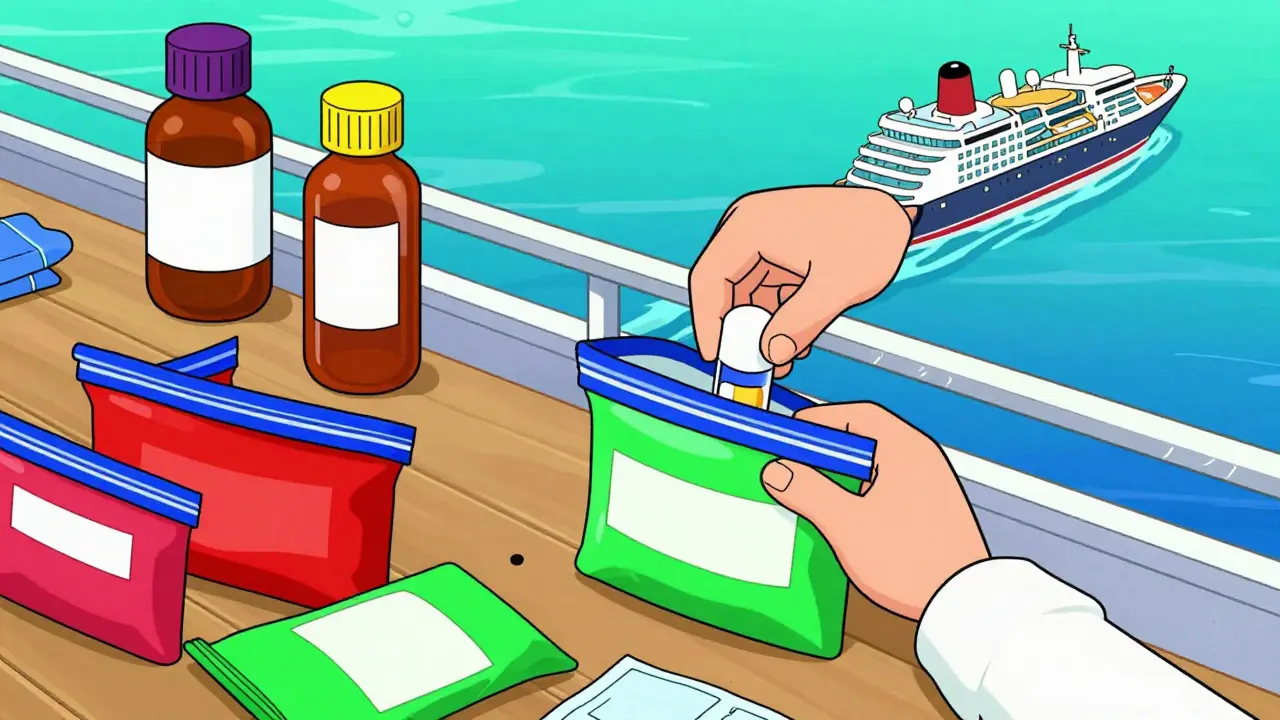
Organization is where most people fail. If you're managing multiple prescriptions, a chaotic bag is a recipe for a missed dose. A highly effective system used by experienced travelers involves color-coded Ziploc bags. Assign one color for "morning," another for "evening," and a third for "as needed." Place the original containers inside these bags. This keeps your meds grouped by time of day while keeping the legal labels visible.
For those who prefer other methods, here are the accepted organizational systems:
- Daily Pill Cards: Single pills in bubbles, easy to track.
- Unit Dose Boxes: Pre-measured doses that prevent double-dosing.
- Pill Minders: Great for road trips, but must be taped shut and labeled for cruises.
- Pill Envelopes: Must include traveler's name, date, time, and pill count.
Beyond the pills themselves, you need a "medical master file." The CDC recommends a list containing the drug name, generic name, dosage, and frequency. Keep one physical copy in a waterproof sleeve and one digital copy on your phone. This is a lifesaver if you end up in a foreign clinic where the staff doesn't recognize a brand name but knows the generic version.

Pre-Trip Checklist and Timing
Don't wait until the night before your departure to scramble for refills. Start your preparation 30 days out. This gives you enough time to consult your doctor about the legality of your meds in your destination countries and to request extra supplies from your pharmacy.
Spend about two to three hours on the final preparation. This includes:
- Verifying all medication expiration dates.
- Creating your digital medication record.
- Transferring meds to approved, labeled containers.
- Getting a signed letter from your doctor for controlled substances.
- Packing your meds last in your carry-on so they are the most accessible items.
Remember that carrying your own meds is not a substitute for insurance. If you're cruising, be aware that a medical evacuation from a ship can cost upwards of $48,000. Always pair your careful packing with comprehensive travel medical insurance.
Can I use a weekly pill organizer on a cruise?
You can, but it is risky. Many cruise lines and customs agents prefer medications in their original pharmacy containers. If you use a pill minder, you must label it clearly with your name and medication details and keep a copy of your prescriptions. To avoid any delays or denied entry at ports, keeping pills in original bottles is the safest bet.
What happens if I run out of medication on a cruise?
Most cruise ships have a medical center that can provide basic replacements or emergency doses, but they may not have your specific brand or a high-strength version. This is why packing a 3-day buffer is critical. If you run out of a critical medication, the ship's doctor can help, but the cost is typically much higher than at a land-based pharmacy.
Do I need a doctor's note for ADHD medication?
Yes, absolutely. Many ADHD medications are stimulants, which are strictly controlled in several countries. In some Caribbean destinations, these require special permits. A doctor's letter explaining the medical necessity, along with the original prescription, is essential to avoid having the medication confiscated at customs.
How do I keep insulin cool during a long drive?
Avoid the glove box or trunk, as these areas experience extreme temperature swings. Use a dedicated medical cooler bag or a UV-protective case designed for biologics. If you don't have one, a small insulated lunch bag with a gel pack (kept away from direct contact with the insulin to prevent freezing) can work for short stretches.
Are there any limits to how much medication I can bring through TSA?
TSA allows you to bring reasonable quantities of prescription medication in your carry-on. These are exempt from the 3-1-1 liquids rule, meaning you can bring liquid medications (like syrups or insulin) in quantities larger than 3.4 ounces, provided you declare them at the security checkpoint.
Next Steps for a Stress-Free Trip
If you're heading out soon, your first move should be to check the Medication Travel Checklist provided by the CDC. If you are traveling to a country with strict drug laws, contact the local embassy or use a resource like Smartraveller to see if your specific meds are banned. For those with biologic meds, a quick call to your pharmacist to ask about "travel packs" or cooling sleeves can save you from a ruined prescription. Finally, take a photo of all your prescription labels and upload them to a secure cloud folder-it's the fastest way to prove ownership if you lose your physical paperwork.
