 Dec, 5 2025
Most travelers don’t think about their meds until they’re boarding the plane. But if you’re taking antimalarials or antiretrovirals - and you’re crossing multiple time zones - getting the timing wrong can mean more than just a missed dose. It could mean malaria, drug resistance, or a rebound in HIV viral load. The truth? Antimalarials and antiretrovirals don’t play nice with jet lag. And antibiotics? They’re rarely the issue here. Most guidance focuses on antimalarials and HIV meds because their windows for error are razor-thin.
Why Timing Matters More Than You Think
It’s not about being punctual. It’s about keeping drug levels steady in your bloodstream. For antiretrovirals, a drop below the therapeutic threshold can let HIV replicate. That’s how drug-resistant strains start. For antimalarials like Malarone, missing a dose during exposure means your body has no shield against the parasite. One missed pill in a malaria zone isn’t just a slip - it’s a gamble with your life.
Take Atovaquone-proguanil (Malarone). It needs to be taken daily, with food - preferably fatty food. A 2008 study showed it absorbs 300-400% better with a meal. Skip the food? You’re basically taking sugar pills. Now add a 14-hour flight from New York to Bangkok, where meal service is at 3 a.m. your body time, but it’s 4 p.m. local time. Do you take it now? Wait? You’re already in a time zone where your body thinks it’s bedtime, but your pill schedule says it’s lunchtime.
Antimalarials: The Rules by Type
Not all antimalarials are created equal. Your choice changes everything.
- Atovaquone-proguanil (Malarone): Start 1-2 days before entering a malaria area. Take daily. Continue for 7 days after leaving. Must be taken with food. Forgiveness window: 12 hours for prevention, 8 hours if you’re treating active infection. Miss a dose? Restart the clock - you need to take it for 4 more weeks after you resume.
- Chloroquine: Used in areas where malaria isn’t resistant. Dose is based on weight: 10 mg/kg on day 1 and 2, then 5 mg/kg on day 3. It’s forgiving - you can shift your dose by up to 6 hours without major risk. But it’s less effective now in most of Africa and Southeast Asia.
- Mefloquine: Taken weekly. This is the easiest for time zones. You can stick to your home schedule for up to 10 days before adjusting. But 1 in 8 people get severe side effects - anxiety, hallucinations, dizziness. Not worth the risk for most.
- Artemether-lumefantrine (ACT): Used for treatment, not prevention. Requires 4 tablets now, 4 more in 8 hours, then twice daily for the next 2 days. All doses need fat. That’s a nightmare on a flight. No meal? No drug effect. No cure.
The CDC’s 2024 Yellow Book says this clearly: your first dose of Malarone should be timed to your arrival in the malaria zone, not your departure. If you land in Cambodia at 10 p.m. local time, your first dose should be at 10 p.m. Cambodia time - even if you just flew 18 hours and your body thinks it’s 4 a.m.
Antiretrovirals: The Precision Game
If you’re on HIV meds, you’re playing a different game. Forgiveness varies wildly by drug.
- Dolutegravir: Can handle up to 12 hours off schedule. One of the most forgiving. Still, don’t push it.
- Raltegravir: 8-hour window. Miss it? Take it as soon as you remember.
- Tenofovir/emtricitabine: 6 hours. After that, risk of resistance climbs.
- Protease inhibitors (e.g., darunavir): Only 4-6 hours. Miss one? You’re in danger zone.
Here’s the hard truth: if your viral load isn’t suppressed, you shouldn’t be traveling without a detailed plan. A 2015 review in the Journal of the International AIDS Society found that travelers with unsuppressed HIV were 3x more likely to experience rebound after time zone shifts. The CDC recommends starting to adjust your dose schedule 72 hours before departure if you’re crossing more than 8 time zones.
How? Shift your dose by 1-2 hours per day. If you’re flying east from Brisbane to London (10-hour time difference), start taking your pill 2 hours earlier each day for 3 days before you leave. That way, when you land, your body is already halfway adjusted.
Real Traveler Stories (And What Went Wrong)
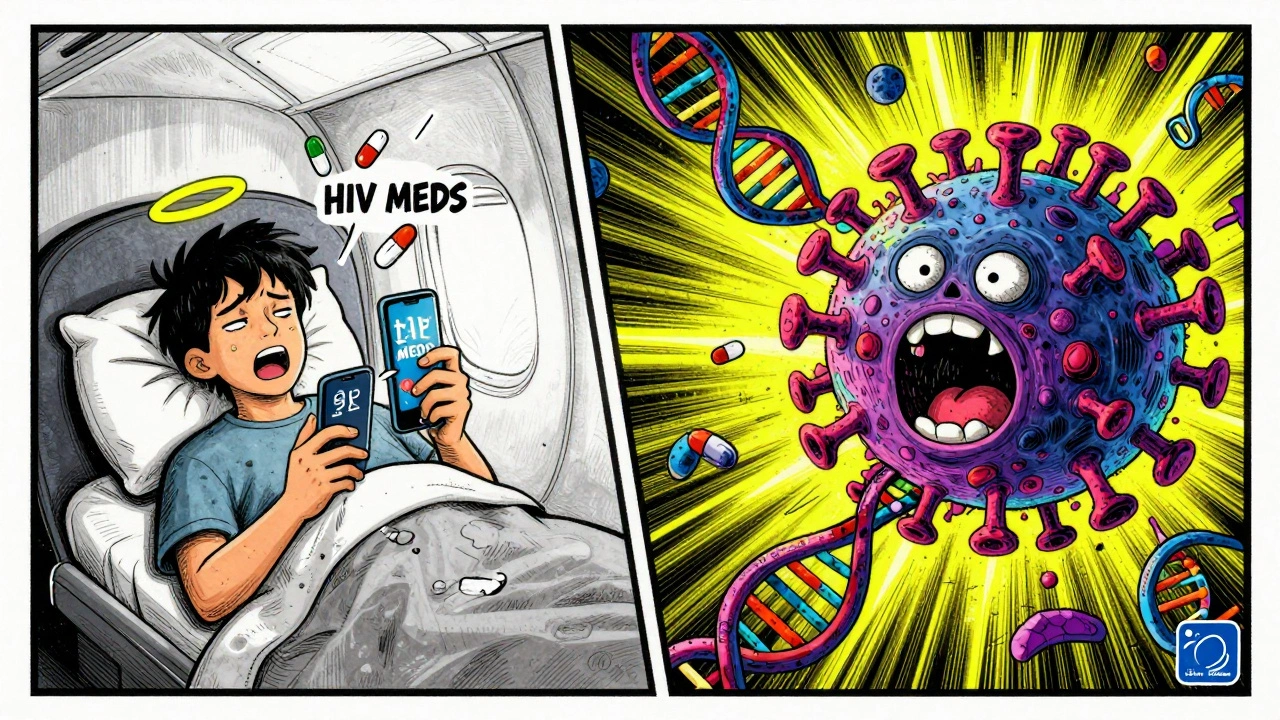
Reddit user ‘MalariaSurvivor’ took Malarone on an empty stomach during a layover in Dubai. Vomited within 20 minutes. Had to restart prophylaxis for 4 extra weeks. Lost a week of vacation.
On Lonely Planet’s forum, ‘HIV_Wanderer’ set four alarms for doses during a 16-hour flight from London to Sydney. Slept through them all. Viral load jumped to 1,200 copies/mL within six weeks. Needed a new drug regimen.
These aren’t rare. The International Association of Physicians in AIDS Care surveyed 1,450 travelers in 2022. 23% missed doses. 7.8% had viral rebound. That’s nearly 1 in 12.
How to Actually Do It: A Simple Plan
Forget complicated charts. Here’s what works:
- Plan 4-6 weeks out. Talk to your doctor. Get a printed schedule with your exact doses, times, and food requirements.
- Calculate your destination time. Use a time zone converter. Know exactly when you’ll land. That’s your new baseline.
- Adjust your dose schedule gradually. Shift by 1-2 hours per day before departure. Don’t try to jump 10 hours overnight.
- Use Medisafe or similar apps. It’s rated 4.7 on iOS. Set alarms for local time at your destination - not your home time. Sync them with your flight schedule.
- Carry food. Pack nuts, cheese sticks, or peanut butter packets. If your antimalarial needs fat, don’t rely on airline meals. They’re often low-fat and served at random times.
- Never skip the last dose. For Malarone, you must take it for 7 days after leaving the malaria zone. People get lazy. That’s when they get sick.
What No One Tells You
Jet lag isn’t just tiredness. It messes with your stomach, your sleep cycle, and your ability to remember pills. If you’re on a long flight, the cabin lighting is bright at night and dark during the day - your body gets confused. Your circadian rhythm is screaming for sleep, but your pill says it’s time to eat.
And here’s the kicker: most pharmacies in malaria-endemic countries don’t have the same brand names. You might need to switch. Always carry a copy of your prescription in English. Know the generic names: atovaquone-proguanil, not just “Malarone.”
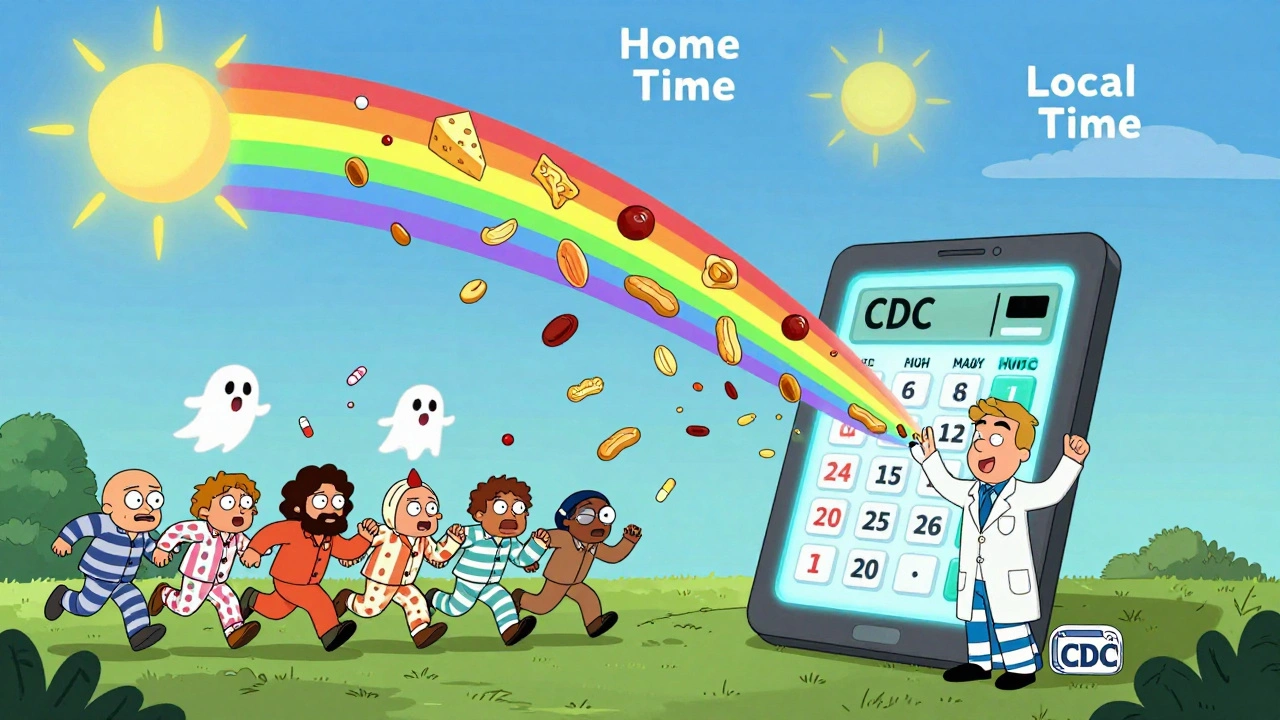
The CDC launched a free Malaria Prophylaxis Timing Calculator in February 2024. You plug in your flight, your meds, and your start/end dates - and it spits out a daily schedule. It reduced errors by 63% in a Johns Hopkins trial. Use it.
The Future Is Coming - But Not Yet
Long-acting injectable HIV drugs like cabotegravir/rilpivirine are a game-changer. One shot every two months. No daily pills. But as of June 2024, it’s only available in 17 countries. Not an option for most.
Researchers are working on AI apps that predict jet lag and sync it with drug half-lives. Expected in late 2025. Until then, you’re stuck with the old-school methods - but now you know how to use them right.
Final Rule: When in Doubt, Wait
If you’re unsure whether to take a dose - wait. Don’t double up. Taking two pills at once can cause toxicity, especially with Malarone. If you miss a dose, call your doctor. For antimalarials, the CDC says: if you miss a dose and you’re still in a malaria zone, continue the medication for 4 more weeks after you resume.
Don’t risk it. Your body doesn’t have a reset button. One wrong dose can undo months of protection.
Can I take antimalarials without food?
No - not for Atovaquone-proguanil (Malarone) or artemether-lumefantrine. These drugs need fat to absorb properly. Taking them on an empty stomach can reduce effectiveness by up to 70%. Always take them with a meal, or at least a snack with fat - like cheese, nuts, or peanut butter.
What if I miss a dose of my HIV medication while traveling?
Take it as soon as you remember - but only if it’s within the forgiveness window. For dolutegravir, that’s up to 12 hours. For protease inhibitors, it’s 4-6 hours. If you miss beyond that, don’t double up. Skip the missed dose and resume your regular schedule. Contact your doctor immediately - you may need a viral load test.
Should I adjust my antimalarial schedule before I leave?
Yes - if you’re crossing more than 6 time zones. Start shifting your dose time by 1-2 hours per day, 3 days before departure. This helps your body adjust and reduces the chance of forgetting a dose when you land. For Malarone, your first dose should be timed to your arrival time in the malaria zone, not your departure time.
Are antibiotics affected by time zones like antimalarials?
Generally, no. Most antibiotics are taken for short courses and have wider therapeutic windows. Unless you’re on a very specific, long-term antibiotic regimen (rare), you don’t need to adjust timing for time zones. The real focus is on antiretrovirals and antimalarials - they’re the ones with narrow margins for error.
Can I use my phone’s alarm to remind me to take my meds?
Only if you set it to the destination’s local time - not your home time. A better option is a medication app like Medisafe, which syncs with your flight itinerary and automatically switches to local time. Manual alarms often fail because people forget to change the time zone setting.
What’s the biggest mistake travelers make with antimalarials?
Stopping too early. Many people think they’re safe once they leave the country. But for Malarone, you must keep taking it for 7 days after leaving the malaria zone. Stopping sooner leaves you vulnerable to delayed onset malaria - which can show up weeks after you return home.
What to Do Next
Don’t wait until the airport. Book a travel health appointment 4-6 weeks before you leave. Bring your full medication list. Ask for a printed dosing schedule with local time equivalents. Download the CDC’s Malaria Prophylaxis Timing Calculator. Set up Medisafe with your destination time zone. Pack snacks with fat. And never, ever skip that last dose.

Billy Schimmel
December 5, 2025 AT 21:47So let me get this straight - you’re telling me I need to plan my pill schedule like I’m launching a rocket, but my phone’s alarm app can’t even handle time zones right? 😅
Max Manoles
December 7, 2025 AT 00:41Let’s be real - if you’re on antiretrovirals and you’re not using Medisafe, you’re not just careless, you’re playing Russian roulette with your immune system. I’ve seen people miss doses because they ‘forgot to change the time’ on their alarm. One missed dose isn’t a mistake - it’s a biohazard. The CDC’s calculator isn’t optional. It’s your lifeline. And yes, you need the fat. No, your sad airline pretzel doesn’t count. Pack almonds. Or cheese. Or peanut butter packets. Do not rely on ‘meal service’ when your life depends on pharmacokinetics.
And for the love of all that’s holy - don’t stop Malarone after you land back home. I had a friend who did that. Came back from Kenya, felt fine, stopped pills on day 5. Three weeks later, he was in the ICU with cerebral malaria. He’s fine now. But he’ll never fly without a printed schedule again. Ever.
This isn’t about being ‘organized.’ It’s about survival. If you think jet lag is just being tired, you’ve never had your body clock scream at you while your pill says it’s lunchtime and your stomach says it’s midnight. Your circadian rhythm doesn’t care about your itinerary. Your drugs do. Choose your side.
Katie O'Connell
December 7, 2025 AT 15:52It is, regrettably, an astonishing oversight that so many individuals fail to appreciate the pharmacological precision required when managing antiretroviral and antimalarial regimens across diurnal boundaries. The notion that one may ‘wing it’ with medication timing - particularly in the context of drugs with narrow therapeutic indices - is not merely irresponsible; it is scientifically indefensible. One must consult the most current edition of the CDC’s Yellow Book, cross-reference with peer-reviewed literature from the Journal of the International AIDS Society, and, if one is truly conscientious, employ a chronobiological time-tracking algorithm to synchronize dosing with circadian rhythm shifts. To neglect such rigor is to invite therapeutic failure - and, by extension, the proliferation of drug-resistant strains, which constitute a global public health emergency.
Brooke Evers
December 7, 2025 AT 22:38I know this sounds dramatic, but I’ve been on HIV meds for 12 years and traveled to 17 countries. I get it - you’re tired, you’re jet-lagged, your stomach is weird, and you just want to sleep. But I promise you, skipping that one pill because you ‘thought you could make it’? It haunts you. I missed a dose once on a 15-hour flight because I thought I’d be fine. Next day, my viral load jumped. Not because I was lazy - because I was exhausted and thought ‘it’s just one.’ That one became a week of panic, three extra blood tests, and a doctor who looked at me like I’d broken a sacred promise.
So here’s what I do now: I set three alarms. One on my phone, one on my watch, and one on my dumb little pill box that beeps. I pack peanut butter packets. I write my schedule on a sticky note and stick it to my passport. I tell my travel buddy - even if they don’t care - because someone needs to know where I am if I pass out. You’re not just taking pills. You’re protecting your future self. And that future self? They’re gonna thank you.
And if you think ‘I’ll just get more pills abroad’ - please. I’ve been in places where the pharmacy didn’t even have the same brand. They gave me something that looked like a candy. I had to show them my prescription, in English, with the generic names circled. Don’t be that person. Be the one who’s ready.
Ashish Vazirani
December 8, 2025 AT 13:31AMERICA THINKS IT’S THE ONLY COUNTRY THAT HAS TRAVELERS?!?!?!?!?!?!?!?!?!?!?!? I took Malarone in Rajasthan, on a train with no AC, no food, and a monkey stealing my bag - and I STILL took it with a peanut butter chapati because I didn’t want to die! You think this is about ‘apps’ and ‘CDC calculators’? NO! It’s about SURVIVAL! You think your fancy iPhone alarm is gonna save you when your flight lands in a village with no electricity? NO! You think your ‘fat snack’ is gonna matter when you’re 300 miles from a hospital? NO! It’s about DISCIPLINE! About RESPECT! About NOT BEING A WEAK WESTERN TOURIST WHO THINKS THE WORLD OWES YOU A MEAL AND A PHARMACY! I’ve seen people die because they thought ‘it’s just one pill’ - and now I carry extra doses in my socks! And I don’t care if you think I’m dramatic - I care that you’re alive!
Mansi Bansal
December 8, 2025 AT 16:00It is profoundly disconcerting to observe the casual disregard for pharmacological integrity exhibited by the general traveling populace. The notion that one may substitute ‘peanut butter packets’ for the rigorous, scientifically validated administration protocols governing antimalarial prophylaxis is not merely an oversight - it is a grotesque misrepresentation of medical science. One does not ‘pack snacks’ to compensate for a lack of temporal discipline; one adheres to the established pharmacokinetic parameters dictated by peer-reviewed clinical trials. The CDC’s calculator, while marginally useful, remains a crude instrument - it does not account for individual metabolic variance, hepatic enzyme polymorphisms, or the diurnal fluctuations of drug absorption in tropical environments. To reduce complex therapeutic regimens to a checklist of ‘snacks’ and ‘alarms’ is to infantilize the patient - and, in doing so, perpetuate a dangerous myth of medical accessibility.
pallavi khushwani
December 9, 2025 AT 12:24It’s wild how we treat our bodies like machines you can just reset with a button. But we’re not robots. We’re messy, tired, confused humans trying to survive jet lag, bad food, and anxiety. I used to stress over every pill - until I realized: if I’m so scared of missing one, maybe I’m not ready to travel. I switched to long-acting HIV meds when I could. Took me a year. But now? I just go. No alarms. No peanut butter packets. Just… me. And I’m still alive. Maybe the real answer isn’t more planning… but less fear.
Not everyone has access to Medisafe. Not everyone can afford to change their meds. Not everyone has a doctor who listens. So yeah - the advice is great. But don’t shame the people who can’t follow it perfectly. We’re doing the best we can with what we’ve got.
Dan Cole
December 10, 2025 AT 10:21Let’s cut the nonsense. The CDC doesn’t care about you. They publish guidelines because they have to - not because they’re protecting your life. The real reason you’re being told to take Malarone with fat? Because the manufacturer paid for the study. The ‘7-day rule’ after leaving the zone? That’s not science - that’s legal liability. And the ‘CDC calculator’? It’s a marketing tool. Look at the funding. Look at the conflicts. You think your viral load is safe because you followed a checklist? No. It’s safe because your body is strong. Your meds are just backup. Stop outsourcing your survival to apps and pamphlets. Take responsibility. Or don’t travel. Either way - stop pretending this is about ‘precision.’ It’s about fear.
Shayne Smith
December 10, 2025 AT 19:03I took Malarone on a flight from LA to Bali and just ate the airline’s curry rice. Didn’t think twice. Didn’t get sick. Didn’t use an app. Just… did it. Maybe people overthink this too much? I mean - I’ve traveled to 12 malaria zones. Still alive. Still healthy. Maybe the real rule is: don’t panic.
Karen Mitchell
December 12, 2025 AT 03:59How is this even allowed to be public advice? You’re telling people to take pills with ‘peanut butter packets’ like they’re toddlers? This is not medicine - it’s a survivalist blog masquerading as public health. Where is the evidence that fat improves absorption? Who funded this? And why are we normalizing the idea that travelers need to carry snacks to take their medication? This is a failure of healthcare systems - not a checklist for vacationers.
Geraldine Trainer-Cooper
December 12, 2025 AT 16:05Just take the pill. Eat something. Don’t overthink it. Life’s too short for alarms and spreadsheets.
Nava Jothy
December 13, 2025 AT 12:04OMG I JUST REALIZED - WHAT IF THE CDC IS LYING?!?!?! 😱 They say Malarone needs fat… but what if it’s just because they want you to buy their ‘travel snacks’?!?!?! I saw a video on TikTok where a guy in Ghana took his meds with tea and lived for 20 years! 😭 And what about the ‘7-day rule’? What if that’s just to sell more pills?!?!?! I’m not taking another dose until I get a second opinion from a shaman in Bali! 🙏 #MalaroneConspiracy #CDCIsABigPharmaFront
Chris Park
December 15, 2025 AT 02:29Let me guess - this whole ‘time zone’ thing is a cover-up. The real reason you need to adjust your meds? It’s not about malaria or HIV. It’s about the WHO tracking your movements. Every time you take a pill at a specific time, your phone pings a satellite. They’re building a global biometric map. That’s why they want you to use Medisafe - it’s a spy tool. And ‘peanut butter packets’? They’re laced with microchips. Don’t you see? This isn’t medicine. It’s control. They want to know where you are. When you sleep. When you eat. And if you don’t take the pill? They flag you as ‘non-compliant’ - and then you disappear. I’ve seen it happen. Don’t be next.
joanne humphreys
December 15, 2025 AT 11:12I’ve been on antiretrovirals for 15 years and traveled to 23 countries. I’ve missed doses. I’ve forgotten. I’ve taken them at 3 a.m. because I was too tired to wait. And I’m still here. I don’t use apps. I don’t pack peanut butter. I just… try. Sometimes I’m late. Sometimes I’m early. But I never panic. I talk to my doctor. I get tested. I adjust. This isn’t about perfection. It’s about showing up - even when you’re tired, confused, or lost. You don’t need a calculator. You need a plan. And maybe… a little grace for yourself.
Nigel ntini
December 15, 2025 AT 23:44This is exactly the kind of practical, life-saving advice that gets buried under noise. Thank you for laying it out so clearly. I’m a nurse in London, and I’ve had patients come back from Uganda with malaria because they thought ‘it’s just one missed pill.’ One. That’s it. You don’t need a PhD to get this right - you need to listen. And then act. I hand out printed schedules to every patient I see traveling. I tell them: ‘Your body doesn’t care about your flight number. It cares about your rhythm.’ And I don’t care if they think I’m overdoing it - I’d rather be annoying than bury someone.
Also - peanut butter packets. YES. I keep them in my travel kit. Always. I even have a little ziplock with cheese cubes. Because sometimes, the difference between life and death is a spoonful of fat.