 Dec, 15 2025
Every time someone takes a medicine, there’s a quiet system working behind the scenes to make sure it’s still safe. That system is drug safety monitoring, and it’s not just a national effort-it’s global. When a new drug hits the market, regulators don’t know all the risks. Some side effects only show up after thousands or millions of people use it. That’s why countries around the world share data on bad reactions, not just to track problems, but to stop them before they spread.
How the Global System Works
The backbone of international drug safety monitoring is the WHO Programme for International Drug Monitoring (PIDM), launched in 1968. It’s not a fancy tech startup-it’s a quiet, decades-old network of 170+ countries sharing reports of adverse drug reactions. At its center is VigiBase, a database managed by the Uppsala Monitoring Centre (UMC) in Sweden. As of 2023, it held over 35 million individual case reports. That’s more than seven times the number from just 10 years ago. Each report, called an Individual Case Safety Report (ICSR), comes from doctors, pharmacists, patients, or pharmaceutical companies. It includes details like the drug name, the side effect, the patient’s age, and when it happened. But here’s the catch: these reports don’t come in random formats. They’re standardized using the E2B(R3) electronic format. That means a report from Brazil can be read by a scientist in Japan without confusion. To make sense of all this data, the system uses two key dictionaries. WHODrug Global, with over 300,000 medicine names, tells the system what drug was involved. MedDRA, with 78,000+ medical terms, standardizes how side effects are described. So if someone reports “dizziness,” it’s mapped to the exact same term as “lightheadedness” or “vertigo.” Without this, the system would be useless-too many variations, too little clarity.Regional Systems: EU vs. US vs. WHO
Not all countries play by the same rules. The European Union runs EudraVigilance, a system that’s faster, stricter, and legally enforced. Under EU law, drug companies must report adverse events within 15 days. The system processes about 1.2 million reports a year, and 98% come in electronically within a week. The EU’s Pharmacovigilance Risk Assessment Committee (PRAC) reviews signals in under 75 days on average-much faster than the global norm of 120 days. The U.S. has FAERS, the FDA’s Adverse Event Reporting System. It handles about 2 million reports annually. But unlike the EU, it doesn’t have legal deadlines for reporting. And while it contributes data to VigiBase, it doesn’t fully integrate with the WHO system. That means the same side effect might be flagged in Europe but missed in the U.S., or vice versa. The WHO system doesn’t have the power to force countries to act. It’s a network, not a regulator. Its strength? Coverage. It collects data from countries that the EU and U.S. never see-like Nepal, Senegal, or Honduras. That’s how the dengue vaccine Dengvaxia’s risk in seronegative people was first spotted-in the Philippines. Without that report, the problem might have gone unnoticed for years.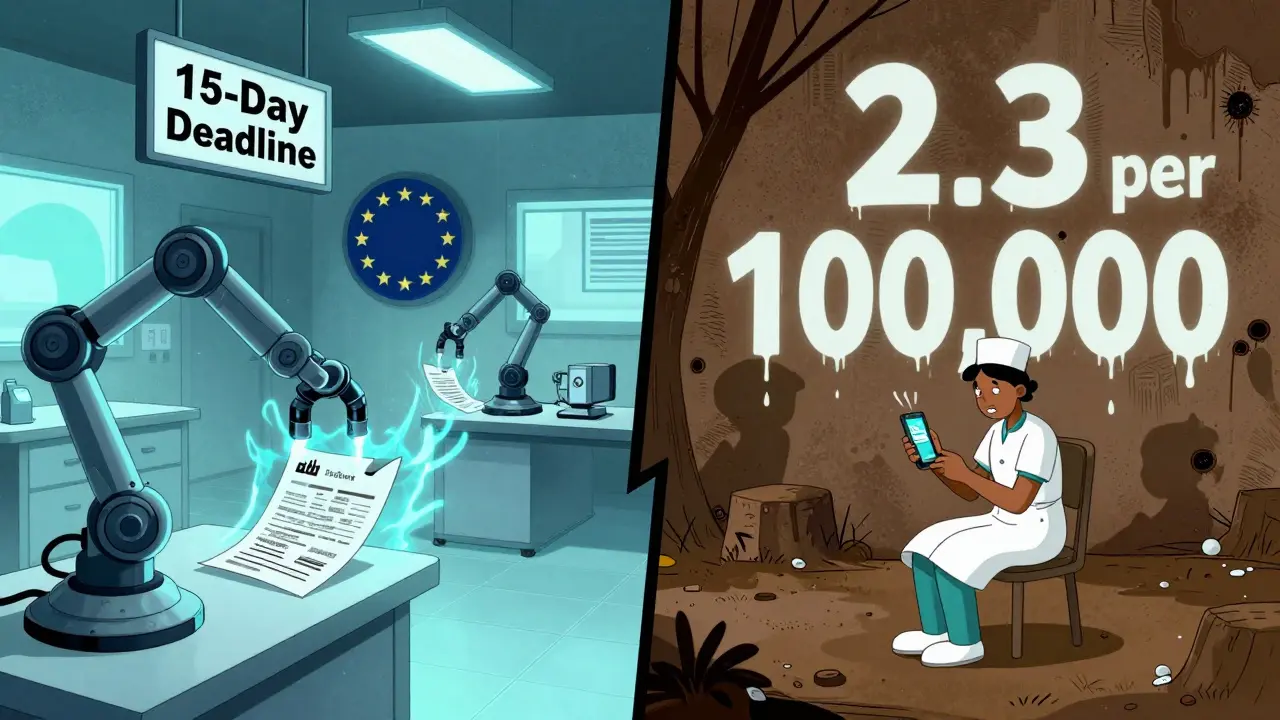
The Data Gap: Rich Countries vs. Poor Countries
Here’s the uncomfortable truth: the system works best where it’s funded best. High-income countries, which make up just 16% of the world’s population, send 85% of all reports to VigiBase. Sweden reports 1,200 adverse events per 100,000 people every year. Nigeria? Just 2.3 per 100,000. That’s not because Nigerians don’t have side effects-it’s because they don’t have the systems to report them. In many low-income countries, pharmacovigilance budgets are less than $0.02 per person annually. In the U.S., it’s over $1.20. That’s why only 42% of low- and middle-income countries have fully functional systems, according to CIOMS. Many don’t have trained staff, reliable internet, or even paper forms to fill out. A 2022 survey in Southeast Asia found that 68% of pharmacovigilance officers had received less than 15 hours of formal training. WHO recommends 40. But change is happening. Ethiopia cut its reporting time from 90 days to 14 after using PViMS, a web-based tool developed by MTaPS. That’s progress. Still, only 35% of health facilities in Ethiopia submit regular reports-mostly because of poor connectivity. In remote areas, a report might sit on a phone for weeks before it can be sent.How Technology Is Changing the Game
Artificial intelligence is now helping sift through millions of reports. UMC’s AI system, rolled out in 2023, cut false positive signals by 28%. That means fewer distractions, faster real alerts. In the EU, active surveillance using electronic health records covering 150 million patients has improved detection sensitivity by 37%. That’s not just reporting-it’s watching. The UK’s Yellow Card Scheme, one of the oldest and most successful, lets healthcare workers report via a mobile app. Over 78% of reports now come through the app, and 95% are submitted within 48 hours. That’s real-time safety monitoring. Meanwhile, the global pharmacovigilance market is growing fast-projected to hit $13 billion by 2030. Every top pharmaceutical company now has a dedicated team of at least 250 people just to monitor drug safety. That’s a big shift from 2018, when the average was 150.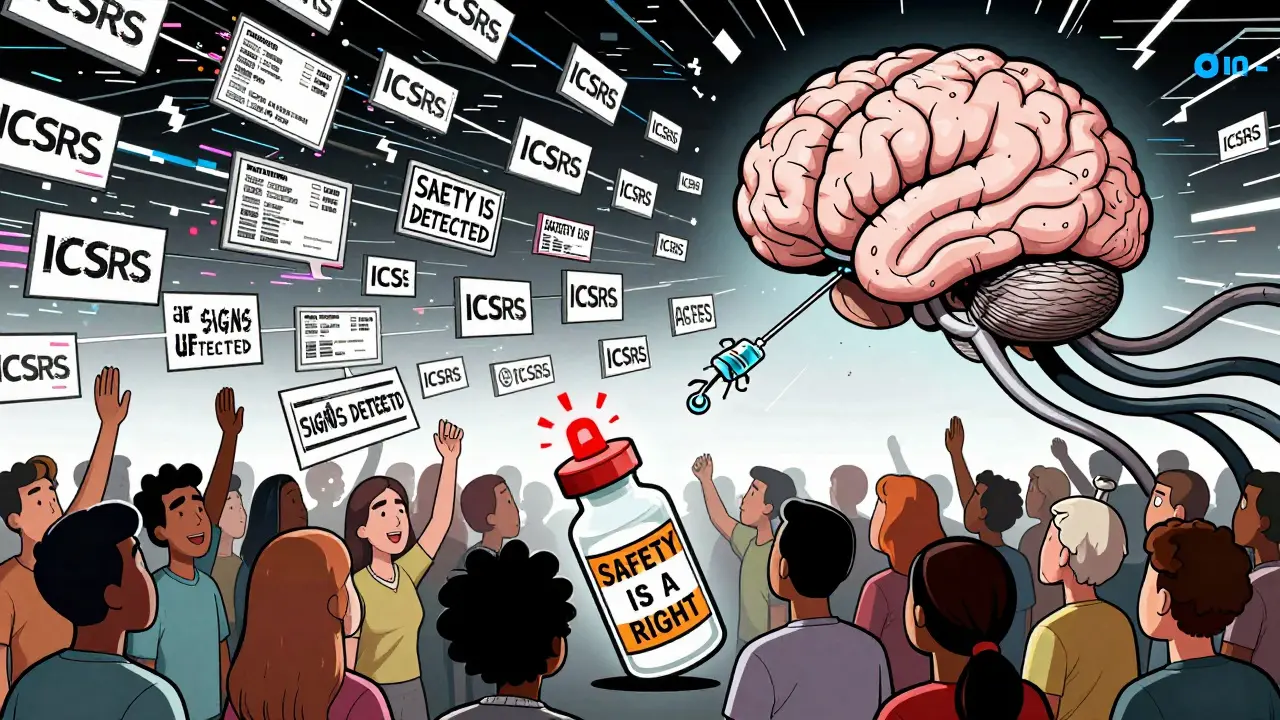
What’s Coming Next
The next big step is ISO IDMP-the Identification of Medicinal Products standard. By 2025, every drug will be tagged with over 100 standardized data points: name, strength, manufacturer, form, even the packaging. Right now, “aspirin 81 mg” might be listed 12 different ways across countries. IDMP will fix that. Experts say it could improve cross-border data matching by 40%. VigiAccess, the public-facing version of VigiBase, has had over 12 million visitors since 2015. Patients, researchers, and even journalists can now search real safety data-not just press releases. Ukraine reactivated its national center in March 2023. Yemen joined in 2022. Zanzibar in 2024. The network is expanding, even in crisis zones. For vaccines, the WHO’s Global Vaccine Safety Initiative has helped 45 low- and middle-income countries switch to electronic reporting. Transmission time dropped from 60 days to 7. That’s huge when you’re trying to catch a dangerous reaction fast.Why It Matters
This system isn’t about bureaucracy. It’s about saving lives. Think of the painkillers that caused heart damage. The antibiotics that triggered rare liver failure. The cancer drugs that led to unexpected nerve damage. Without global reporting, these would have been blamed on bad luck-until too many people were hurt. The system works because it’s collective. One country sees a pattern. Another confirms it. A third realizes it’s happening in their population too. That’s how medicines get warnings, updates, or even pulled from shelves. It’s how a drug that works for most becomes safe for all. But the system is only as strong as its weakest link. If a country lacks funding, training, or infrastructure, the whole network is at risk. A single blind spot can hide a global threat. The future of drug safety isn’t just about better tech. It’s about equity. More funding. More training. More voices from the Global South. Because a side effect in Lagos is just as important as one in London.What is pharmacovigilance?
Pharmacovigilance is the science of detecting, understanding, and preventing adverse effects from medicines. It’s not just about recording side effects-it’s about using that data to protect patients and improve how drugs are used. The World Health Organization defines it as essential to ensuring medicines remain safe throughout their entire lifecycle.
How does VigiBase work?
VigiBase is the WHO’s global database for adverse drug reaction reports. Countries send standardized electronic reports using the E2B(R3) format. Each report includes details like the drug, the reaction, the patient, and the outcome. The Uppsala Monitoring Centre manages the database and uses tools like MedDRA and WHODrug to standardize the data. AI and statistical tools then look for unusual patterns that might signal a new safety issue.
Why do some countries report more than others?
It’s not about how many side effects happen-it’s about how well the system can detect and report them. High-income countries have trained staff, digital tools, funding, and public awareness campaigns. Low-income countries often lack basic infrastructure: no internet, no forms, no training, no budget. Sweden reports 1,200 adverse events per 100,000 people. Nigeria reports 2.3. That gap reflects system strength, not safety.
Can I access drug safety data myself?
Yes. VigiAccess, launched by WHO in 2015, lets anyone search anonymized data from VigiBase. You can look up a drug and see what side effects have been reported globally. It’s used by patients, researchers, doctors, and journalists. No login needed. Just go to the VigiAccess website and search.
What’s the biggest challenge facing global drug safety monitoring?
The biggest challenge is inequality. The system relies on data from every country, but most data comes from just a few. Without strong systems in low-income regions, dangerous side effects can go unnoticed for years. Fixing this requires more funding, better training, and real investment-not just in technology, but in people. Safety isn’t a luxury. It’s a right.

anthony epps
December 15, 2025 AT 20:49i had no idea drugs were tracked like this. so it's not just the FDA watching stuff, but like... the whole world sharing reports? kinda wild.
Tiffany Machelski
December 16, 2025 AT 14:38the part about nigeria reporting only 2.3 per 100k really hit me. it's not that nothing's happening there - it's that no one can even see it.
Hadi Santoso
December 18, 2025 AT 02:57so cool that vigiaccess is public. i looked up my grandma's blood pressure med last week and found out about this rare dizziness thing that 300+ people reported. didn't even know you could do that. thanks world health org for not keeping this secret.
Souhardya Paul
December 19, 2025 AT 09:46the fact that ethiopia cut reporting time from 90 days to 14 using a simple web tool? that's the kind of low-tech win we need more of. you don't need ai to fix broken systems - you need commitment and basic infrastructure. we're overcomplicating this in rich countries.
Ron Williams
December 19, 2025 AT 14:06the global south isn't just a data gap - it's a moral blind spot. if a kid in honduras has a bad reaction and no one can report it, does it even matter? the system's built to protect people who already have access to it. that's not safety. that's privilege dressed up as science.
Josias Ariel Mahlangu
December 20, 2025 AT 23:50it's embarrassing how much we rely on countries like sweden and the us to do the work of the entire planet. if you can't afford to report a side effect, you're basically asking people to die quietly so the system doesn't get "inconvenienced."
Dave Alponvyr
December 22, 2025 AT 00:48so the usa has 2 million reports a year and still doesn't even have deadlines? wow. just let the drugs kill people and hope someone notices.
Andrew Sychev
December 23, 2025 AT 13:55the world is literally built on the backs of nurses and pharmacists in places with no internet, no training, and no pay. they're the ones catching the next thalidomide - and they're doing it with a phone and a prayer. this isn't science. it's heroism.
Billy Poling
December 24, 2025 AT 12:34while i appreciate the sentiment regarding equity in pharmacovigilance, it is imperative to acknowledge that the structural disparities in global health infrastructure are not solely attributable to financial underinvestment but also to systemic governance failures, inconsistent regulatory harmonization, and the absence of standardized public health education frameworks that would enable sustainable data capture mechanisms in low-resource settings - and until these root causes are addressed, even increased funding may yield only marginal improvements without fundamental institutional reform.
Aditya Kumar
December 25, 2025 AT 16:12why do we even need all this? just tell people to read the label.