 Jan, 4 2026
NSAID Risk Assessment Tool
Assess Your NSAID Risk
This tool helps you understand your risk of gastrointestinal bleeding from NSAID use based on factors discussed in the article. Enter your details to get personalized guidance.
Risk Assessment
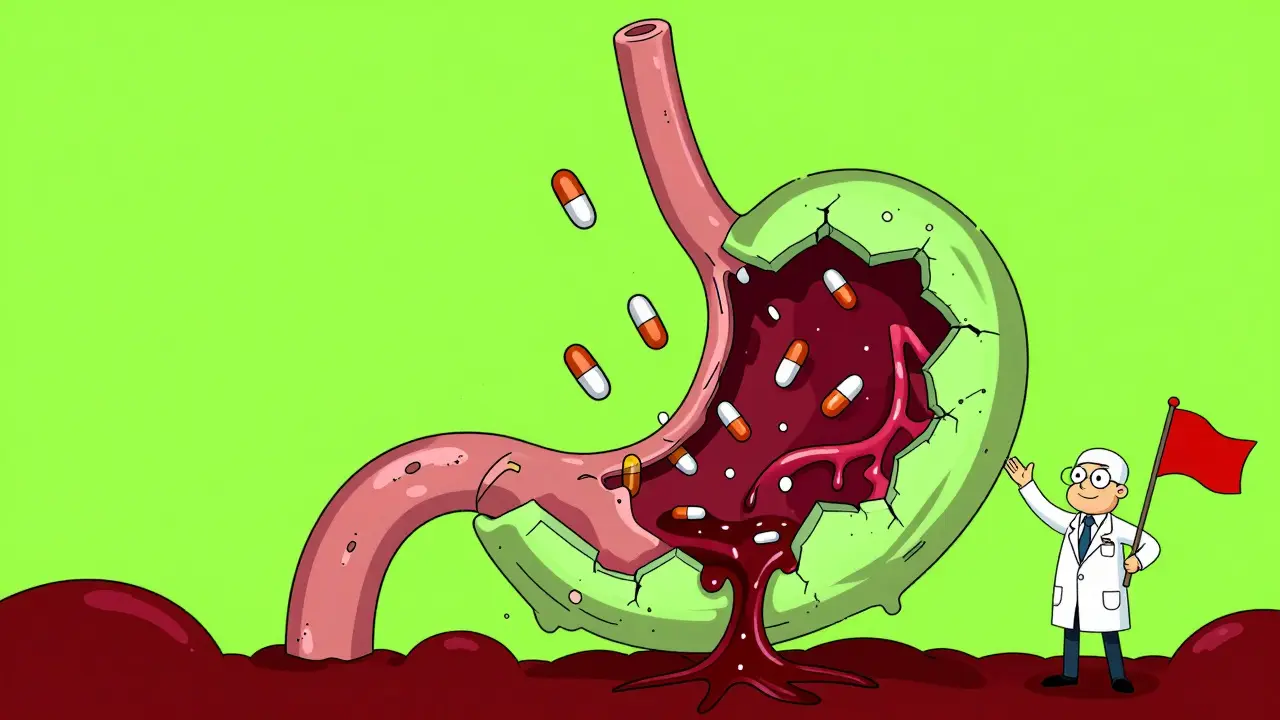
Every year, millions of people reach for ibuprofen, naproxen, or diclofenac to ease a headache, sore knee, or back pain. These are NSAIDs - non-steroidal anti-inflammatory drugs - and they work. But behind the relief lies a quiet danger: gastrointestinal bleeding. For many, it starts as a vague stomach ache or fatigue. By the time they realize something’s wrong, they’re in the emergency room, needing blood transfusions. This isn’t rare. It’s predictable. And it’s preventable.
How NSAIDs Cause Ulcers and Bleeding
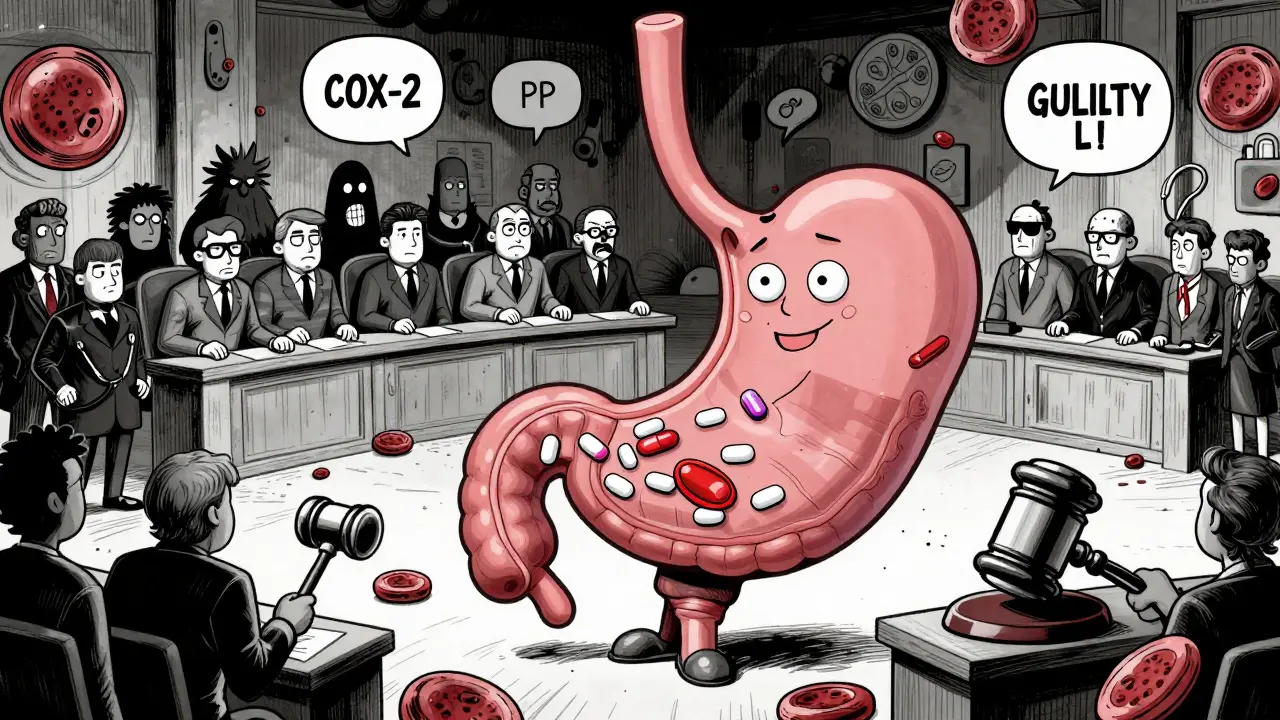
NSAIDs don’t just block pain signals. They shut down enzymes called COX-1 and COX-2. COX-2 causes inflammation - that’s the target. But COX-1 protects your stomach lining by making mucus and keeping blood flowing to the gut. When NSAIDs block COX-1, your stomach loses its natural shield. Acid eats away at the tissue. What starts as a small erosion can turn into a deep ulcer. And when that ulcer hits a blood vessel, you bleed.This isn’t just about classic ulcers. Studies show that up to 86% of people with NSAID-related GI bleeding don’t even have a visible ulcer. The damage can happen anywhere - from the stomach down to the small intestine. Some bleed slowly, causing iron deficiency anemia. Others bleed suddenly, vomiting blood or passing black, tarry stools. Both are medical emergencies.
The Real Risk Numbers
Let’s talk numbers, because numbers don’t lie. A 2020 meta-analysis in JAMA Internal Medicine found that NSAID users are 3.2 to 4.2 times more likely to suffer upper GI bleeding or perforation than non-users. That’s not a small increase. That’s a major jump.Not all NSAIDs are equal. Non-selective ones - like naproxen, diclofenac, and high-dose ibuprofen - carry the highest risk. Selective COX-2 inhibitors like celecoxib were developed to avoid this. And they do. A 2000 Lancet study showed celecoxib had half the rate of serious ulcers compared to ibuprofen. But here’s the catch: COX-2 inhibitors raise heart attack risk. Rofecoxib (Vioxx) was pulled from the market in 2004 after studies showed it doubled heart attack risk in some patients.
So you’re not choosing between safe and dangerous. You’re choosing between two different kinds of risk.
Who’s Most at Risk?
If you’re young and healthy, taking an occasional Advil for a sprain? Your risk is low. But if you fit any of these profiles, you’re in the danger zone:- Age 70 or older - risk doubles every decade
- History of peptic ulcer or GI bleeding
- Taking blood thinners like warfarin or aspirin
- Using corticosteroids (like prednisone)
- Taking more than one NSAID at once
- Having heart failure, kidney disease, or liver cirrhosis
A 2021 American College of Gastroenterology guideline says: if you have two or more of these, you’re high risk. And high risk means you shouldn’t be taking NSAIDs without protection.

What Actually Works to Protect Your Stomach
The good news? We know how to stop this. The best tool is a proton pump inhibitor - PPI. Drugs like omeprazole, esomeprazole, or pantoprazole. They don’t just reduce acid. They let the stomach lining heal.A 2017 Cochrane review of over 13,000 patients found PPIs cut NSAID-related ulcers by 75%. That’s not a slight improvement. That’s almost eliminating the risk. And it’s not just theory. In real life, patients on PPIs with NSAIDs have far fewer hospitalizations.
Misoprostol also works - it replaces the protective mucus NSAIDs destroy. But it causes diarrhea in 1 in 5 people and cramps in many more. Most patients won’t stick with it.
Then there’s Vimovo - a single pill combining naproxen and esomeprazole. Approved by the FDA in 2023, it’s designed for high-risk patients. In the PRECISION-2 trial, it cut ulcer complications from 25.6% down to 7.3% compared to naproxen alone. That’s a massive drop.
What Patients Don’t Tell Their Doctors
Here’s the hidden problem: people don’t talk about it. On patient forums like HealthUnlocked, 63% of NSAID users reported stomach pain, nausea, or fatigue - but only 37% told their doctor. Why? They think it’s normal. Or they don’t want to stop the pain relief.On Reddit, a caregiver described how their 78-year-old mother developed severe anemia from slow, unnoticed bleeding. She’d been taking ibuprofen daily for arthritis. No one connected the dots until she passed out. She needed three units of blood.
And it’s not just the elderly. A 2022 Arthritis Foundation survey of over 5,000 people found 42% quit NSAIDs because of stomach problems. They didn’t switch to something safer - they just stopped. And that means more pain, more disability, more missed work.
What Should You Do?
If you’re taking NSAIDs regularly - even over-the-counter - here’s what to do:- Ask yourself: Do I have any of the risk factors? Age? Past ulcer? Blood thinner? Steroids?
- Track your dose. Are you taking more than 800 mg of ibuprofen a day? That’s a red flag.
- Don’t assume OTC is safe. Nearly a quarter of NSAID users take more than the label recommends - and never tell their doctor.
- Ask about PPIs. If you’re high risk, don’t wait for symptoms. Start a PPI before you start the NSAID.
- Consider alternatives. Physical therapy, acetaminophen, or topical creams might work just as well with less risk.
And if you’ve had a GI bleed before? The guidelines are clear: use a COX-2 inhibitor like celecoxib with a PPI. That combo cuts your risk of another bleed by over 80%.
The Bigger Picture
NSAIDs are cheap, effective, and everywhere. In the U.S. alone, they cause over 100,000 hospitalizations and 16,500 deaths each year. The cost? $2.2 billion. Globally, the market is worth $11.3 billion. We’re making billions off a drug that kills people - if we don’t manage the risk.The FDA has required black box warnings on all NSAIDs since 2005. But warnings on a label don’t change behavior. Real change happens when patients and doctors talk. When we stop thinking of stomach upset as ‘just a side effect’ and start treating it as a warning sign.
The future is coming. New drugs like naproxcinod - a hybrid NSAID that releases nitric oxide to protect the gut - are in late-stage trials. They show promise. But they’re not here yet.
Right now, the best tool is knowledge. Know your risk. Know your meds. And don’t be afraid to ask: Is this worth it?
Can I take NSAIDs if I’ve had a peptic ulcer before?
Yes - but only with strong protection. If you’ve had a prior ulcer or GI bleed, you should never take a non-selective NSAID alone. The safest option is a COX-2 inhibitor like celecoxib combined with a proton pump inhibitor (PPI). This combo reduces the chance of another bleed by over 80%. Always discuss this with your doctor before restarting NSAIDs.
Are over-the-counter NSAIDs safer than prescription ones?
No. The risk comes from the drug itself, not whether it’s prescription or not. Ibuprofen sold as Advil has the same effect as the prescription version. The problem is that people take OTC NSAIDs longer, at higher doses, and without medical oversight. Studies show 26% of users exceed the recommended daily dose - and most never tell their doctor. That’s when danger spikes.
Do PPIs have side effects?
Yes, but they’re usually mild and far less dangerous than GI bleeding. Short-term use (under 6 months) is very safe for most people. Long-term use (over a year) may slightly increase risk of bone fractures, low magnesium, or gut infections like C. diff. But for high-risk patients, the benefit of preventing a life-threatening bleed far outweighs these risks. Always take the lowest effective dose for the shortest time needed.
Is it safe to take aspirin with NSAIDs?
Not without protection. Aspirin is itself an NSAID and blocks COX-1, which increases bleeding risk. If you’re on low-dose aspirin for heart protection and also take ibuprofen or naproxen, your risk of GI bleeding jumps significantly. If you need both, talk to your doctor about switching to a COX-2 inhibitor like celecoxib and adding a PPI. Never stop aspirin without medical advice.
What are the signs of NSAID-related bleeding?
Symptoms vary. Overt bleeding means vomiting blood (red or coffee-ground looking) or passing black, tarry stools. But many people have occult bleeding - slow, invisible blood loss. Signs include unexplained fatigue, dizziness, pale skin, or shortness of breath. If you’re on NSAIDs and develop iron deficiency anemia with no other cause, NSAID-induced bleeding should be suspected. A simple blood test can catch this before it becomes an emergency.
Are there natural alternatives to NSAIDs for pain?
Yes, and they’re often safer. For joint or muscle pain, topical capsaicin, turmeric (curcumin), or acupuncture can help. For mild pain, acetaminophen (Tylenol) doesn’t affect the stomach lining. Physical therapy, heat/cold packs, and weight management can reduce pain long-term without drugs. Always discuss alternatives with your doctor - especially if you’re high risk for bleeding.

Terri Gladden
January 5, 2026 AT 09:42en Max
January 6, 2026 AT 17:11Jacob Milano
January 6, 2026 AT 17:47Allen Ye
January 8, 2026 AT 09:04mark etang
January 9, 2026 AT 15:12Brendan F. Cochran
January 10, 2026 AT 16:06jigisha Patel
January 12, 2026 AT 07:07Jason Stafford
January 12, 2026 AT 19:00Justin Lowans
January 13, 2026 AT 00:55Michael Rudge
January 13, 2026 AT 05:13Ethan Purser
January 14, 2026 AT 04:07