 Feb, 1 2026
Pediatric Medication Excipient Checker
Check Medication Safety
Enter the name of your child's medication to see if it contains potentially dangerous excipients for children.
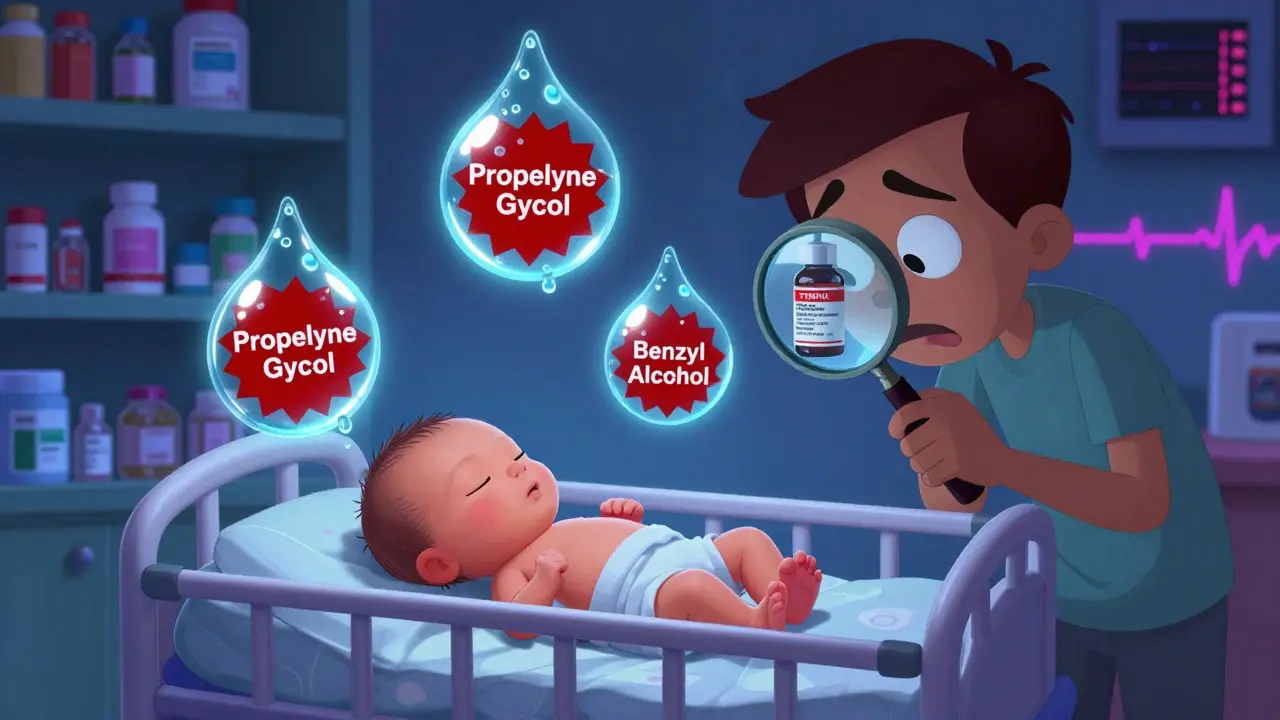
Many children's medications contain excipients like propylene glycol, sorbitol, and benzyl alcohol that can be dangerous for infants and young children. These ingredients aren't always listed clearly, and they can cause serious harm when used in the wrong doses or for the wrong age group.
Remember: "Pediatric" doesn't mean safe. The FDA has identified these ingredients as potential risks for babies, especially those under 2 months old. Always check inactive ingredients.
What Are Pediatric Excipients-and Why Should You Care?
Every time you give your child a liquid medicine, syrup, or even a topical cream, you’re not just giving them the active drug. You’re also giving them excipients-the invisible ingredients added to make the medicine taste better, last longer, or flow easier. Most of these are harmless in adults. But in babies and young children, even small amounts of certain excipients can cause serious harm.
Imagine giving your newborn a few milliliters of medicine that contains 80% propylene glycol. That’s not a typo. Some common sedatives and anti-seizure drugs for infants have concentrations this high. Their tiny bodies can’t process these substances the way an adult’s can. The result? Seizures, low blood pressure, organ damage, or worse.
These aren’t rare cases. A 2022 study tracking neonatal medication use found that 92% of babies in intensive care received at least one drug containing propylene glycol. And the average daily dose exceeded safety limits by nearly 50%. Yet most parents-and even some doctors-don’t know these ingredients are even in the medicine.
Alcohol in Baby Medicine: More Dangerous Than You Think
When you hear "alcohol" in medicine, you might think of ethanol-the kind you find in hand sanitizer or wine. But in pediatric formulations, the real concern is propylene glycol and, to a lesser extent, ethanol. Both are used as solvents to dissolve drugs that won’t mix with water.
Propylene glycol is in everything from lorazepam (used for seizures) to esmolol (for heart rhythm issues). One study found that 80% of lorazepam formulations are made with this chemical. In adults, it’s mostly safe. In newborns? Not even close.
Why? Because babies, especially preemies, have underdeveloped livers and kidneys. Their bodies can’t break down or flush out propylene glycol fast enough. The chemical builds up. And when it does, it can cause:
- Central nervous system depression (lethargy, slow breathing)
- Seizures
- Low blood pressure
- Heart rhythm problems
- Acute kidney injury
- Hemolysis (red blood cells breaking apart)
There’s no safe "dose" for all babies. A full-term infant might tolerate 10 mg/kg/day. A 24-week preemie weighing 700 grams? That same amount could be deadly. The FDA and European Medicines Agency have flagged this as a major safety gap. Yet, many formulations still haven’t changed.
Even ethanol-often thought of as "just alcohol"-can be dangerous. In children, it can cause hypoglycemia, coma, and respiratory failure. There’s no warning label on most bottles. No mention on the pharmacy label. Just a hidden ingredient buried in the fine print.
Sorbitol: The Sweet Trap in Children’s Medicines
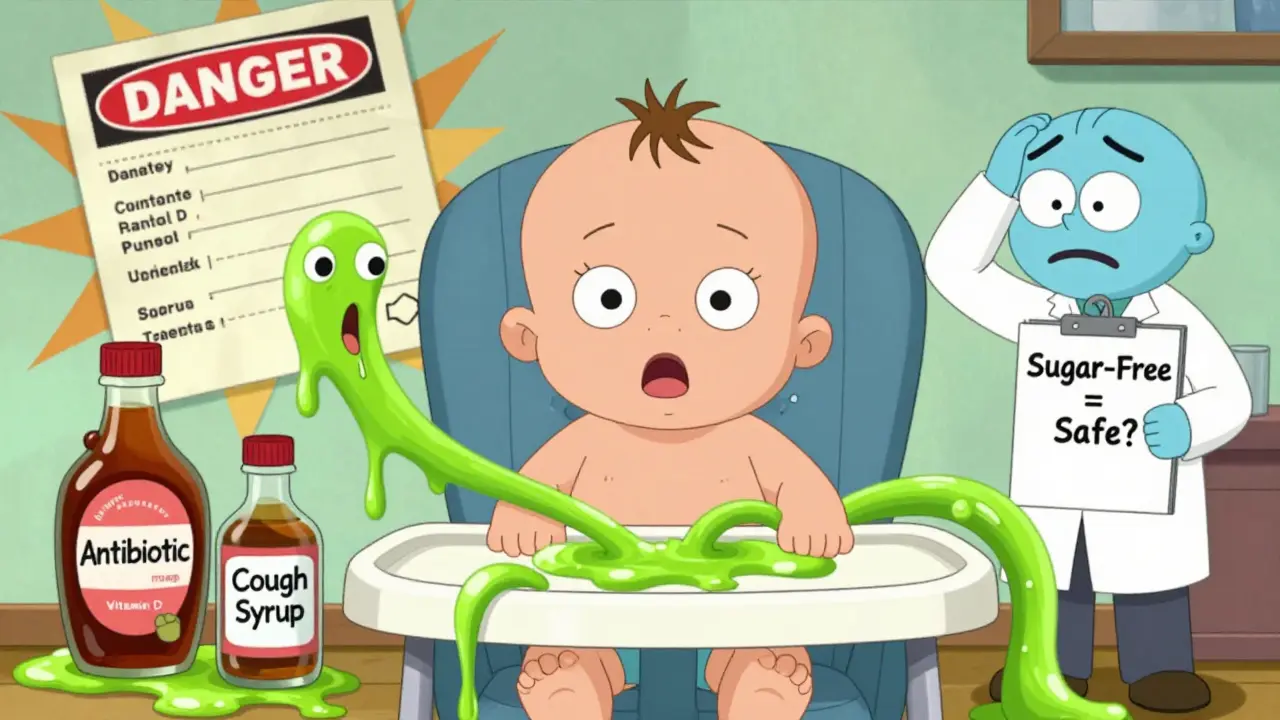
Most liquid children’s medicines taste sweet. That’s not magic. It’s sorbitol, a sugar alcohol used to make syrups palatable. But for kids, especially those under 2, it’s not harmless.
Sorbitol is poorly absorbed in the gut. That means it sits there, drawing water into the intestines. The result? Severe diarrhea, bloating, cramps. In a baby with a fever or infection, that kind of fluid loss can lead to dehydration fast.
But it gets worse. Some children have underlying metabolic conditions that make sorbitol toxic. One study linked high doses of sorbitol to metabolic acidosis-a dangerous drop in blood pH that can cause organ failure. In extreme cases, it’s been tied to bacterial overgrowth and even sepsis in vulnerable infants.
And it’s everywhere. Antibiotics, antivirals, antifungals, even some cough syrups. A 2020 analysis of 2,095 pediatric medications found that 31% contained sorbitol or similar sugar alcohols. Many of these were given to infants under 6 months-the group most at risk.
Parents often assume "sugar-free" means safe. But sorbitol isn’t sugar. It’s a chemical that behaves like a laxative in small bodies. And unlike lactose intolerance, which most people know about, sorbitol sensitivity is rarely tested or discussed.
Benzyl Alcohol: A Silent Killer in Neonates
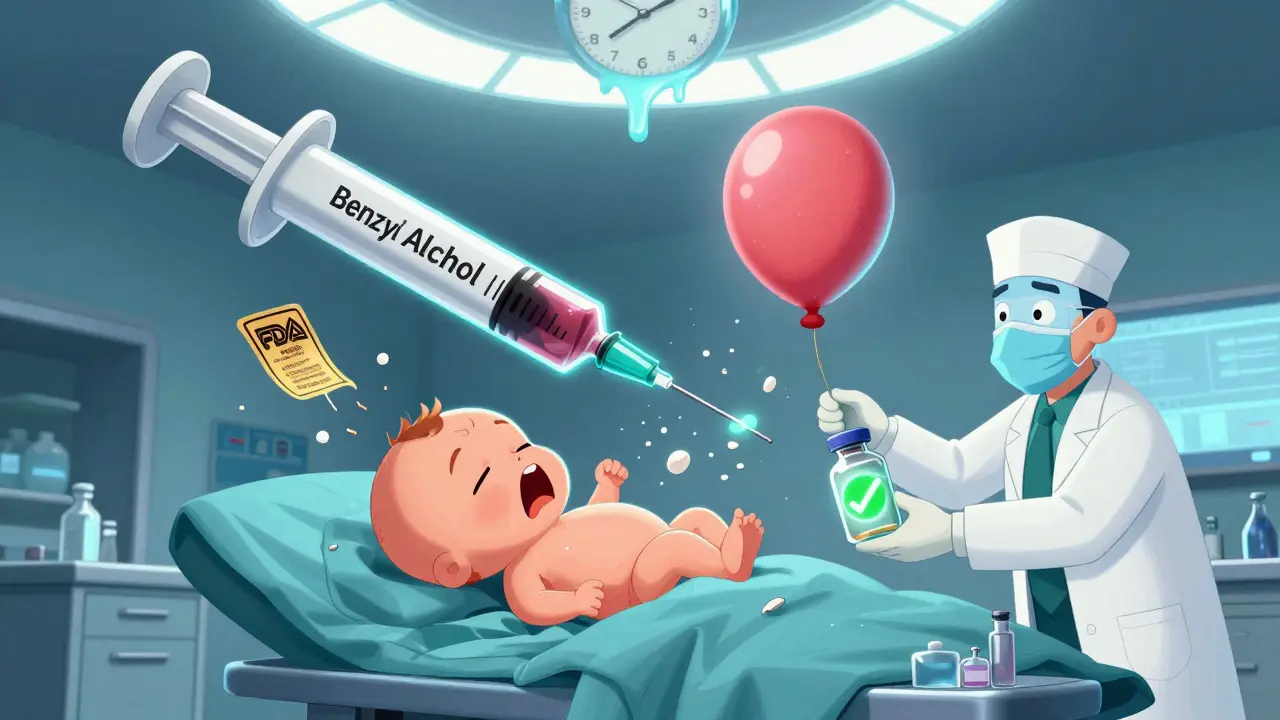
Of all the excipients, benzyl alcohol is the most dangerous for newborns. It’s used as a preservative in multi-dose vials and injectables. Sounds harmless? Think again.
In the 1980s and 90s, a cluster of infant deaths in the U.S. was traced back to benzyl alcohol. Eight preterm babies, all under 1,200 grams, died after receiving E-Ferol-a vitamin supplement containing benzyl alcohol. Their symptoms? Thrombocytopenia, liver enlargement, kidney failure, fluid buildup. All linked to benzyl alcohol toxicity.
Since then, the FDA has warned against using benzyl alcohol in infants under 28 days old. But it’s still in use. Why? Because it’s cheap. And because many manufacturers haven’t switched to safer alternatives.
Even topical products aren’t safe. Benzyl alcohol is found in some teething gels, nasal sprays, and even eye drops. In one case, a baby developed methemoglobinemia-a condition where blood can’t carry oxygen-after a topical anesthetic containing benzocaine (a benzyl alcohol derivative) was applied to their gums.
The Pediatric Pharmacy Association’s 2025 KIDs List explicitly bans benzyl alcohol-containing products in neonates. Yet, many hospitals still stock them. Pharmacists know the risk. But without better alternatives, they’re forced to choose between no medicine and dangerous medicine.
Why Aren’t These Ingredients Removed?
You’d think with all the evidence, drugmakers would have fixed this by now. But they haven’t. Here’s why:
- No legal requirement: In most countries, excipients don’t need to be tested for safety in children. Only the active ingredient does.
- Cost and complexity: Reformulating a drug for babies means new trials, new packaging, new approvals. It’s expensive and slow.
- Off-label use: Most pediatric medicines are adult drugs diluted or repackaged. No one designed them for babies.
- Lack of awareness: Many doctors don’t know what’s in the meds they prescribe. Pharmacists are often the last line of defense-and they’re stretched thin.
A 2022 survey found that 78% of hospital pharmacists struggle to find safe pediatric formulations. Sixty-three percent say they regularly have to compound medications themselves-sometimes mixing adult drugs with unsafe excipients just to get the right dose.
Regulators are starting to catch up. The European Union’s revised Pediatric Regulation, set to take effect in 2026, will require full safety dossiers for all excipients in children’s medicines. The FDA’s 2023 draft guidance also pushes for better labeling and testing. But until these rules are enforced, babies remain at risk.
What Can Parents Do?
You can’t control what’s in the medicine-but you can ask the right questions. Here’s how to protect your child:
- Check the ingredients list: Don’t just look at the active drug. Scroll down to "inactive ingredients." Look for propylene glycol, ethanol, sorbitol, benzyl alcohol.
- Ask for alternatives: "Is there a version without alcohol or sorbitol?" Many pharmacies can order or compound safer versions.
- Use single-dose formulations: Multi-dose vials often contain preservatives like benzyl alcohol. Single-use vials or oral syringes are safer.
- Report adverse reactions: If your child has a seizure, unusual drowsiness, or diarrhea after starting a new medicine, tell your doctor-and file a report with your country’s drug safety agency.
- Use the STEP database: The Safety and Toxicity of Excipients for Paediatrics database (available online) lists safe and unsafe excipients by age group. Bookmark it.
Don’t assume "pediatric" means safe. That label means it’s for children-not that it’s been tested for safety in children.
What’s Being Done-and What’s Next?
Change is coming, but slowly. The European Paediatric Formulation Initiative (EuPFI) has identified 17 new excipients in development that are safer for babies. One targets replacing propylene glycol with a non-toxic solvent. Another replaces sorbitol with starch-based fillers that work just as well.
The Safe Excipient Exposure in Neonates and Small Children (SEEN) study, which tracked over 500 infants, showed that reducing propylene glycol exposure cut seizure rates by 40%. That’s proof that safer formulations save lives.
But progress depends on pressure. Parents asking questions. Pharmacists pushing for alternatives. Doctors refusing to prescribe unsafe products. Until we demand better, these hidden dangers will keep slipping through the cracks.
Bottom Line
Children aren’t small adults. Their bodies handle medicine differently. And excipients-those quiet, invisible additives-are often the hidden cause of serious harm. Alcohol, sorbitol, and benzyl alcohol aren’t just chemicals on a label. They’re potential triggers for seizures, organ failure, and death in the youngest patients.
Knowing what’s in your child’s medicine isn’t paranoia. It’s protection. The system isn’t perfect. But you can still be their advocate. Ask. Check. Demand safer options. Because no baby should be harmed by something that was never meant to be there in the first place.

Eli Kiseop
February 2, 2026 AT 16:50Dan Pearson
February 3, 2026 AT 18:51Monica Slypig
February 3, 2026 AT 20:31Becky M.
February 4, 2026 AT 01:53Hannah Gliane
February 5, 2026 AT 14:15Murarikar Satishwar
February 7, 2026 AT 04:31Bob Hynes
February 7, 2026 AT 22:28Ellie Norris
February 9, 2026 AT 02:42Marc Durocher
February 9, 2026 AT 09:19larry keenan
February 9, 2026 AT 13:03Nick Flake
February 10, 2026 AT 21:27Chinmoy Kumar
February 11, 2026 AT 17:17