 Feb, 28 2026
PPI-Antifungal Interaction Checker
This tool helps you determine if your proton pump inhibitor (PPI) and antifungal medication combination is safe based on the latest research. Always consult your doctor or pharmacist before making any changes to your medications.
When you're taking a proton pump inhibitor (PPI) for acid reflux and an antifungal for a stubborn infection, you might not think they affect each other. But they do-and sometimes in ways that can make your treatment fail or even become dangerous. This isn't just theoretical. Real patients are getting sicker because these two common drug classes clash in the stomach and bloodstream. The problem isn't one-size-fits-all. Some antifungals barely notice PPIs. Others crash hard. And now, new research is flipping the script entirely: PPIs might actually help some antifungals work better. Here’s what you need to know if you or someone you care about is on both.
Why PPIs Change How Antifungals Are Absorbed
Proton pump inhibitors like omeprazole, pantoprazole, and esomeprazole don’t just reduce stomach acid-they completely shut it down. Normally, your stomach is super acidic, with a pH around 1.5 to 2.5. That’s strong enough to dissolve food and kill most bacteria. But when you take a PPI, that pH jumps to 4 or even 6. Sounds harmless? Not for certain antifungals.
Drugs like itraconazole and ketoconazole need acid to dissolve properly. They’re like salt in cold water: they just sit there and don’t dissolve if the environment isn’t acidic enough. When PPIs raise stomach pH, these antifungals can’t get into your bloodstream. A 2023 study in JAMA Network Open found that when taken with PPIs, itraconazole’s absorption drops by up to 60%. That means your blood levels might fall below what’s needed to kill a fungal infection. And if you’re treating something like aspergillosis or a deep fungal infection, that’s not just inconvenient-it’s life-threatening.
Ketoconazole is even worse. At pH 1.2, it dissolves at 22 mg/mL. At pH 6.8? It drops to 0.02 mg/mL. That’s a 1,100-fold drop. The FDA and European regulators now list PPI use as a contraindication for ketoconazole. You simply shouldn’t take them together.
Fluconazole: The Exception That Proves the Rule
Not all antifungals are affected the same way. Fluconazole is different. It’s highly water-soluble, doesn’t need acid to dissolve, and gets absorbed just fine whether your stomach is acidic or not. Its bioavailability stays steady at 90%±5% across all pH levels, according to FDA data updated in January 2024. So if you’re on fluconazole for a yeast infection or candidiasis, your PPI won’t touch its absorption. You can take them together without worry.
But here’s the twist: fluconazole doesn’t just sit there. It interferes with how your liver processes other drugs. It strongly inhibits CYP2C9 and, at higher doses, CYP3A4. That means if you’re also taking warfarin, sulfonylureas, or certain statins, fluconazole can make them build up in your blood. That’s why doctors often cut warfarin doses by 20-30% when fluconazole is added. The absorption issue is gone, but the metabolic one is real.
Voriconazole: A Complex Dance in the Liver
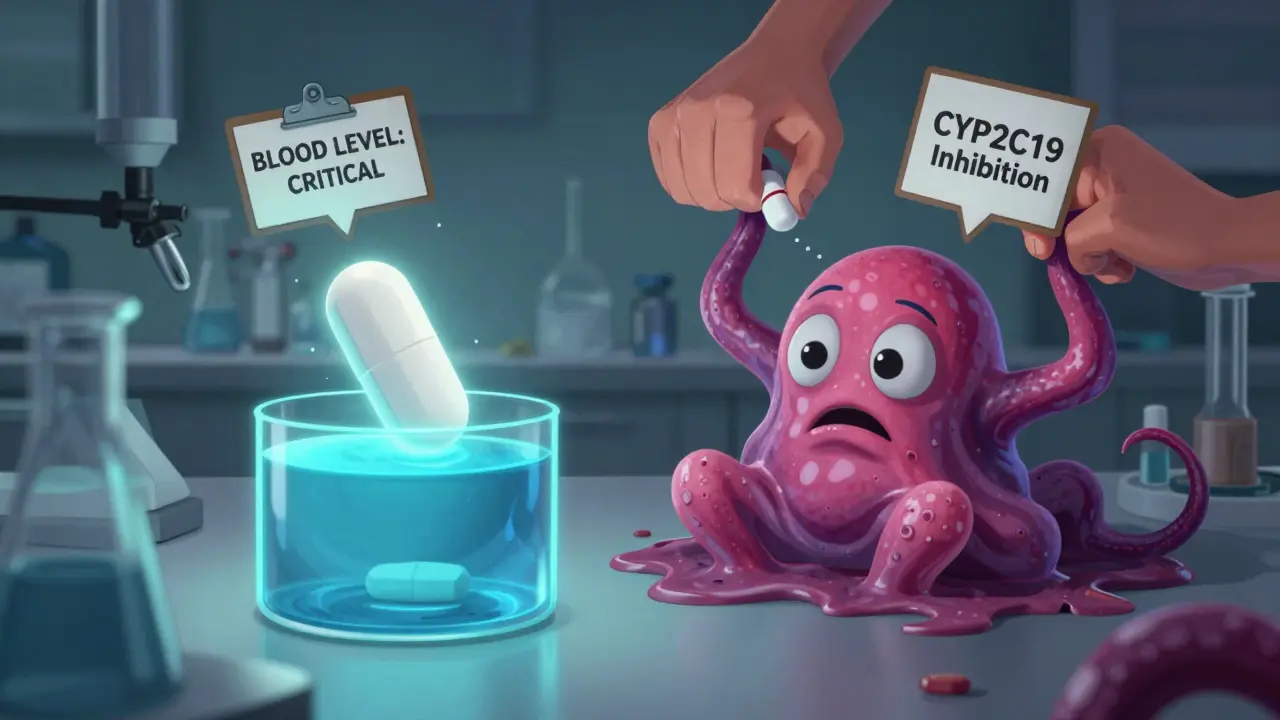
Voriconazole doesn’t care about stomach pH. Its absorption is fine even with PPIs. But its metabolism? That’s a different story. Voriconazole is broken down mostly by CYP2C19 and CYP3A4. And guess what? PPIs like pantoprazole and omeprazole are competitive inhibitors of those same enzymes. A 2015 study in Antimicrobial Agents and Chemotherapy showed that when PPIs are added, voriconazole clearance drops by 25-35%. That means levels in your blood rise, sometimes dangerously high.
High voriconazole levels can cause hallucinations, liver damage, or vision problems. That’s why the Cleveland Clinic’s 2024 protocol requires checking voriconazole blood levels within 72 hours of starting a PPI. If levels are too high, they drop the dose by 25-50%. If you’re on voriconazole and a PPI, you need lab monitoring. No exceptions.
The Surprising New Discovery: PPIs Might Boost Antifungal Power
Here’s where things get wild. A 2024 study published in PMC (PMC10831725) found something no one expected: PPIs might actually help antifungals kill fungi better-at the cellular level.
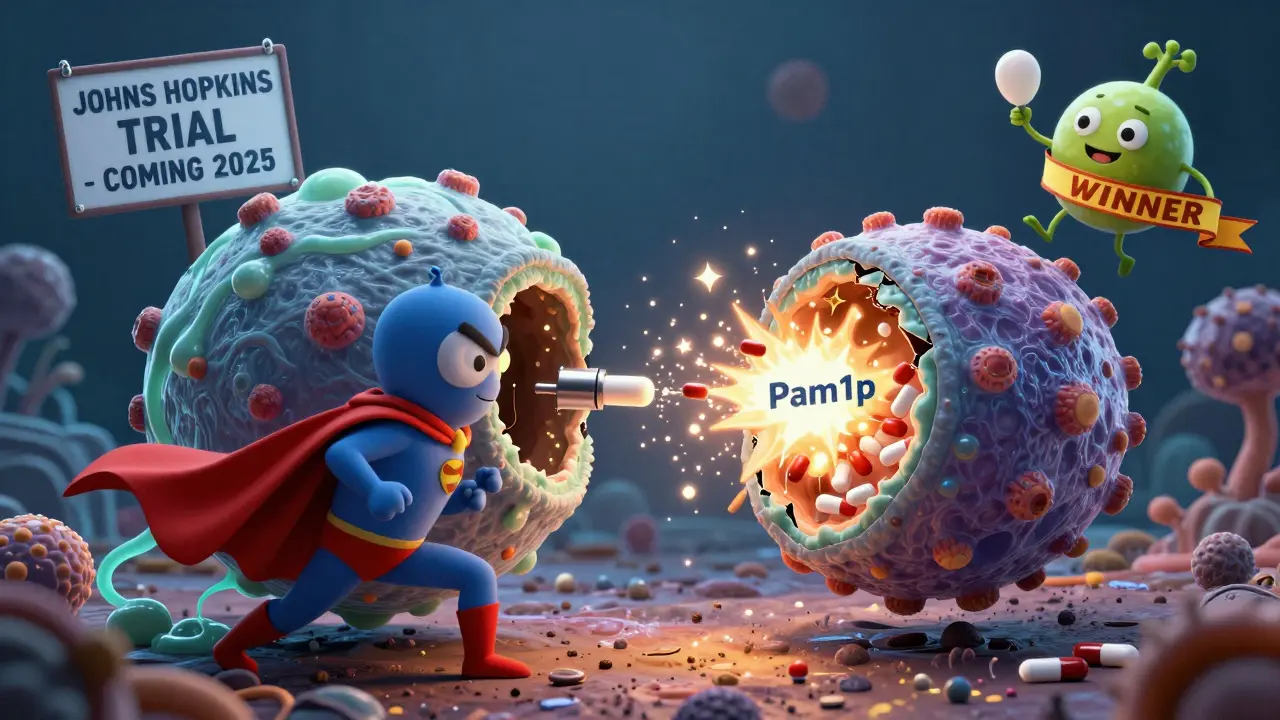
The study showed that omeprazole, even at low doses, blocks a fungal protein called Pam1p, which is a plasma membrane ATPase. This protein helps fungi pump out toxins and antifungal drugs. When you block it, fluconazole can stay inside the fungus longer and work better. In lab tests, omeprazole cut the minimum inhibitory concentration (MIC) of fluconazole by 4 to 8 times against resistant Candida glabrata. That’s like turning a weak drug into a strong one.
This isn’t just lab magic. It’s being tested in real patients. Johns Hopkins is running a Phase II trial (NCT05876543) right now, giving people omeprazole 40mg daily along with fluconazole to treat stubborn candidiasis. Results are due in late 2025. If it works, we could be looking at a whole new way to treat drug-resistant fungal infections-by adding a cheap, common heartburn drug.
What Doctors Actually Do in Real Life
Despite the clear risks, many patients still get these combinations. A 2024 audit by the Institute for Safe Medication Practices found that over 22% of itraconazole prescriptions in community pharmacies were still paired with PPIs. That’s alarming. Why? Because the FDA added a black box warning to itraconazole in June 2023: “Concomitant administration with proton pump inhibitors is contraindicated.”
So what do experts recommend?
- Itraconazole + PPI? Never. If you need an antifungal and a PPI, switch to voriconazole or echinocandin (like caspofungin) instead.
- Ketoconazole + PPI? Absolutely not. Ketoconazole is already restricted in many countries due to liver risks. Adding a PPI makes it useless and dangerous.
- Voriconazole + PPI? Monitor blood levels. Adjust dose. Don’t assume it’s safe.
- Fluconazole + PPI? Safe for absorption. Watch for drug interactions with warfarin or diabetes meds.
Pharmacists surveyed in a 2023 study in Pharmacotherapy said 87% of them routinely recommend switching to echinocandins when both drugs are needed. Why? Because managing the interaction is risky, expensive, and often fails. Echinocandins aren’t affected by stomach pH or liver enzymes. They’re given intravenously, so they bypass the whole problem.
What’s Coming Next: Better Drugs, Better Solutions
The future is already being built. The FDA is funding research into pH-independent formulations of itraconazole. A new submicron version called SUBA-itraconazole showed 92% bioavailability even with high stomach pH in a 2023 Phase I trial. That means one day, you might be able to take itraconazole with your omeprazole without a problem.
Meanwhile, the idea of using PPIs as antifungal boosters is gaining traction. If the Johns Hopkins trial succeeds, we could see a new treatment paradigm: low-dose PPIs as adjuvants for resistant fungal infections. Imagine a simple, cheap combo that makes fluconazole work again-especially in places where new antifungals are too expensive.
Dr. Thomas Walsh from Weill Cornell predicted in February 2024 that within five years, these pH-independent formulations will be standard. But until then, the rules are clear: know your drugs. Know your risks. And don’t assume two common prescriptions are safe together.
Key Takeaways
- Itraconazole and ketoconazole absorption drops up to 60% with PPIs-avoid combining them.
- Fluconazole absorption is unaffected by PPIs, but it can interfere with other drugs like warfarin.
- Voriconazole levels rise with PPIs due to liver enzyme inhibition-monitor blood levels.
- New research suggests PPIs may enhance antifungal activity by blocking fungal pumps, opening doors for new treatments.
- Best practice: When possible, switch to echinocandins (like caspofungin) instead of managing this interaction.
Can I take fluconazole with a proton pump inhibitor?
Yes, fluconazole absorption is not affected by PPIs because it dissolves easily in water regardless of stomach pH. However, fluconazole can interfere with how your liver processes other medications like warfarin, statins, or some diabetes drugs. Always check for interactions with your pharmacist or doctor.
Why is itraconazole affected by PPIs but fluconazole isn’t?
Itraconazole is a fat-soluble drug that needs an acidic environment to dissolve and be absorbed. PPIs raise stomach pH, making it too weak for itraconazole to dissolve properly. Fluconazole, on the other hand, is water-soluble and absorbs well even in neutral or alkaline conditions. It doesn’t rely on stomach acid at all.
What should I do if I’m on both a PPI and an antifungal?
First, identify which antifungal you’re taking. If it’s itraconazole or ketoconazole, talk to your doctor immediately-this combination is dangerous. If it’s voriconazole, ask about getting your blood levels checked. If it’s fluconazole, you’re likely safe from absorption issues, but check for interactions with other medications. In many cases, switching to an echinocandin like caspofungin avoids the problem entirely.
Are there any antifungals that don’t interact with PPIs?
Yes. Echinocandins (caspofungin, micafungin, anidulafungin) are given intravenously and bypass the digestive system entirely, so they’re not affected by stomach pH or PPIs. Fluconazole also doesn’t have absorption issues, though it has metabolic interactions. These are often the preferred choices when PPIs are necessary.
Is it true that PPIs can make antifungals work better?
New research suggests yes-specifically for fluconazole against resistant Candida strains. In lab studies, omeprazole blocked a fungal pump that usually pushes antifungals out of the cell, making fluconazole up to 8 times more effective. A clinical trial is underway to see if this works in people. This doesn’t mean you should take them together yet, but it could lead to new treatments soon.

Aisling Maguire
March 2, 2026 AT 10:30Okay but like… I’ve been on omeprazole for years and fluconazole for that one yeast thing, and never thought twice. Turns out I’m lucky? 😅
Sneha Mahapatra
March 3, 2026 AT 20:59It’s wild how something as simple as stomach pH can unravel an entire treatment plan. Nature doesn’t care about our pill schedules. We’re just guests in a system that’s been fine-tuned over millions of years. 🌱
Angel Wolfe
March 5, 2026 AT 17:58Sophia Rafiq
March 6, 2026 AT 06:16Fluconazole + PPI = chill. Voriconazole + PPI = time to get your TDM done. Itraconazole? Just switch to caspofungin. Done. No drama. CYP enzymes are a whole other beast tho. Always check the metabolic pathways before hitting "send" on that script.
Eimear Gilroy
March 7, 2026 AT 00:07So if PPIs block fungal ATPase pumps, does that mean long-term PPI users might have lower rates of resistant Candida? Or is it only when you give them together? I’m curious if this could be a hidden benefit we’ve been missing.
Ajay Krishna
March 7, 2026 AT 03:26Really appreciate how this breaks down the science without making anyone feel stupid. I’ve seen so many patients get confused between absorption and metabolism. The fact that fluconazole doesn’t care about pH but still messes with warfarin? That’s the kind of nuance that saves lives. Thanks for writing this.
Justin Ransburg
March 8, 2026 AT 05:09This is exactly the kind of detailed, evidence-based information we need more of in public health discourse. Too often, patients are left to guess whether their meds are working-or harming them. Kudos to the researchers and clinicians who are pushing for smarter, safer combinations. This could redefine how we treat resistant fungal infections.
Miranda Anderson
March 9, 2026 AT 21:53I’ve been on PPIs for 8 years for silent reflux and just got prescribed voriconazole last month for a stubborn aspergillosis. My pharmacist pulled me aside and said "you’re lucky your doctor knew what they were doing"-then handed me a printed chart with blood level targets and a calendar for monitoring. I didn’t even know this was a thing. Now I’m paranoid every time I refill my meds. But also… kind of impressed? Like, this is the kind of precision medicine people talk about. It’s scary but kind of beautiful.
Gigi Valdez
March 10, 2026 AT 17:31The distinction between absorption and metabolism is critical. Many patients conflate the two. Itraconazole’s failure with PPIs is pharmacokinetic, not pharmacodynamic. Fluconazole’s interaction is the reverse. Understanding this prevents both under- and over-treatment. Always consult a clinical pharmacist when polypharmacy is involved.
Lisa Fremder
March 11, 2026 AT 08:06Brandon Vasquez
March 12, 2026 AT 09:04Thanks for the clarity. I work in a rural clinic and see this combo all the time. Patients don’t know the difference between fluconazole and itraconazole. We’ve started using a simple flowchart: "If it ends in -conazole, check the pH dependency. If it’s echinocandin, you’re golden." Saved a few folks from ER trips already.
Vikas Meshram
March 13, 2026 AT 12:40Actually, the FDA contraindication for ketoconazole with PPIs was issued in 2021, not 2023. Also, the study cited in PMC10831725 was a retrospective cohort, not a randomized trial. Please fact-check before posting. This misinformation could harm patients who rely on Reddit for medical advice. And yes, I’m a pharmacist. And yes, I’ve seen the consequences.