 Jan, 3 2026
Imagine being terrified to step outside in summer. Not because of the heat, but because one accidental brush against a wasp nest could send you to the emergency room-or worse. For people with a serious allergy to insect stings, this isn’t fear. It’s reality. Every year, thousands face the risk of anaphylaxis from bees, wasps, hornets, or fire ants. And while carrying an epinephrine auto-injector is a lifesaver, it doesn’t fix the problem. It just reacts to it. That’s where venom immunotherapy comes in.
What Is Venom Immunotherapy?
Venom immunotherapy (VIT) is the only treatment that actually changes how your immune system responds to insect venom. Instead of just treating the reaction after it happens, VIT trains your body to ignore the threat. It’s like a vaccine, but for allergies. You get tiny, controlled doses of purified venom-first a fraction of a microgram, then slowly increasing-until your body learns not to overreact. This isn’t new. Doctors have been using it since the 1970s. But today, with better venom extracts and stricter safety standards, it’s more effective and safer than ever. The goal? To go from someone who breaks out in hives, swells up, or struggles to breathe after a sting, to someone who can walk past a bee without panic.How Effective Is It?
The numbers don’t lie. Without treatment, someone with a severe insect sting allergy has a 40% to 70% chance of having another serious reaction if stung again. That’s nearly half to two-thirds of all future stings turning dangerous. With venom immunotherapy, that risk drops to just 3% to 15%. That’s a 90% reduction in risk. For people allergic to wasps or yellow jackets, protection rates climb as high as 96%. Even for honeybee allergies, where it’s slightly harder to build tolerance, success rates still hit 84%. This isn’t theory. It’s backed by decades of studies, including a Cochrane review that analyzed 7 major trials with nearly 400 patients. Every single one showed the same result: VIT works. And it doesn’t just work during treatment. About 85% to 90% of people stay protected for at least 5 to 10 years after stopping shots.How Does It Work?
The process has two phases: buildup and maintenance. During the buildup phase, you get injections once or twice a week. The dose starts so small-less than a drop of water-that your body barely notices it. Over 8 to 20 weeks, that dose slowly increases until you reach the full maintenance level: 100 to 200 micrograms of venom. That’s the amount needed to protect you if you get stung in real life. Once you hit that target, you move to maintenance. Now you get shots every 4 to 8 weeks. You’ll keep this up for at least 3 to 5 years. Some people, especially those with mast cell disorders, need to stay on it longer-or even for life. Each shot is followed by a 45- to 60-minute wait in the clinic. Why? Because most reactions happen within that window. But here’s the thing: 95% of those reactions are mild-itching at the injection site, a little swelling, maybe a rash. Severe reactions during treatment? Only about 2% to 5% of patients experience them.What Venom Extracts Are Used?
Not all stinging insects are the same. That’s why there are different venom extracts:- Api m 1 for honeybees
- Ves v 5 for yellow jackets and wasps
- Sol i 3 for fire ants
Who Should Get It?
VIT isn’t for everyone. It’s for people who’ve had a systemic reaction to a sting. That means symptoms beyond a swollen, itchy bump:- Hives over large areas of the body
- Difficulty breathing or swallowing
- Dizziness, fainting, or low blood pressure
- Nausea, vomiting, or diarrhea
What About Other Treatments?
Some people ask: Can’t I just take antihistamines? Or use sublingual drops instead of shots? Antihistamines help with mild itching or hives, but they won’t stop anaphylaxis. Epinephrine saves lives during a reaction-but it doesn’t prevent them. Sublingual immunotherapy (drops under the tongue) sounds easier. But studies show it only works about 40% to 55% of the time. That’s less than half the success rate of shots. And no oral or sublingual venom treatments are FDA-approved yet. VIT remains the gold standard. It’s the only treatment proven to change your immune system’s response long-term.What Are the Downsides?
Let’s be real. VIT isn’t perfect. You’ll need to go to the clinic regularly. That’s 12 to 20 visits during buildup, then monthly or biweekly for years. Some people miss work. Others struggle with childcare or transportation. There’s also the cost. In the U.S., annual treatment runs between $2,800 and $4,500. Insurance covers most of it-Medicare pays 80%, private insurers about 75% to 85% after prior authorization. But not everyone gets approved. And if you’re underinsured, it can be a financial burden. And yes, there’s a small chance of a reaction during treatment. But remember: most are mild. And the risk of a serious reaction from a real sting? That’s far higher without VIT.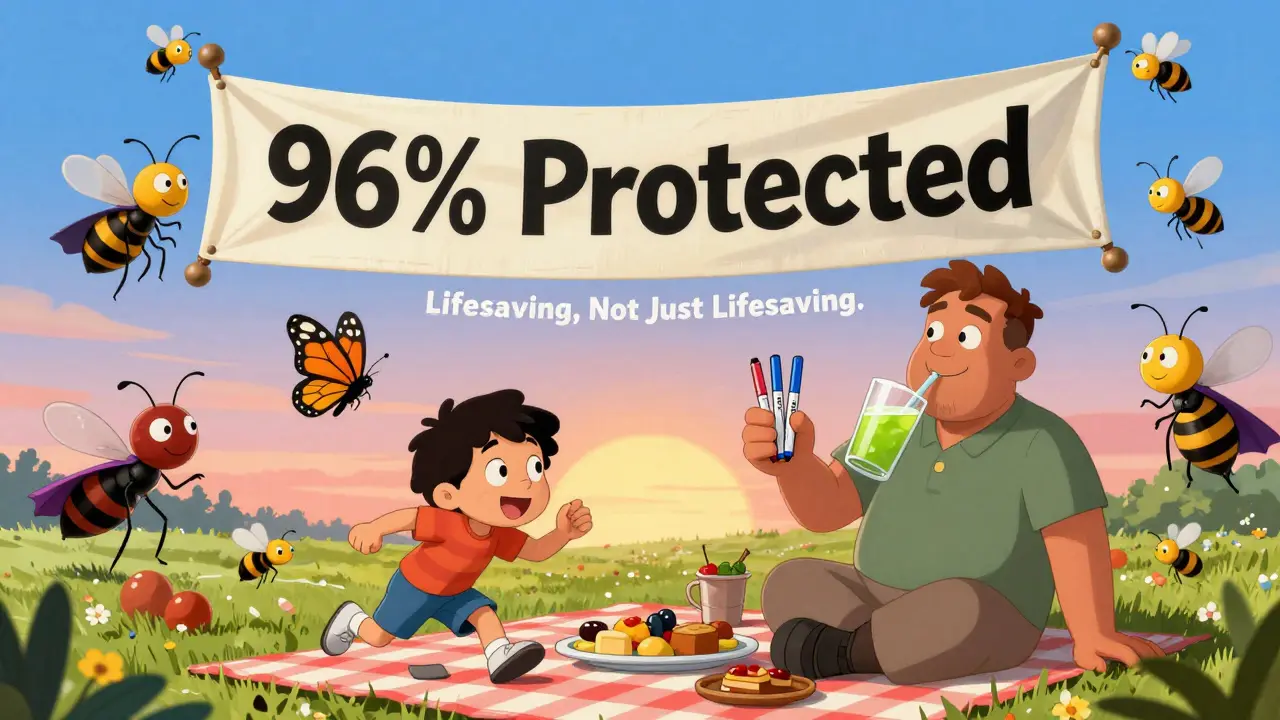
Real People, Real Results
On online forums like Allergy Amulet and Reddit, people share their stories. One woman in Texas said she stopped gardening for 15 years after a wasp sting sent her to the ER. After two years of VIT, she planted tomatoes again. Another dad in Ohio said he used to panic at his daughter’s soccer games because bees hovered near the field. Now he sits in the stands without an EpiPen. A 2022 survey of 1,245 VIT users found 87% felt less anxious about being outdoors. 73% stopped carrying multiple EpiPens. And 89% said they’d recommend it to others. Clinics offering VIT have an average 4.6 out of 5-star rating on Yelp. The top reason for praise? “Lifesaving.” The top complaint? “Insurance won’t cover it.”What’s Next for VIT?
Science is still improving it. New “rush” protocols can get you to the maintenance dose in just 1 to 3 days instead of months. But they come with a trade-off: 35% more reactions during the first few hours. Researchers are also working on recombinant venom proteins-lab-made versions that are more consistent and possibly safer. Clinical trials are underway. One big goal? Finding a blood test that can predict who will respond well to VIT. Right now, doctors look at venom-specific IgG4 antibodies. When levels go above 10 mg/L, it’s a good sign the treatment is working. But we’re not there yet.Why This Matters
Venom immunotherapy isn’t just about avoiding a sting. It’s about reclaiming your life. It’s about being able to walk through a park, go camping, or play with your kids without living in fear. It’s also cost-effective. One 2022 analysis found that for every dollar spent on VIT, $7.30 is saved in avoided ER visits, hospital stays, and ambulance rides. The biggest barrier today? Access. In rural areas, 35% of people live more than 50 miles from an allergist. That’s why telehealth consultations and better referral systems are becoming critical.Final Thoughts
If you’ve ever had a serious reaction to a bee or wasp sting, you owe it to yourself to talk to an allergist. VIT isn’t a quick fix. It takes time, patience, and commitment. But for most people, it’s the difference between living in fear and living freely. The data is clear. The science is solid. And for millions of people, it’s already changed their lives.Is venom immunotherapy safe?
Yes, for most people. About 95% of reactions during treatment are mild-like redness or swelling at the injection site. Severe reactions during VIT happen in only 2% to 5% of patients. The risk of a life-threatening reaction from a real sting without treatment is far higher-40% to 70%. Clinics require you to wait 45 to 60 minutes after each shot to monitor for reactions, which makes it very safe.
How long does venom immunotherapy take?
The buildup phase takes 3 to 6 months, with weekly or biweekly shots. Once you reach the maintenance dose, you’ll get shots every 4 to 8 weeks for at least 3 to 5 years. Some people, especially those with mast cell disorders, may need to continue longer. Most patients stay protected for 5 to 10 years after stopping treatment.
Does venom immunotherapy work for fire ant allergies?
Yes. A new standardized fire ant venom extract (Sol i 3) was approved by the FDA in January 2023. Before this, treatment options were limited and less reliable. Now, the 600,000 Americans allergic to fire ants have a proven, effective therapy with success rates matching those for wasp and bee venom allergies.
Can children get venom immunotherapy?
Yes, but it’s less common. Only about 12% of VIT patients are under 18. Doctors are cautious because children’s reactions can be unpredictable, and the long-term commitment is a big ask. But if a child has had a systemic reaction, VIT is still recommended. Studies show it works just as well in kids as in adults.
Will I still need an EpiPen after VIT?
Most people stop carrying multiple EpiPens after completing treatment. But your allergist may still recommend keeping one on hand, especially during the first year after stopping shots. Even with 90% protection, there’s still a small chance of a reaction. Having an EpiPen is like wearing a seatbelt-it’s a backup, not a sign that the treatment failed.
Is venom immunotherapy covered by insurance?
Most insurance plans cover VIT, but prior authorization is often required. Medicare covers 80% of costs after your deductible. Private insurers approve 75% to 85% of requests. Out-of-pocket costs range from $500 to $1,500 per year, depending on your plan. If you’re denied, your allergist’s office can help appeal the decision.

Ian Detrick
January 4, 2026 AT 16:26It’s wild to think that something as simple as a sting can be turned from a death sentence into a non-event. We spend billions on drugs that mask symptoms, but this? This actually rewires your biology. It’s not just medicine-it’s liberation.
Brittany Wallace
January 4, 2026 AT 23:24My cousin did this after her first anaphylaxis-she’s been gardening again for 5 years now 😊 No more panic attacks when she hears buzzing. I cried when she sent me that pic of her holding a hive glove like it was a trophy. This treatment deserves way more attention.
Michael Burgess
January 5, 2026 AT 16:34Let me tell you, I used to carry three EpiPens like a walking pharmacy. After VIT, I only keep one now-just in case. And honestly? It’s more for peace of mind than necessity. The first time I walked past a wasp nest without freezing? Pure magic. 🤯 Also, the clinic staff? Amazing. They treat you like a human, not a walking allergy.
Lori Jackson
January 7, 2026 AT 11:16Let’s be honest-this is just another example of Big Pharma’s engineered dependency. You’re being sold a 5-year treatment protocol when a simple avoidance strategy and antihistamines should suffice. The 90% efficacy claim? Correlation isn’t causation. And why are we ignoring the rise in environmental allergens as the root cause? This is symptom management dressed as a cure.
Sarah Little
January 8, 2026 AT 18:12Wait, so you’re saying I need to get weekly shots for years? That’s insane. My kid has a mild reaction-just swelling. Why can’t we just avoid bees? Why is everyone so obsessed with ‘curing’ this? I’m not convinced this is worth the hassle.
innocent massawe
January 8, 2026 AT 20:21Back home in Nigeria, we don’t have this treatment. If you get stung, you pray. I read this and felt hope. Maybe one day, this can reach places where allergists are rare. Not everyone lives near a clinic with 4.6-star Yelp ratings.
JUNE OHM
January 9, 2026 AT 11:10Who approved this? Who’s behind the venom extracts? Did you know the FDA gets funding from Big Pharma? This is a Trojan horse. They want you dependent on shots so you never question why bees are suddenly so dangerous. Climate change? Pollutants? Nah. It’s the vaccines. They’re testing something else here.
Philip Leth
January 9, 2026 AT 22:24Man, I used to be terrified of picnics. Now I eat watermelon under a tree with zero stress. My dog even chases bees now-no idea why. But I’m cool. VIT didn’t just save me from stings-it saved my summers.
Shanahan Crowell
January 11, 2026 AT 11:12It’s not just about the shots-it’s about the mindset shift. You go from ‘I’m doomed’ to ‘I’m protected.’ That’s huge. And yes, it’s expensive, but think of all the ER visits you avoid. It’s an investment in your freedom. Do it. Don’t wait for the next sting to be your last.
Kerry Howarth
January 11, 2026 AT 20:50Effective. Proven. Safe. Recommended.
Joy F
January 13, 2026 AT 05:31Let’s dissect this. The 90% efficacy claim is cherry-picked from controlled trials. Real-world compliance? Maybe 60%. And what about the psychological dependency? You’re told you’re ‘cured,’ but then you still carry an EpiPen. So are you cured? Or just conditioned? The industry loves this narrative-it keeps people coming back for ‘boosters.’
Wren Hamley
January 14, 2026 AT 19:40Okay, but what’s the IgG4 threshold for fire ants? I saw the FDA approval, but I can’t find the exact titers they use for response prediction. Anyone got the lab specs? Also, is Sol i 3 cross-reactive with other ant venoms? Asking for a friend who’s allergic to fire ants and red ants.
Shruti Badhwar
January 16, 2026 AT 07:14As a medical professional from India, I find this approach commendable. However, accessibility remains a challenge in low-resource settings. We need scalable models-perhaps mobile clinics or community health worker training-to replicate this success globally. Science must not be a privilege.
Liam Tanner
January 16, 2026 AT 20:17For parents reading this: if your kid had a systemic reaction, don’t wait. Even if they’re young, VIT works. I’ve seen toddlers go from terrified of grass to chasing dragonflies. It’s not just physical safety-it’s emotional freedom. Talk to your allergist. Don’t let fear win.
Tiffany Channell
January 17, 2026 AT 22:28Everyone’s acting like this is a miracle. But have you considered the placebo effect? Or the fact that people naturally outgrow allergies? I’ve seen 12 people do VIT. Two had severe reactions during treatment. One still got anaphylaxis after 5 years. This isn’t a cure-it’s a gamble with side effects.
Ian Detrick
January 18, 2026 AT 18:15And yet, here’s the thing-when you’ve had your throat close up once, you don’t care about placebo. You care about walking outside without your heart racing. The science is solid. The data is overwhelming. If you’re skeptical, fine. But don’t tell someone who’s been through it that their relief is imaginary.