 Jan, 15 2026
QT Interval Safety Checker
Check Your QT Interval
Enter your wearable ECG measurement to determine if your QT interval is within safe limits.
Enter your QT interval measurement to see if it's within safe limits.
Why QT Interval Monitoring Matters More Than You Think
Most people know their heart beats, but few realize that the QT interval - the time between the start of the Q wave and the end of the T wave on an ECG - can be a silent warning sign for sudden cardiac death. When this interval gets too long, it raises the risk of a dangerous rhythm called torsades de pointes. This isn’t rare. Medications like certain antibiotics, antipsychotics, and even some COVID-19 treatments can stretch the QT interval. In hospitals, doctors watch this closely. But what happens when you’re at home? That’s where wearable ECGs come in.
How Wearable ECGs Detect QT Prolongation
Devices like the Apple Watch Series 4 and later, and the KardiaMobile 6L, don’t just track your heart rate. They capture actual ECG waveforms - the same ones doctors use in clinics. The Apple Watch uses a single-lead system: you touch the digital crown with your finger, completing a circuit through your body. It records a 30-second ECG from Lead I. The KardiaMobile 6L is different. It’s a small device you hold with both thumbs on top and rest your left foot on the bottom. This creates a 6-lead ECG - I, II, III, aVL, aVF, aVR - mimicking a full clinical setup. These aren’t guesses. They’re real electrical signals from your heart.
Accuracy Compared to Hospital ECGs
Studies show these devices are surprisingly accurate. In a 2021 study published in Scientific Reports, researchers compared Apple Watch ECGs to standard 12-lead ECGs. The correlation for QT interval measurements was 0.886 for Lead I and 0.914 for average QT across leads. That’s strong. The KardiaMobile 6L matched 12-lead ECG results within ±20 milliseconds in a 2024 Cleveland Clinic review. For context: a 20ms error is like measuring a 10-second timer with a stopwatch that’s off by half a second. In cardiac terms, that’s acceptable for screening.
Real-World Use During the Pandemic
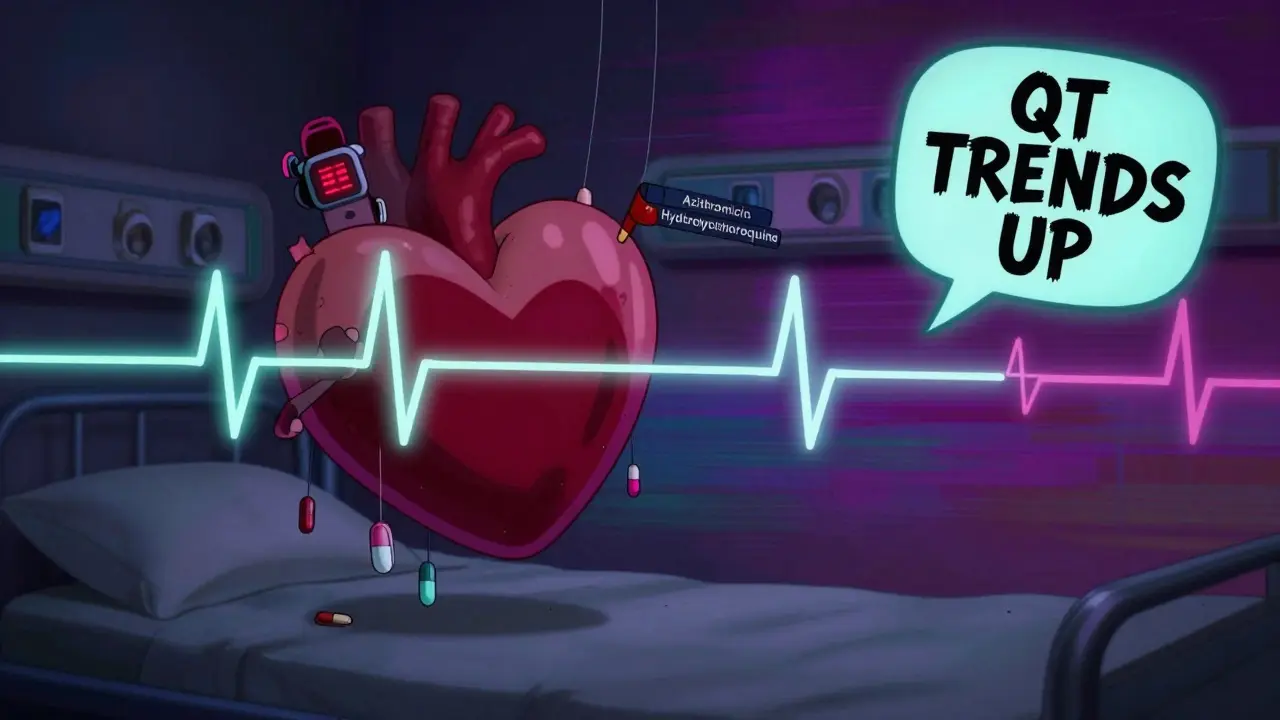
In 2020, hospitals were overwhelmed. Patients with COVID-19 were being given drugs like hydroxychloroquine and azithromycin - both known to prolong QT. Doctors couldn’t monitor every patient in person. That’s when the FDA gave emergency clearance for the KardiaMobile 6L to be used for QT monitoring. A case report from Dr. Jason Chinitz showed how a patient on these drugs used an Apple Watch daily. The device caught a rising QT interval before it became dangerous. That’s the power of real-time data. No more waiting for a clinic appointment. No more guessing. You get alerts when your heart’s electrical timing shifts.
Limitations You Can’t Ignore
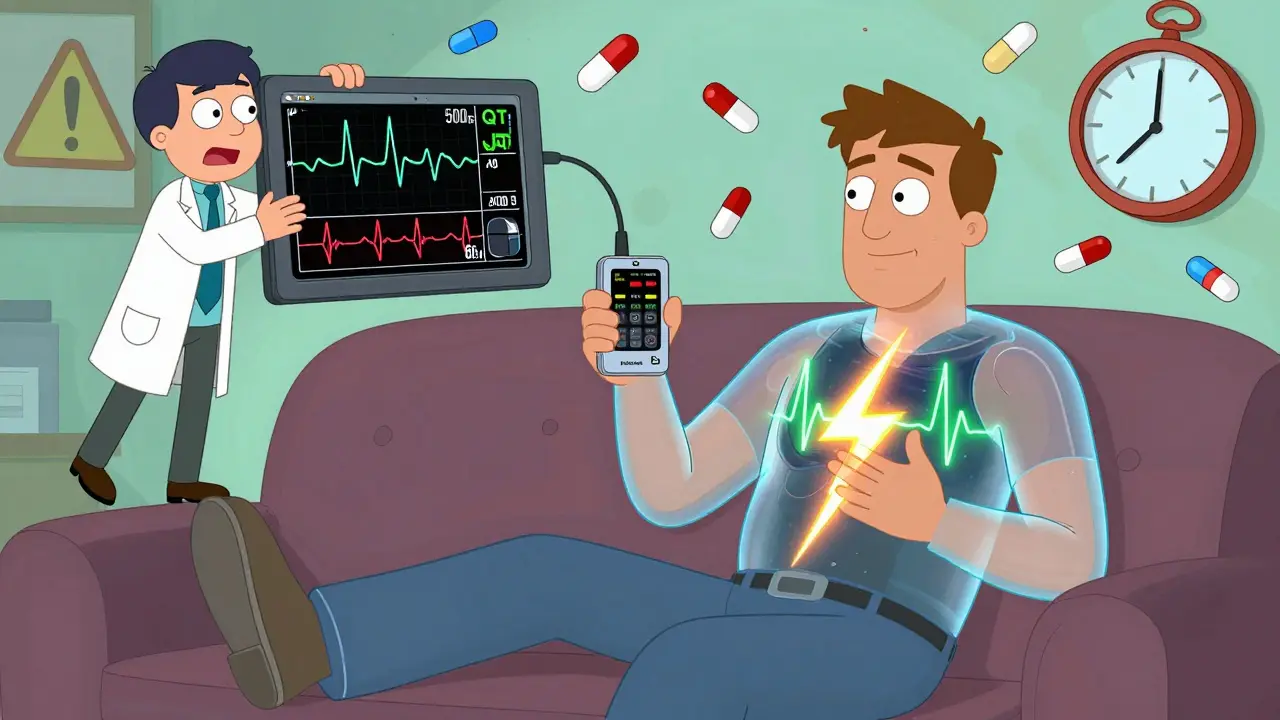
These aren’t magic boxes. Consumer wearables were built for atrial fibrillation detection - finding irregular rhythms. Detecting QT prolongation is harder. The Apple Watch can’t measure all leads. It’s limited to one or two. Skin contact matters. If your hand is sweaty or the watch is loose, the signal gets noisy. A 2023 study found the sensitivity for spotting abnormal Q waves was only 20.6%. That means it misses most structural heart issues. And here’s the big one: no consumer device has a built-in algorithm that automatically flags QT prolongation. You still need a doctor to interpret the data. These tools give you a heads-up. They don’t replace clinical judgment.
AI Is Changing the Game
That’s where artificial intelligence steps in. A 2024 study in PLOS Digital Health trained a deep learning model to read single-lead ECGs and predict if the QT interval was dangerously long (over 500ms). It used data from 686 patients with inherited heart conditions. The model didn’t just detect patterns - it learned what QT prolongation looks like across different heart rhythms. This is the next step: automated, real-time alerts without waiting for a cardiologist. Imagine your smartwatch telling you, “Your QT is trending up. Contact your doctor today.” That’s not science fiction. It’s coming fast.
Who Should Use This Technology?
If you’re on a medication that can affect your QT interval - like amiodarone, ciprofloxacin, or lithium - this isn’t just useful. It’s potentially life-saving. Same if you have a family history of long QT syndrome, or if you’ve had unexplained fainting. Clinical trials now use these devices to monitor drug safety in real-world settings. Pharmaceutical companies are adopting them to reduce costs and improve data quality. But even outside trials, patients on long-term meds can use them to track changes over time. It’s not about replacing doctors. It’s about giving you and your doctor better data, faster.
How to Use a Wearable ECG for QT Monitoring
- Get a device cleared for medical use: Apple Watch Series 4 or later, or KardiaMobile 6L.
- Read the instructions. For Apple Watch: rest your arm, touch the crown, stay still for 30 seconds.
- For KardiaMobile 6L: place thumbs on top electrodes, rest left foot on bottom electrodes. Keep still.
- Record your ECG at the same time each day - consistency matters.
- Save each recording. Don’t delete them.
- Share results with your doctor. Don’t try to interpret them yourself.
The Future Is Continuous Monitoring
Right now, most people record ECGs manually - once a day, maybe twice. But the next wave is continuous. Smart rings, clothing with embedded sensors, even patches you wear for weeks - they’re all in development. The goal? To catch every tiny fluctuation in QT interval, not just snapshots. Imagine a system that notices your QT is slowly lengthening over 72 hours because of a new medication, and warns you before you even feel symptoms. That’s the future. And it’s not far off. The FDA has already cleared 16 uses for AliveCor’s devices. Regulatory bodies are catching up to the tech. This isn’t a gimmick. It’s the future of cardiac safety.
What to Do Next
If you’re on a QT-prolonging drug, ask your doctor if wearable ECG monitoring is right for you. Don’t wait for symptoms. Don’t assume your heart is fine because you feel okay. QT prolongation doesn’t cause pain. It just stops your heart. Wearables give you a chance to act before it’s too late. Start with a device your doctor trusts. Record consistently. Share the data. That’s how you turn a piece of tech into a life-saving tool.

Cheryl Griffith
January 17, 2026 AT 11:38Kasey Summerer
January 17, 2026 AT 15:05Bobbi-Marie Nova
January 19, 2026 AT 09:57swarnima singh
January 19, 2026 AT 11:08Isabella Reid
January 20, 2026 AT 18:34john Mccoskey
January 21, 2026 AT 09:31Nicholas Gabriel
January 22, 2026 AT 21:41kanchan tiwari
January 24, 2026 AT 08:55Allen Davidson
January 25, 2026 AT 09:32Samyak Shertok
January 26, 2026 AT 16:47Jody Fahrenkrug
January 27, 2026 AT 05:45Ryan Hutchison
January 29, 2026 AT 04:22