 Jan, 31 2026
Generic drugs save patients and the healthcare system billions every year. In the U.S., 90.7% of all prescriptions filled are for generics - yet they make up just 23% of total drug spending. That’s the power of competition. But behind those numbers is a quiet risk: not all generics are created equal, and pharmacists are often the last line of defense before a patient gets harmed.
What Makes a Generic Problematic?
The FDA requires generics to match brand-name drugs in active ingredient, strength, dosage form, and route of administration. They must also prove bioequivalence - meaning the body absorbs the drug at a rate and extent that falls within 80% to 125% of the brand. Sounds strict? It is. But that 45% window is wide enough to cause trouble in specific cases. The real issue isn’t that generics are unsafe. It’s that some patients react differently when switched between manufacturers - especially with drugs where tiny changes in blood levels can mean the difference between control and crisis. Take levothyroxine, for example. A patient stable on one generic brand might suddenly develop fatigue, weight gain, or elevated TSH levels after switching to another. Why? Because even a 10% drop in absorption can push thyroid levels out of range. The FDA has documented cases where switching manufacturers caused TSH to jump from 2.1 to 8.7 in just six weeks - a clear sign of under-treatment. The same goes for warfarin, phenytoin, and digoxin. These are called narrow therapeutic index (NTI) drugs. There’s a razor-thin line between effective and toxic. For these, a 20% variation in bioavailability isn’t just a statistic - it’s a patient falling into seizures, clots, or heart failure.When Pharmacists Must Step In
Pharmacists don’t need to question every generic. Most work just fine. But there are clear red flags:- Unexplained therapeutic failure within 2-4 weeks of a generic switch. If a patient’s blood pressure spikes, seizures return, or cholesterol climbs after a switch - it’s not coincidence. Document the manufacturer and contact the prescriber.
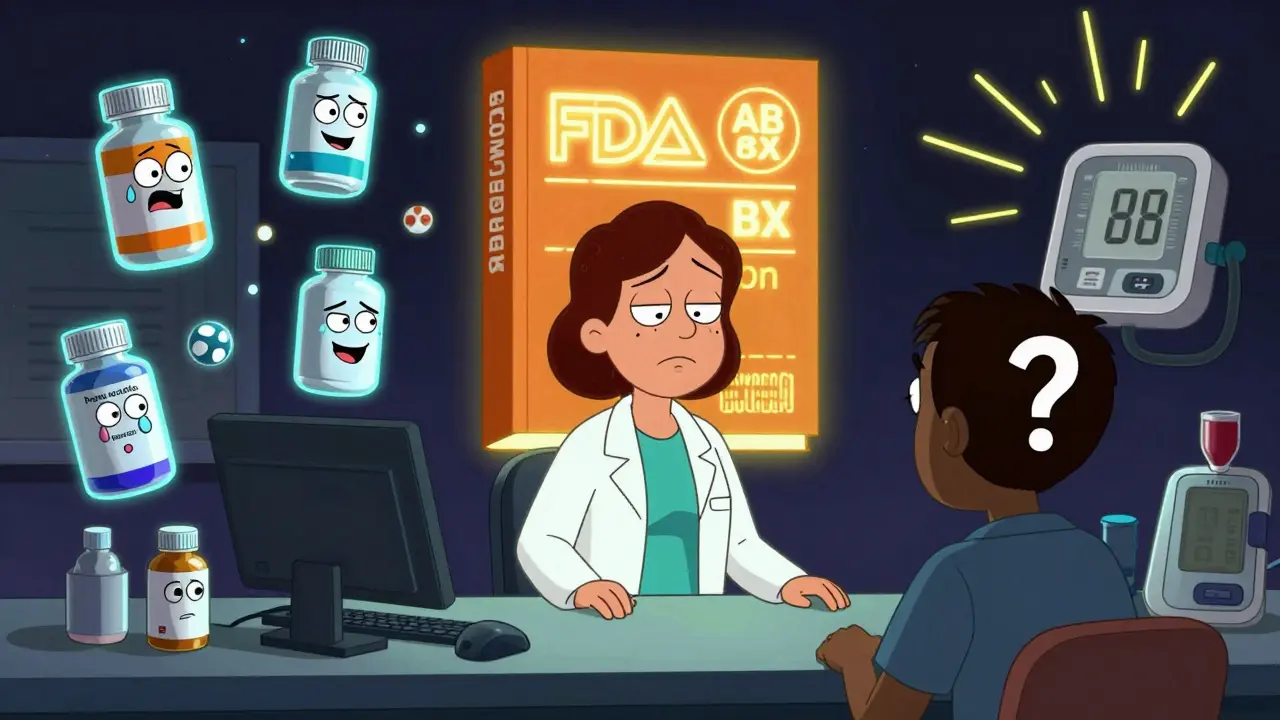
- NTI drugs with multiple switches. If a patient has been on three different generic versions of levothyroxine in a year, that’s a problem. Stability matters. The FDA’s Orange Book lists which generics are rated AB (therapeutically equivalent) and which are BX (not equivalent). Check it every time.
- Complex formulations. Extended-release pills, inhalers, topical creams, and injectables are harder to copy. In 2020, FDA testing found 7.2% of generic extended-release opioids failed dissolution tests - meaning the drug didn’t release properly. That’s not bioequivalence. That’s a safety risk.
- Look-alike, sound-alike names. Oxycodone/acetaminophen vs. hydrocodone/acetaminophen. The packaging is nearly identical. One mistake, and a patient gets the wrong opioid. That’s not the drug’s fault - it’s a dispensing error. Pharmacists must double-check labels, especially with high-risk combinations.
- Patient complaints about side effects. If a patient says, “This generic makes me nauseous - the last one didn’t,” listen. A 2023 Consumer Reports survey found 22.4% of patients reported different side effects after switching manufacturers. That’s not placebo. It’s formulation differences - fillers, coatings, or release mechanisms.
The Data Doesn’t Lie - But It’s Misleading
You’ll hear that generics are just as safe as brand-name drugs. And statistically, that’s mostly true. The FDA’s adverse event reporting system shows 1.8 serious events per million prescriptions for generics versus 1.9 for brands. But here’s the catch: generics make up 90% of prescriptions. So the raw number of reports is high - not because they’re riskier, but because they’re used more. The real signal is in the rate per patient. For NTI drugs, switching manufacturers increases the risk of adverse events by 2.3 times. Digoxin, for example, causes 12.7 adverse events per 10,000 prescriptions when switched - compared to 4.3 for non-NTI drugs. That’s not noise. That’s a pattern. And then there’s the manufacturing side. In 2022, the FDA inspected 2,147 generic drug facilities. They found 187 data integrity issues and 243 quality control failures. Most were in India and China. That’s not conspiracy - it’s supply chain reality. When a factory cuts corners on stability testing or skips batch validation, it doesn’t always show up in bioequivalence studies. But it shows up in patients.
What Pharmacists Can Do
You don’t need to stop dispensing generics. You need to be smarter about them.- Record the manufacturer. Every time you dispense a generic, write down the company name - not just the drug. If a patient has a problem later, you can trace it. Studies show 68.4% of therapeutic failure investigations require manufacturer-specific data.
- Use the Orange Book. Don’t assume all generics are equal. Look up the therapeutic equivalence code. If it’s BX, flag it. Don’t substitute unless the prescriber says so.
- Ask patients directly. After a switch, call them in two weeks. “How are you feeling? Any new side effects?” Simple questions catch problems early.
- Report adverse events. Use the FDA’s MedWatch system. It takes under five minutes. Every report adds to the data that protects future patients. Since mandatory reporting started in 15 states, pharmacist-reported incidents have risen by 18.3%.
- Advocate for consistency. If a patient is doing well on a specific generic, ask the prescriber to write “Dispense as Written” or “Do Not Substitute.” That’s your right - and their safety.
Why This Matters Beyond the Pharmacy
This isn’t just about pills. It’s about trust. Patients assume that if it’s FDA-approved, it’s identical. But when they feel different on a new generic, they start doubting the system. That leads to non-adherence - skipping doses, avoiding meds altogether, or switching back to expensive brands. And it’s not just patients. Pharmacists are caught in the middle. Insurance companies push for the cheapest generic. Prescribers assume all are equal. But if a patient ends up in the ER because of a poorly made generic, who gets blamed? The pharmacist who dispensed it - even if they didn’t know the manufacturer was problematic. The FDA is trying to fix this. They’ve launched the Complex Generic Products Team, issued 28 new guidances in 2023, and plan to increase generic sampling by 40% over the next three years. But until then, the burden falls on you.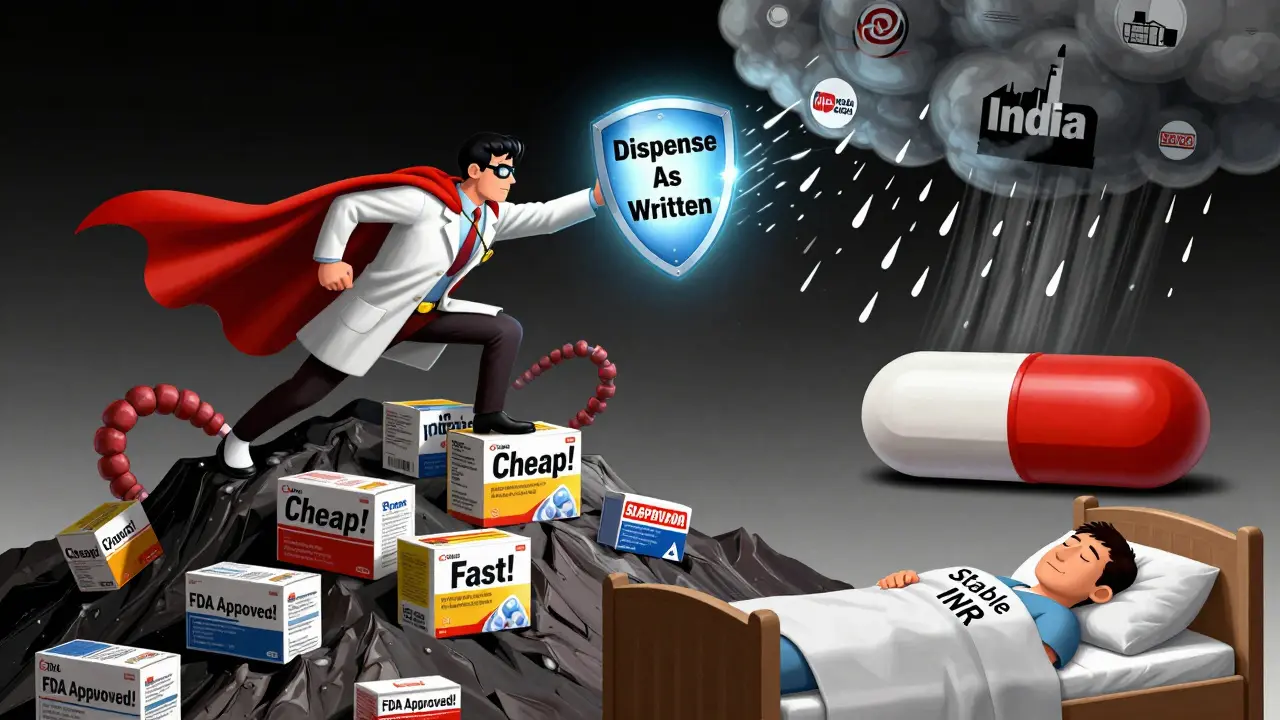
Real Cases, Real Consequences
A 68-year-old woman with atrial fibrillation was switched from one generic warfarin to another. Her INR dropped from 2.8 to 1.5 in 10 days. She developed a blood clot in her leg. The pharmacy had no record of the manufacturer - so no one could trace it. A teenager with epilepsy was switched to a new generic phenytoin. Within days, she had three seizures. Her parents brought her to the ER. Her phenytoin level was 30% below therapeutic range. The pharmacy had switched manufacturers without noting it. A man with Crohn’s disease was on a delayed-release generic mesalamine. He started having flare-ups. The new version used a different coating - it dissolved too early in the stomach. He lost weight. He lost hope. He didn’t know the difference - but his body did. These aren’t outliers. They’re symptoms of a system that assumes equivalence equals safety. It doesn’t.Final Thought: Don’t Assume - Verify
Generics are essential. They make care affordable. But safety isn’t automatic. It’s earned - through vigilance, documentation, and courage to speak up. You’re not a gatekeeper. You’re a safeguard. When a patient says, “This doesn’t feel right,” believe them. When a drug behaves differently after a switch, investigate. When the manufacturer changes, record it. When in doubt, call the prescriber. The system relies on you. Don’t let it down.Are all generic drugs safe?
Most generics are safe and effective. The FDA requires them to meet strict bioequivalence standards. But for certain drugs - especially narrow therapeutic index (NTI) drugs like levothyroxine, warfarin, and phenytoin - switching between manufacturers can cause clinically significant changes in blood levels. Not all generics are interchangeable in practice, even if they’re technically approved.
What is a narrow therapeutic index (NTI) drug?
An NTI drug has a very small difference between the effective dose and the toxic dose. Even small changes in how much of the drug enters the bloodstream can lead to treatment failure or serious side effects. Examples include levothyroxine, warfarin, phenytoin, digoxin, and tacrolimus. For these, consistent manufacturer use is critical.
How do I know if a generic is therapeutically equivalent?
Check the FDA’s Orange Book. It lists all approved generics and assigns them a therapeutic equivalence code. AB-rated means the drug is considered therapeutically equivalent to the brand. BX-rated means it’s not - either because bioequivalence hasn’t been proven or there are unresolved issues. Never assume equivalence without checking.
Can I refuse to substitute a generic?
Yes. In most states, pharmacists can refuse substitution if they believe it poses a risk to patient safety - especially for NTI drugs. If the prescriber writes “Dispense as Written” or “Do Not Substitute,” you are legally required to honor it. Even without that notation, professional judgment allows you to contact the prescriber if you suspect a problematic switch.
Why do some patients report different side effects with generics?
Generic drugs must have the same active ingredient, but they can differ in inactive ingredients - like fillers, dyes, or coatings. These can affect how the drug is absorbed or how it feels to the patient. For example, a delayed-release tablet with a different coating might dissolve too early, causing stomach upset. These aren’t always caught in bioequivalence studies, but patients notice them.
Should I always document the generic manufacturer?
Yes. Documenting the manufacturer is one of the most important steps you can take. In 68.4% of therapeutic failure investigations, the problem was traced back to a specific manufacturer. Without that record, you can’t help the patient or prevent future issues. Make it part of your routine - even if it takes 10 extra seconds.

vivian papadatu
February 1, 2026 AT 10:23Just had a patient come in last week crying because her thyroid meds made her feel like she was dragging through wet cement. Switched from Teva to Mylan without warning. We checked the Orange Book, flagged it, called the MD. She’s back on Teva now and back to normal. This isn’t theoretical - it’s Tuesday morning in the pharmacy.
Documenting manufacturer? Non-negotiable. Even if it’s 10 extra seconds. That’s the difference between a patient getting help and being dismissed as ‘just anxious.’
June Richards
February 2, 2026 AT 12:43Ugh. Another ‘pharmacist hero’ post. Newsflash: if your patient can’t tell the difference between two FDA-approved drugs, maybe they’re just hypochondriacs. I’ve been filling generics for 20 years. Zero incidents. Stop scaring people over placebo effects.
Lu Gao
February 3, 2026 AT 14:29Wait - so you’re saying a pill made in India with different fillers is somehow more dangerous than a pill made in the US? 😅
But also… I’ve had patients say ‘this one makes me sleepy’ and it turned out the new version had a different dye. So… maybe? I don’t know. I’m confused now. 🤷♀️
Jamie Allan Brown
February 4, 2026 AT 10:35There’s a quiet dignity in the work pharmacists do that rarely gets acknowledged. You’re not just counting pills - you’re watching for the subtle signs that something’s off. The fact that we even have to have this conversation says more about our system than any FDA report ever could.
Thank you for writing this. And thank you to every pharmacist who’s ever paused, looked up the manufacturer, and asked, ‘Are you sure this is right?’
Lisa Rodriguez
February 5, 2026 AT 03:34My mom’s on digoxin and switched generics last year - ended up in the ER with atrial fibrillation. We never knew which brand she got until we dug through her pill bottle labels. That’s the problem - nobody writes it down. I’m telling my doc to write ‘do not substitute’ on everything now.
Also - yes, the fillers matter. I got a rash from a generic ibuprofen because of the coating. No joke. So I get why this matters.
Ed Di Cristofaro
February 5, 2026 AT 10:42Pharmacists are just trying to make extra cash by making patients paranoid. The FDA approves these drugs - if you don’t trust them, go buy brand-name and pay $500 a month. You’re not a hero. You’re a liability.
Lilliana Lowe
February 6, 2026 AT 10:11It’s fascinating how the article cites the FDA’s Orange Book yet ignores that the FDA itself has acknowledged the 80-125% bioequivalence window is archaic for NTI drugs. The EMA uses a 90-111% range. Why are we still using 1980s standards? This isn’t about manufacturer loyalty - it’s about regulatory failure. And frankly, most pharmacists are too busy to even check the Orange Book properly.
Also, ‘Dispense as Written’ is not a legal right in 14 states. Please fact-check before you post.
Deep Rank
February 6, 2026 AT 20:12OMG I’ve been waiting for someone to say this! I work in a pharmacy in Bangalore and we get these generics from China and India and sometimes the pills are literally falling apart in the bottle! One time a patient came back crying because her seizure med tasted like plastic - turns out the coating was made with industrial-grade polymer! The FDA doesn’t even inspect half these factories! I’ve seen pills with different colors in the same bottle! How is this legal?!
And don’t even get me started on the pharmacists who just grab the cheapest one without looking - they’re not helping, they’re just lazy. I’ve had patients die because of this. I’m not exaggerating. This is real life. We need a revolution.
Also, why do you think people in the US are so sick? It’s the generics. The whole system is rigged. Big Pharma owns the FDA. I know this because I read it on Reddit. And I’m not even a doctor.
But seriously - document everything. Every single pill. Write the name down. Like, on your hand if you have to. I’ve done it. It saved a life.
Naomi Walsh
February 8, 2026 AT 11:42How is this even still a debate? The bioequivalence standards were designed for aspirin, not anticoagulants. The fact that we’re still using a 45% window for drugs with a 2:1 therapeutic index is not just negligent - it’s criminal. And now pharmacists are being asked to be forensic chemists on a 10-minute break between insurance calls?
Stop romanticizing the pharmacist. This is a systemic failure. The FDA needs to mandate tighter equivalence thresholds for NTI drugs - and stop outsourcing inspections to third-world labs with no oversight. Until then, every pharmacist who dispenses a BX-rated NTI drug without explicit authorization is committing malpractice.
Bryan Coleman
February 9, 2026 AT 02:12I’m a pharmacy tech and I can confirm - we’re supposed to log the manufacturer but half the time we don’t. Too busy. Too many scripts. Too many insurance hassles. But I started doing it after my cousin’s mom had a bad reaction. Took me 15 seconds to write ‘Teva’ on the label. Now I do it for every generic. It’s not hard. Just… don’t forget.
Also - yeah, the weird taste? Real. My grandma said her levothyroxine tasted ‘like pennies’ after the switch. We changed it back. She slept better.
Naresh L
February 9, 2026 AT 20:37It’s interesting how we treat medication as if it’s just a chemical formula, when in reality, the body doesn’t respond to molecules in isolation - it responds to the entire experience of the drug: the coating, the filler, the rhythm of taking it, the trust we place in the pill. A change in manufacturer doesn’t just alter bioavailability - it alters the patient’s relationship with their own body.
Maybe the problem isn’t the generic. Maybe it’s the assumption that health can be reduced to a single metric. We measure equivalence by blood levels, but we ignore the lived experience of the patient. And that’s where the real failure lies.
Sami Sahil
February 10, 2026 AT 13:36Bro this is so real. I work in a clinic and we had a kid on phenytoin - switched generics, had a seizure in class. Mom was furious. We traced it to a batch from a factory in Punjab. Now we only use the same brand for all our epilepsy patients. No more guessing.
Also - if your patient says ‘this feels different,’ BELIEVE THEM. Not because it’s magic - because their body knows. You don’t need a PhD to listen. Just care.