 Dec, 19 2025
Colorectal cancer is one of the most preventable cancers-if you catch it early. Yet, too many people wait until symptoms appear, by which time treatment becomes harder, costlier, and less effective. The good news? Screening saves lives. The better news? You can start screening at 45, not 50. That change, made official in 2021 by the U.S. Preventive Services Task Force and adopted nationwide, wasn’t arbitrary. It was a response to rising rates of colorectal cancer in younger adults. Since 1994, cases in people under 50 have jumped by over 50%. Rectal cancer alone has grown by 3.2% each year in this group. If you’re 45 or older, you’re now in the target zone for routine screening. And if you’ve been putting it off, now is the time to act.
Colonoscopy: The Gold Standard for Detection and Prevention
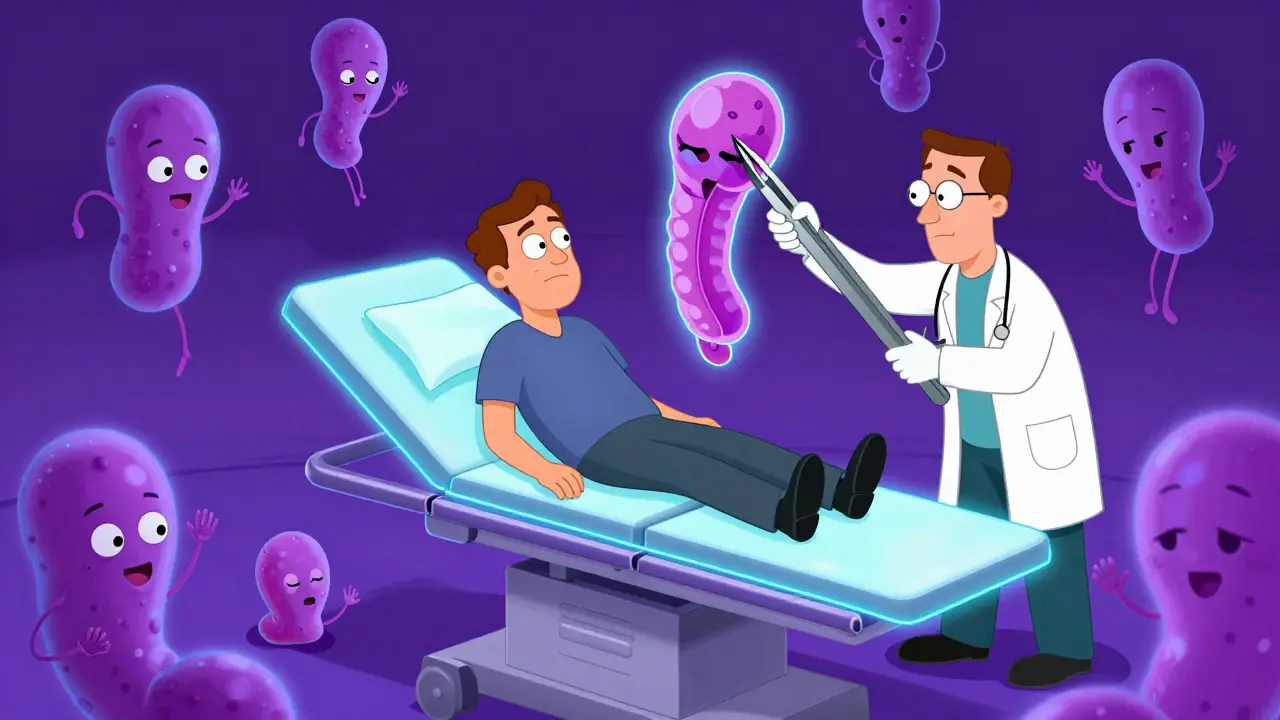
Colonoscopy remains the most effective tool for catching colorectal cancer before it spreads. Unlike other tests, it doesn’t just find cancer-it stops it. During the procedure, a doctor uses a thin, flexible tube with a camera to look inside your colon. If they spot a polyp-a small growth that can turn cancerous-they can remove it right then and there. No second visit. No waiting. Just prevention.
That’s why colonoscopy is recommended every 10 years for people at average risk. Studies show it cuts colorectal cancer incidence by 67% and reduces deaths by 65%. It’s not perfect-bowel prep is unpleasant, sedation is required, and there’s a small risk of perforation (about 1 in 1,000 procedures). But the benefits far outweigh the downsides. A 2023 case report in Gastroenterology & Hepatology followed a 47-year-old African American man who had a stage I tumor found during his first colonoscopy at age 45. His five-year survival probability? 95%. Without screening, he likely wouldn’t have known he had cancer until it reached stage IV, where survival drops to just 14%.
Colonoscopy is especially critical for high-risk groups: those with a family history of colorectal cancer, inflammatory bowel disease (like Crohn’s or ulcerative colitis), or inherited syndromes like Lynch syndrome or familial adenomatous polyposis (FAP). For them, screening often starts before 45 and happens more frequently-sometimes every 1 to 5 years. African Americans, who face a 20% higher incidence and 40% higher death rate from colorectal cancer, are also strongly advised to start at 45 and choose colonoscopy over stool tests when possible.
Other Screening Options: What Works When Colonoscopy Isn’t Right
Not everyone wants-or can-get a colonoscopy. That’s why other screening tools exist. Each has trade-offs.
Fecal Immunochemical Test (FIT) is a simple at-home stool test that looks for hidden blood. It’s non-invasive, low-cost, and covered by insurance. It detects about 79-88% of colorectal cancers. But it misses many polyps and needs to be done every year. If the test is positive, you still need a colonoscopy to find out why. In safety-net clinics, FIT adherence is 67%, compared to just 42% for colonoscopy. Hispanic patients are more likely to complete FIT than non-Hispanic White patients.
Stool DNA test (sDNA-FIT) looks for both blood and abnormal DNA shed by cancerous or precancerous cells. It’s more sensitive than FIT-detecting 92% of cancers-but less specific. That means more false positives. About 13% of people who take it get a positive result, even if they don’t have cancer. That leads to unnecessary colonoscopies. Still, it’s a good option for those who refuse annual FIT or colonoscopy. It’s recommended every 3 years.
Flexible sigmoidoscopy examines only the lower third of the colon. It’s quicker, needs less prep, and has fewer complications. But it can’t see polyps or cancers in the upper colon. It reduces distal cancer deaths by 28%, but overall CRC mortality reduction is lower than colonoscopy. It’s done every 5 years, often paired with annual FIT.
CT colonography (virtual colonoscopy) uses X-rays to create 3D images of the colon. No sedation. No scope. But you still need bowel prep. And if they find anything, you still need a colonoscopy to remove polyps. Plus, you’re exposed to radiation-about 1 to 10 millisieverts per scan, similar to a few chest X-rays. It’s good for people who can’t tolerate sedation but still requires follow-up if anything’s found.
Chemotherapy Regimens: What Happens After Diagnosis
If screening finds cancer, the next step is staging. Is it confined to the colon? Has it spread to lymph nodes? To the liver or lungs? Treatment changes based on that.
For early-stage cancers (Stage I and II), surgery alone is often enough. No chemo needed. But if cancer has reached nearby lymph nodes (Stage III), chemotherapy becomes standard. The goal? Kill any stray cancer cells that might have escaped during surgery.
The two most common chemo regimens for Stage III colorectal cancer are FOLFOX and CAPOX.
FOLFOX combines oxaliplatin, leucovorin, and 5-fluorouracil (5-FU). It’s given over 2 weeks, repeated every 2 weeks for 6 months. Side effects include nerve damage (tingling in fingers and toes), fatigue, nausea, and low blood counts. The nerve damage can last months or even years after treatment ends.
CAPOX uses capecitabine (an oral pill that turns into 5-FU in the body) and oxaliplatin. It’s also given every 3 weeks for 6 months. Many patients prefer it because they can take the pill at home. But it can cause hand-foot syndrome-redness, pain, and peeling on palms and soles. Both regimens work equally well in most cases. The choice often comes down to patient preference, lifestyle, and tolerance for side effects.
For Stage IV cancer-where the disease has spread beyond the colon-chemotherapy is still used, but it’s not meant to cure. It’s meant to control growth, relieve symptoms, and extend life. Drugs like cetuximab or bevacizumab may be added to chemo if the tumor has specific genetic markers (like RAS wild-type). In some cases, surgery or radiation is used to remove or shrink metastases in the liver or lungs.
Who Should Be Screened and When? The Rules Have Changed
Here’s what the guidelines say in 2025:
- Average risk, age 45-75: Screen with colonoscopy every 10 years, FIT every year, or sDNA-FIT every 3 years.
- Ages 76-85: Talk to your doctor. Screening may still help if you’re healthy and haven’t been screened before. If you’ve had regular screenings with normal results, you may stop.
- Over 85: Screening is not recommended.
- High risk: Start before 45. Colonoscopy every 1-5 years, depending on your condition.
- History of polyps: Follow-up colonoscopy in 3-5 years, depending on size and number.
Medicare and most private insurers cover these tests at no cost to you. Colonoscopy is covered every 10 years for average-risk people, or every 2 years if you’ve had polyps. FIT and sDNA-FIT are covered annually or every 3 years.
Barriers to Screening-and How to Overcome Them
Despite all the evidence, only 67% of adults aged 50-75 are up to date with screening. That’s far below the national goal of 70.5%. Why?
- Bowel prep is awful. People hate it. But newer prep solutions are easier. Ask your doctor about split-dose regimens-half the prep the night before, half the morning of. It’s more effective and less nauseating.
- It’s embarrassing. Talking about poop, blood, or colon exams feels awkward. But doctors hear this every day. You’re not the first. And you won’t be the last.
- It’s expensive. It’s not-if you have insurance. Uninsured people pay out-of-pocket. But community health centers and state programs often offer free or low-cost screening.
- They don’t know they need it. Primary care doctors miss the mark 42% of the time when it comes to recommending screening. Don’t wait for your doctor to bring it up. Ask. Say: “I’m 46. Should I get screened for colon cancer?”
Successful programs use patient navigators-trained staff who help people schedule tests, arrange transportation, and understand results. Clinics with navigators see 35% higher completion rates. Automated reminders-text or email-boost adherence by 28%.
What’s Next? Blood Tests, AI, and Personalized Screening
The future of colorectal cancer screening is moving beyond the colonoscope.
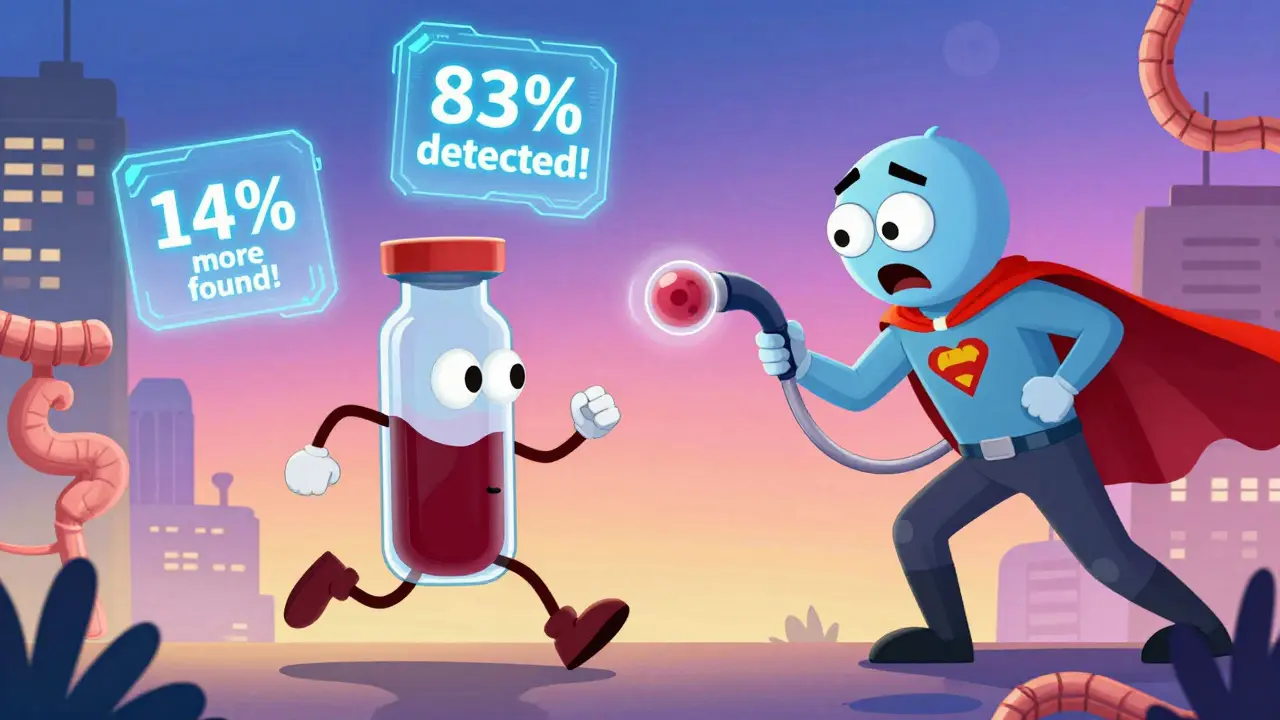
Scientists are testing blood tests that detect cancer DNA. The Guardant SHIELD test, studied in 10,000 people, picked up 83% of colorectal cancers. It’s not ready for prime time yet, but it could one day replace stool tests for people who refuse them.
AI is already here. The GI Genius system, approved by the FDA in 2021, uses real-time artificial intelligence to highlight polyps during colonoscopy. In one study, it boosted detection by 14%. That means more polyps found, more cancers prevented.
Soon, screening may be personalized. Instead of everyone starting at 45, your risk could be calculated using your genetics, diet, weight, activity level, and family history. A person with high genetic risk might start at 35. Someone with low risk and healthy habits might wait until 50. This precision approach could cut unnecessary colonoscopies by 30% without missing cancers.
Final Thoughts: Don’t Wait for Symptoms
Colorectal cancer doesn’t scream. It whispers. Bloating. Fatigue. A change in bowel habits. By the time you notice, it’s often too late. Screening is your silent protector.
If you’re 45 or older, get screened. Choose colonoscopy if you can. If not, FIT every year works. Don’t let fear, inconvenience, or embarrassment stop you. The numbers don’t lie: screening saves lives. It’s not just a test. It’s a chance to live longer, healthier, and free from cancer.

pascal pantel
December 20, 2025 AT 11:18Let’s cut through the noise: colonoscopy isn’t ‘the gold standard’-it’s the only tool that actually prevents cancer by removing polyps. FIT is a band-aid for people who hate bowel prep and want to pretend they’re doing something. The 79-88% sensitivity? That’s just a fancy way of saying 1 in 5 cancers get missed. And don’t get me started on sDNA-FIT’s 13% false positive rate-that’s a pipeline to unnecessary colonoscopies and anxiety. The real issue isn’t screening access, it’s systemic complacency. We’re treating prevention like a checklist, not a lifeline.
Gloria Parraz
December 21, 2025 AT 15:27I had my first colonoscopy at 46 after my dad passed from stage IV. I was terrified. The prep was brutal. But the moment the doctor said, ‘We got it-polyp removed, all clear’-I cried in that gown. No one talks about how this test doesn’t just save lives, it saves families. If you’re on the fence, do it for the people who’ll be left behind if you don’t. You don’t need to be brave. Just do it.
Sahil jassy
December 23, 2025 AT 14:54in india we dont have access to colonoscopy for most people. fit is the only option. its cheap and works. dont judge people for using it. its better than nothing. my aunt got diagnosed early because of fit. she is alive today. that matters.
Kathryn Featherstone
December 25, 2025 AT 13:15I work in a community clinic. We’ve seen FIT adherence jump from 38% to 67% after we started sending text reminders and offering evening appointment slots. People aren’t lazy-they’re overwhelmed. The system needs to meet them where they are, not shame them for not fitting into a 1990s healthcare model. Navigators aren’t optional. They’re the difference between life and death for a lot of folks.
Nicole Rutherford
December 27, 2025 AT 12:25Ugh. Another ‘colonoscopy is great’ lecture. But did you mention that 1 in 1,000 people get perforated? Or that 40% of people who get a colonoscopy end up with chronic bloating and IBS-like symptoms afterward? And let’s not pretend everyone can afford to take two days off work. You’re not helping-you’re just pushing fear and privilege. Maybe try talking to people who actually live this, instead of quoting studies from your ivory tower.
Marsha Jentzsch
December 27, 2025 AT 15:08Okay but… what if you’re a 45-year-old woman with no symptoms, no family history, and you’re terrified of the prep? Do you really have to do it? I mean… I’ve read horror stories. What if I just… wait? What if I’m one of the lucky ones? You’re acting like if I don’t do it, I’m going to die tomorrow. I’m not a statistic. I’m a person.
Carolyn Benson
December 29, 2025 AT 13:36There’s a deeper question here: why do we treat cancer screening like a moral obligation? Why is avoidance framed as cowardice? The real crisis isn’t low screening rates-it’s that we’ve turned health into a performance. You’re not ‘responsible’ if you skip the colonoscopy. You’re just human. We’ve pathologized normal fear. And in doing so, we’ve alienated the very people we claim to save. Maybe the answer isn’t more tests… but more compassion.
Connie Zehner
December 31, 2025 AT 06:14PSA tests were once the gold standard too-until we realized they caused more harm than good. Are we repeating the same mistake? Colonoscopy has risks. FIT has limits. But we’re treating this like a binary: do it or die. What about the 30% of people who get false positives and end up with anxiety disorders? Or the ones who develop chronic pain from the prep? Where’s the data on long-term mental health impact? You’re all so focused on survival rates… but what about quality of life? 😔