 Apr, 11 2026
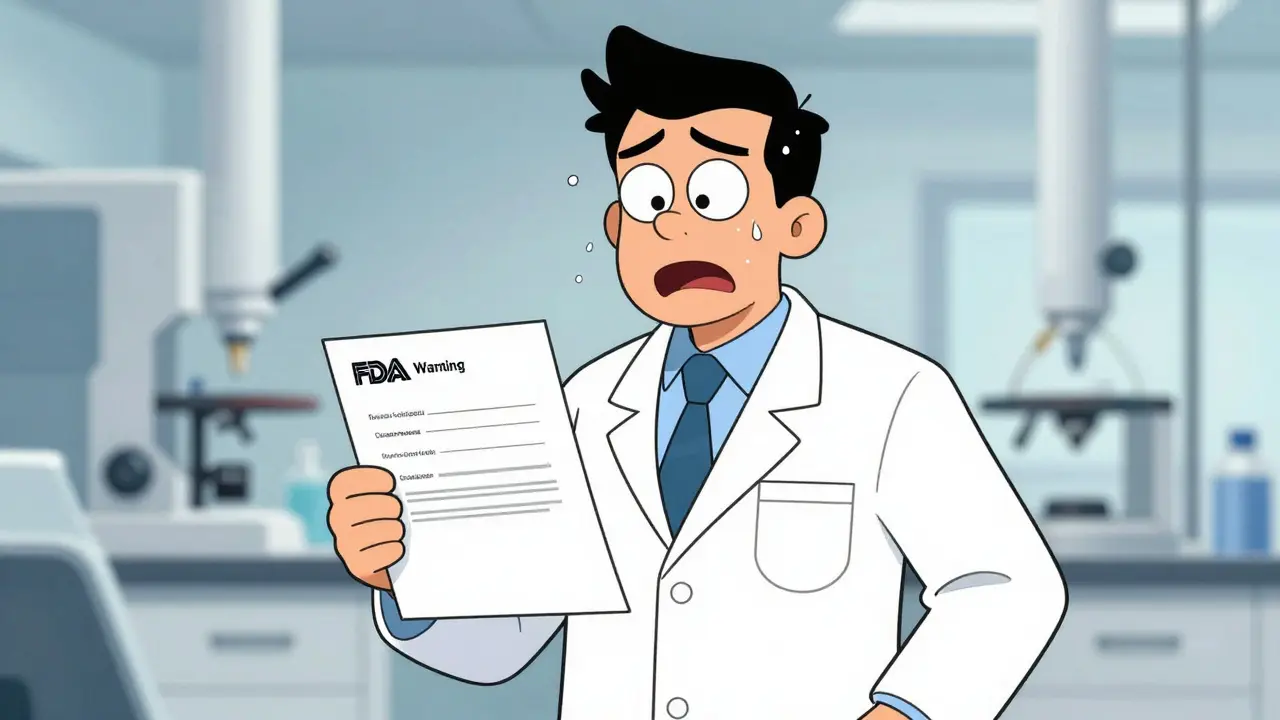
Getting a warning letter from the FDA is a nightmare for any manufacturer. It doesn't just mean a slap on the wrist; it can lead to import alerts that essentially lock your products out of the U.S. market. In 2025, we've seen a sharp increase in this scrutiny. For instance, warning letters for medical device quality systems jumped by 32% compared to the previous year. The agency is no longer just checking boxes; they are hunting for systemic failures that could put patients at risk.
Whether you're running a pharmaceutical plant or a medical device facility, the root of these problems usually isn't a single mistake. It's a failure in the CGMP is Current Good Manufacturing Practice, a set of regulations enforced by the FDA to ensure the quality, safety, and purity of drug products . When these standards slide, the results are predictable and often dangerous. If you want to avoid the dreaded Form 483, you need to know where the FDA is looking most closely right now.
The Biggest Red Flags in 2025 Inspections
If you look at the data from recent enforcement actions, a few specific themes keep popping up. These aren't rare accidents; they are patterns of negligence that the FDA is now aggressively targeting.
Aseptic Processing Failures
This is the most common issue, appearing in nearly half of the warning letters this year. The FDA is finding that companies are cutting corners on sterile environments. For example, some facilities have failed their media fill studies-which are basically "practice runs" to see if a process stays sterile. If you can't prove your environment is clean, the FDA assumes your product is contaminated.
The Data Integrity Crisis
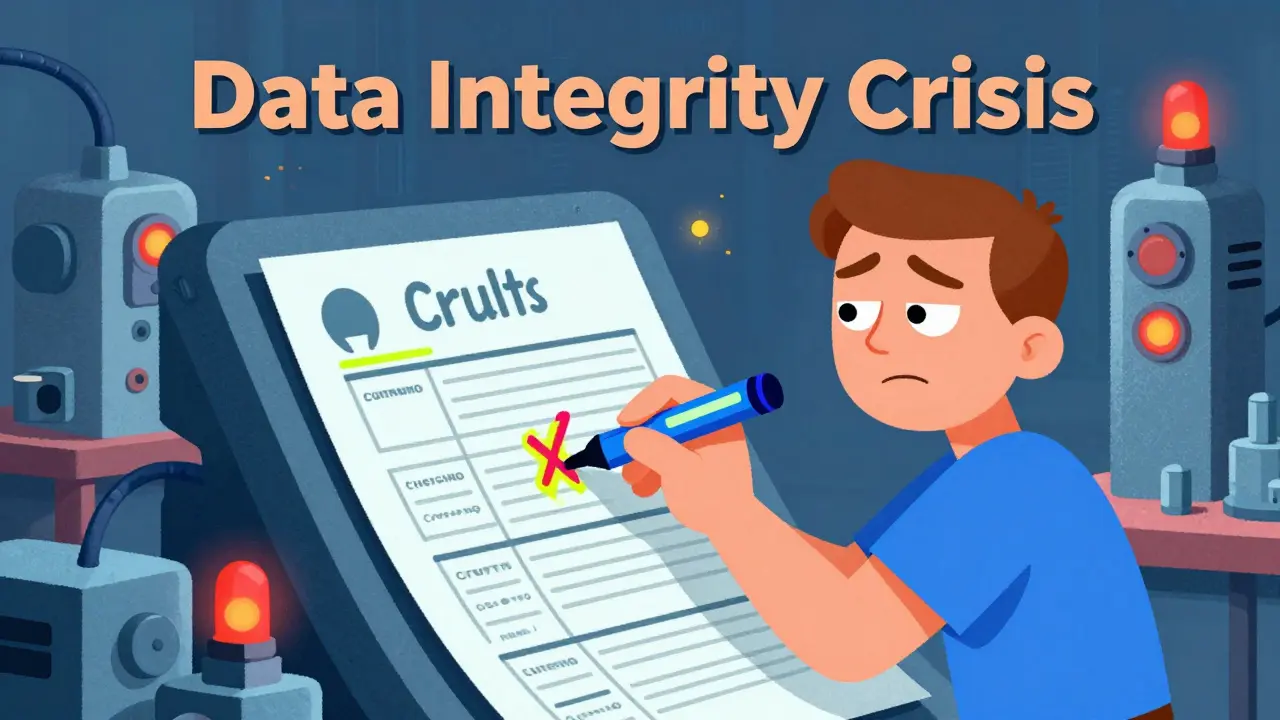
Data integrity is a huge focal point. The FDA expects records to follow
ALCOA+ is
a framework ensuring data is Attributable, Legible, Contemporaneous, Original, and Accurate, with additional requirements for completeness and consistency
principles. We're seeing absurd violations, like staff using erasable markers on laminated production records. If a record can be wiped away, it's not a legal document-it's a liability. The agency is also cracking down on instruments that lack audit trails, meaning there's no way to tell if a result was deleted or changed to make a batch look "perfect."
Material Control Gaps
You can't trust your suppliers blindly. The FDA has flagged companies for failing to test high-risk raw materials. A prime example is the failure to test glycerin or sorbitol for diethylene glycol (DEG) contamination. These chemicals are toxic, and missing a test isn't just a paperwork error; it's a life-or-death failure in quality control.
| Deficiency Type | Frequency in Warning Letters | Common Example | Primary Risk |
|---|---|---|---|
| Aseptic Processing | 47% | Inadequate media fill studies | Product Contamination |
| Data Integrity | 39% | Erasable markers on records | Fraudulent/Inaccurate Data |
| Material Control | 35% | Lack of DEG testing in glycerin | Toxicity/Patient Death |
| Process Validation | 28% | No validation for specific products | Inconsistent Product Quality |
Why Technical Fixes Aren't Enough: The Quality Culture Problem
You can buy the most expensive software and hire the best consultants, but if your leadership doesn't care about quality, you'll still fail. The FDA is shifting its focus from "technical compliance" to "quality culture." In 2025, roughly 78% of cited facilities showed a pattern where management prioritized shipping schedules over compliance. When the goal is "hit the deadline at all costs," quality is the first thing to be sacrificed.
This cultural rot shows up in the most basic ways. Some facilities have been caught not even preparing batch production records for every batch. That's like trying to bake a cake without a recipe and then claiming it was made perfectly. The FDA's QMM is Quality Management Maturity program, an initiative by the CDER to encourage manufacturers to move beyond baseline CGMP and adopt advanced quality systems initiative is trying to fix this by rewarding companies that proactively improve their systems, rather than those that just do the bare minimum to pass an inspection.
Regional Patterns and Global Risks
The FDA has ramped up unannounced foreign inspections by 40% in 2025, with a heavy focus on Asia. If you're manufacturing in China, India, or Malaysia, you are currently in the crosshairs. Each region has its own "signature" struggle:
- China: Frequently cited for analytical method validation failures.
- India: Struggling heavily with basic data integrity and audit trails.
- Malaysia: Often cited for poor quality unit oversight.
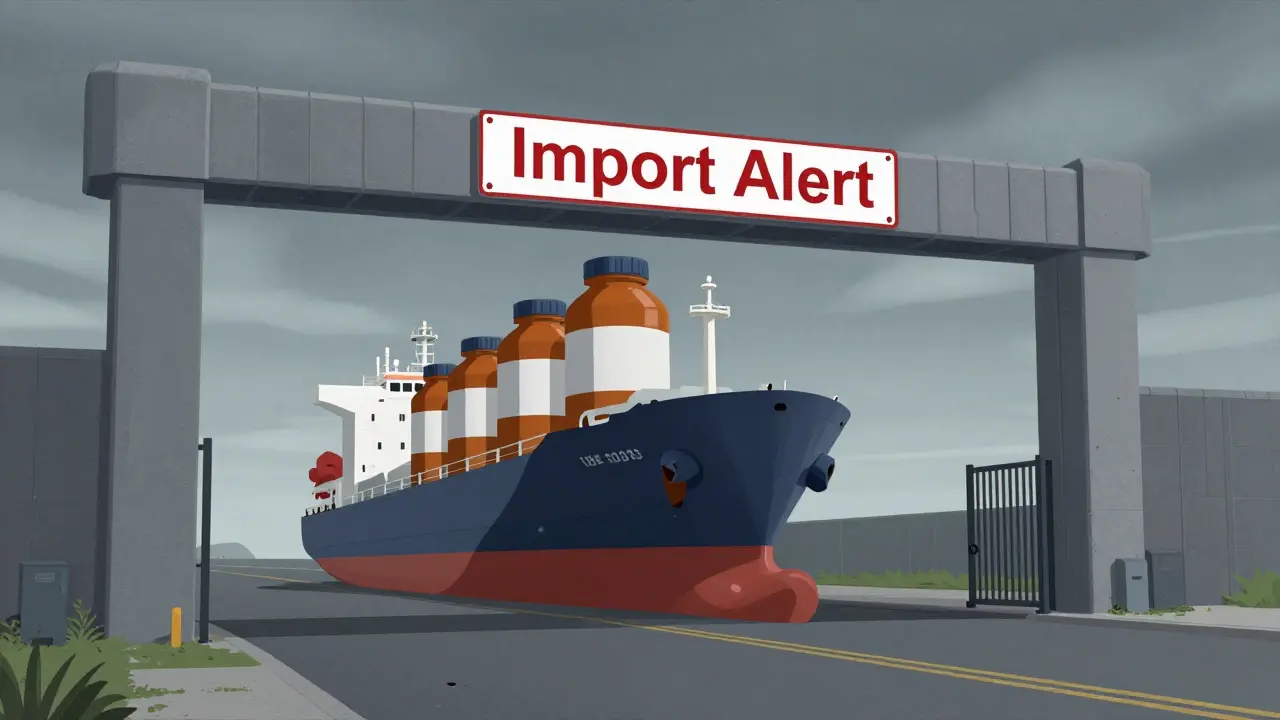
The danger here is the "Import Alert." If the FDA finds critical violations, they can place a facility on Import Alert 66-40. This means your product is stopped at the border and requires a physical examination for every single shipment. For most companies, this is a financial death sentence.
How to Fix These Deficiencies (The Remediation Path)
If you've already received a Form 483 or a warning letter, you can't just send a letter saying "we'll do better." The FDA requires concrete, validated evidence of change. Usually, this involves hiring an independent CGMP consultant-a requirement in 92% of recent warning letters.
For data integrity, you need a system that meets the ALCOA+ standard. This means validated audit trails, user-specific access (no shared passwords), and timestamps that can't be altered. Records should generally be retained for at least 180 days in an electronic format that is traceable.
For process validation, the gold standard is the "rule of three." You need to demonstrate three consecutive successful validation batches where every in-process control meets the pre-specified criteria. If you only have one successful batch, the FDA views it as luck, not a validated process.
For material control, specifically for high-risk components like glycerin, you should follow USP General Chapter <1085> is the United States Pharmacopeia standard for Good Manufacturing Practices, providing guidelines for the quality and purity of pharmaceutical components . This involves testing for diethylene glycol (DEG) and ethylene glycol (EG) at sensitivity levels of 0.1% w/w. If you're relying solely on a supplier's certificate of analysis (CoA) without doing your own spot-checks, you're playing a dangerous game.
What is the difference between a Form 483 and a Warning Letter?
A Form 483 is issued at the end of an inspection when an investigator finds potential violations. It's essentially a list of observations. A Warning Letter is more serious; it's a formal notification that the FDA has reviewed the 483 response and decided the deficiencies are significant enough to warrant official enforcement action. A 483 is a warning; a Warning Letter is a legal demand for correction.
How long does it usually take to remediate FDA deficiencies?
Depending on the severity, remediation typically takes between 6 and 18 months. Simple documentation fixes can be done quickly, but implementing a full data integrity system or re-validating a manufacturing process requires multiple batches and rigorous testing to satisfy FDA inspectors.
Why does the FDA focus so much on "Data Integrity"?
Because if the data is unreliable, the product is unsafe. If a company deletes a "failed" test result and only records the "passed" one, the FDA has no way of knowing if the product is actually consistent. Data integrity is the only window the FDA has into whether a company is actually following its own quality procedures.
What happens if a facility is placed on Import Alert 66-40?
Your products are effectively blocked from entering the U.S. unless they undergo physical examination. This causes massive supply chain delays and financial losses. To get off the alert, you typically have to prove full remediation of the CGMP violations, often verified by a re-inspection of the facility.
Is the QMM program mandatory?
As of 2025, the Quality Management Maturity (QMM) program is voluntary. However, the FDA has indicated that the results of these assessments may influence how often they inspect your facility starting in 2026. Basically, if you prove you have a high-maturity quality system, you might see fewer intrusive inspections.
What to Do Now
If you're a quality manager, your first step isn't updating a SOP-it's talking to your executives. If the leadership doesn't understand that quality is a prerequisite for profit, no amount of paperwork will save the site. Start by conducting a gap analysis against ALCOA+ standards and review your supplier testing protocols. Don't wait for an unannounced inspection to find out that your glycerin is contaminated or your audit trails are missing. By the time the FDA finds it, the cost of fixing it will be ten times higher than if you'd caught it yourself.

Doug DeMarco
April 12, 2026 AT 19:23Man, that part about the erasable markers is just wild! 😂 Imagine thinking that's a good idea in a regulated facility. For anyone just starting out in QA, just remember that the FDA is basically looking for any reason to trust you-or not trust you. Keep your records tight and always double-check your audit trails! 🚀
Franklin Anthony
April 13, 2026 AT 09:59funny how the fda only cares about the ones they want to target actually it is all about the money and control obviously no one says it but we all know the real game here
Victor Parker
April 14, 2026 AT 17:17Total scam!! 🙄 They just want to shut down the foreign plants so we have to buy the expensive local stuff. It's all a big play to keep us under their thumb. Wake up people! 🚩
Emily Wheeler
April 15, 2026 AT 02:27It really makes me think about how we perceive the concept of quality as a mere checklist rather than a holistic philosophy of care, and while I agree that the systemic failures are concerning, I believe we should strive to foster an environment where employees feel empowered to report errors without fear, because ultimately, the synergy between human intuition and rigid regulatory frameworks is where the true safety of the patient actually resides in the long run.
Ryan Hogg
April 16, 2026 AT 02:18I've spent three years trying to convince my boss that our data integrity is a joke and honestly I'm just exhausted. It's like screaming into a void while the ship is sinking and everyone is just pretending the water isn't at their ankles. I can't even sleep anymore thinking about the next audit. It's just soul-crushing to work in a place that treats safety as a suggestion.
danny Gaming
April 16, 2026 AT 15:12Typical US government overreach lol. They come to india or china and act like they own the place while our own domestic plants are probably just as bad but they hide it better becaus they are homegrown. totaly biased system if u ask me
kalpana Nepal
April 18, 2026 AT 07:59This is just western arrogance. We are the pharmacy of the world and the FDA tries to dictate everything. True quality comes from the soul of the worker, not from a piece of paper from America.
Danny Wilks
April 18, 2026 AT 16:47It is quite fascinating to observe how these regulatory trends reflect the broader global shift toward transparency, and although the implementation of ALCOA+ standards may seem tedious to the uninitiated, the long-term stability of the global supply chain depends heavily on these rigorous benchmarks, especially when one considers the catastrophic potential of chemical contaminants like diethylene glycol in common pharmaceutical bases.
Trey Kauffman
April 19, 2026 AT 19:47Oh sure, because a "quality culture" is definitely something you can just install like a software update. I'm sure a few PowerPoint slides on "integrity" will magically stop people from using White-Out on their logs. Truly revolutionary stuff here.
Lynn Bowen
April 21, 2026 AT 10:27The point about Import Alert 66-40 is really the most critical part of this for anyone managing overseas logistics. It's the difference between a manageable delay and a complete business shutdown.
Ben hogan
April 22, 2026 AT 23:00Imagine actually believing that the "rule of three" is a sophisticated metric for validation. It's a primitive approach for people who can't handle actual statistical process control. Only a mid-wit would find this list impressive, as it basically just summarizes the absolute bare minimum of professional competence. This isn't "insight," it's a glossary for the illiterate.