 Aug, 26 2026
Ever wondered if that cheaper pill at the pharmacy is actually as good as the brand-name version? You are not alone. Many people assume that because a generic drug costs less, it might be cut on quality or work differently in your body. The reality is quite different. In the United States, generic drugs must meet strict regulatory standards set by the Food and Drug Administration (FDA) to ensure they are therapeutically equivalent to their brand-name counterparts. This means they have to do the same thing, in the same way, with the same safety profile.
The system isn't just about saving money; it's about trust. Since the Hatch-Waxman Act of 1984, the FDA has built a framework that allows affordable competition while keeping quality high. Today, more than 90% of prescriptions filled in the U.S. are for generic drugs. That’s a massive number of patients relying on these standards every single day. So, how does the FDA make sure every dose you swallow is safe and effective? Let’s break down the actual requirements and testing processes that stand behind your medication.
What Counts as "Equivalent"?
To understand the quality standards, you first need to grasp two key concepts: pharmaceutical equivalence and bioequivalence. These terms sound technical, but they describe very practical things.
Pharmaceutical equivalence means the generic drug contains the exact same active ingredient as the brand-name drug. It must have the same strength (for example, 500 mg), the same dosage form (like a tablet or capsule), and the same route of administration (taken by mouth, injected, etc.). While inactive ingredients like dyes, fillers, or binders can differ slightly, the core medicine remains identical. This ensures that what you are actually taking is the same chemical compound.
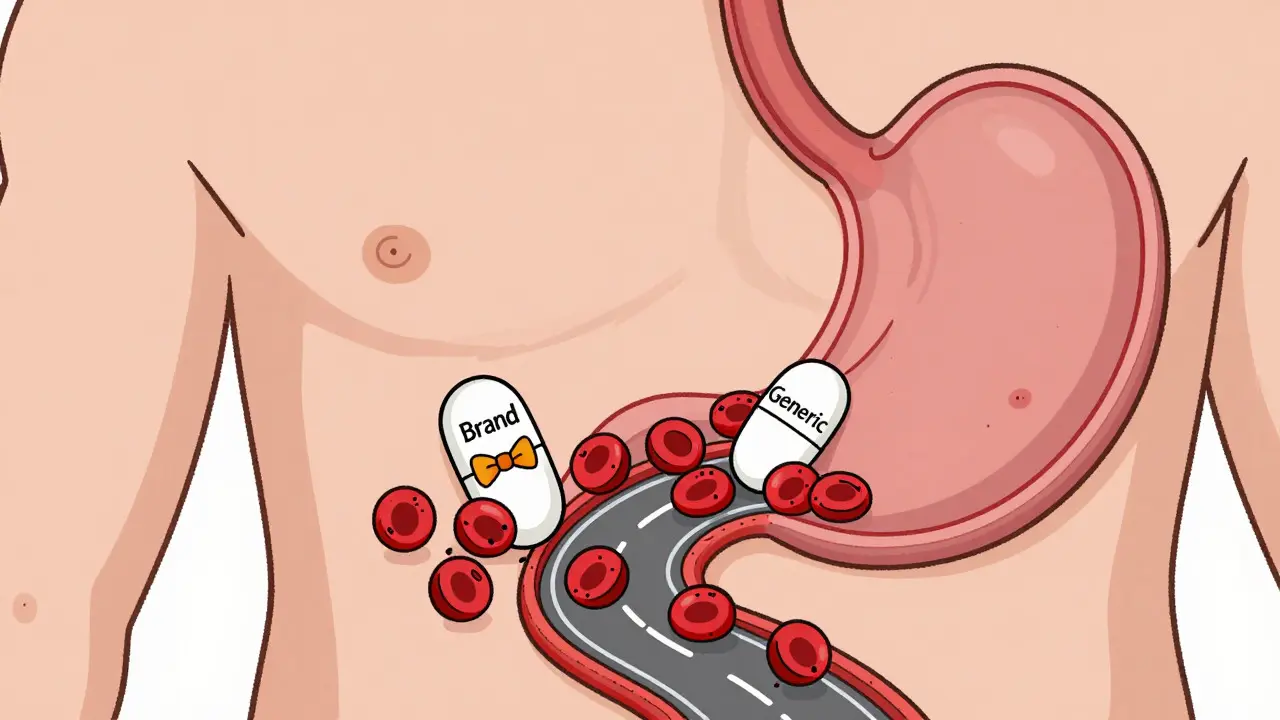
Bioequivalence goes a step further. It asks: does the drug get into your bloodstream at the same rate and to the same extent as the brand-name version? If a generic tablet dissolves too slowly, it might not work as fast as needed. If it releases too quickly, it could cause side effects. The FDA measures this using pharmacokinetic studies. Specifically, the 90% confidence interval for the ratio of the generic to the brand-name drug must fall within an acceptance range of 80% to 125% for both maximum concentration (Cmax) and total exposure (AUC). This tight window ensures that the difference in absorption is statistically insignificant for most patients.
| Criteria | Pharmaceutical Equivalence | Bioequivalence |
|---|---|---|
| Active Ingredient | Must be identical | Measured in blood/tissue |
| Dosage Form | Must be identical (e.g., tablet) | Not directly compared, but affects absorption |
| Strength | Must be identical (e.g., 50mg) | Calculated via Cmax/AUC ratios |
| Inactive Ingredients | Can vary (dyes, fillers) | Must not significantly alter absorption |
| Testing Method | Chemical analysis | Clinical trials in healthy volunteers |
The Role of Current Good Manufacturing Practices
Quality doesn't start when the pill hits the pharmacy shelf; it starts in the factory. Both generic and brand-name manufacturers must follow Current Good Manufacturing Practices (cGMP), codified in 21 CFR Parts 210 and 211. These rules are non-negotiable. They mandate strict oversight of raw materials from the moment they arrive at the facility until the final product is packaged.
Under cGMP, manufacturers need clear written procedures for every step of production. Critical parameters, like temperature during drying or mixing times, must be monitored and recorded. Quality control teams run rigorous tests on every batch to confirm identity, strength, purity, and overall quality. Interestingly, many major brand-name companies also manufacture generic drugs, often in the same facilities. According to FDA data, approximately 50% of generic drugs are made by the same companies that produce the original brand-name versions. This overlap reinforces the idea that the manufacturing standards are universal, not tiered based on price.
The FDA takes enforcement seriously. They conduct around 3,500 inspections annually across manufacturing facilities worldwide. If a facility fails to meet cGMP standards, it can face warnings, import alerts, or even shutdowns. This constant scrutiny helps keep contamination and defects out of your medicine cabinet.
How Bioequivalence Is Actually Tested
You might wonder who gets tested. For most small-molecule generic drugs, the FDA requires clinical studies involving 24 to 36 healthy volunteers. These participants take either the generic or the brand-name drug in a randomized order. Researchers then measure drug levels in their blood over time. By comparing the average results, statisticians determine if the 90% confidence interval falls within that 80-125% acceptance limit we mentioned earlier.
But not all drugs are simple tablets. What about inhalers, eye drops, or long-acting injectables? These are known as complex generics. For these products, measuring blood levels alone isn't enough. An inhaler needs to deliver medication to the lungs in a specific particle size distribution. An eye drop needs to stay on the surface of the eye long enough to work. To address this, the FDA has developed over 2,100 product-specific guidances. These documents outline unique testing methods for each type of complex drug, ensuring that the generic performs just as well physically and structurally as the reference listed drug (RLD).
The Approval Process: From Application to Shelf
Getting a generic drug approved isn't instant. Manufacturers submit an Abbreviated New Drug Application (ANDA) to the FDA. Unlike new drugs that require years of Phase I, II, and III clinical trials for safety and efficacy, generics rely on the existing safety and efficacy data of the brand-name drug. Instead, the focus is on proving equivalence and manufacturing consistency.
The review process involves several cycles. The FDA's Office of Generic Drugs coordinates with the Office of Pharmaceutical Quality to evaluate chemistry, manufacturing, and controls data. Stability testing is a huge part of this. Manufacturers must provide data showing the drug remains stable over its proposed shelf life. This typically includes accelerated stability studies at 40°C and 75% relative humidity for six months, plus long-term studies at recommended storage conditions for 12 to 24 months.
Thanks to the Generic Drug User Fee Amendments (GDUFA), which was reauthorized in 2022, the FDA aims to review complete ANDAs within 10 months. In fiscal year 2022, the agency approved 892 original ANDAs. As of 2023, there are over 20,000 approved generic drug products representing roughly 14,800 different branded drugs. This volume shows just how extensive the regulatory pipeline is.

Why Does This Matter for Your Health?
For most patients, switching between brands and generics shouldn't change how you feel. The American Medical Association has supported the therapeutic equivalence of FDA-approved generics since 2010, stating they are safe and effective alternatives. A 2022 Consumer Reports survey found that 89% of U.S. adults were satisfied with generic medications. Most people don't notice any difference in how the drug works.
However, there are exceptions. Drugs with a narrow therapeutic index (NTI) are sensitive to small changes in blood levels. Examples include levothyroxine (for thyroid issues), warfarin (a blood thinner), and certain seizure medications. A 2021 study in JAMA Internal Medicine found that some patients switching between different generic versions of levothyroxine experienced fluctuations in thyroid levels that required dose adjustments. While rare, these cases highlight why consistency matters. If you are on an NTI drug, it’s worth discussing with your doctor whether staying with one specific manufacturer is preferable for you.
Despite these nuances, the economic impact is undeniable. Generic drugs saved the U.S. healthcare system approximately $37 billion in 2022 alone. Without these strict but efficient quality standards, those savings would be impossible, and access to essential medicines would be much more limited for millions of people.
Frequently Asked Questions
Are generic drugs exactly the same as brand-name drugs?
They contain the same active ingredient, strength, and dosage form. However, inactive ingredients like colors, flavors, or fillers may differ. The FDA requires them to be bioequivalent, meaning they reach the bloodstream at similar rates and levels.
Who regulates generic drugs in the US?
The Food and Drug Administration (FDA), specifically through its Center for Drug Evaluation and Research (CDER) and the Office of Generic Drugs (OGD), oversees the approval and quality monitoring of generic drugs.
What is the 80-125% rule in bioequivalence?
This is the statistical acceptance range for comparing the generic and brand-name drug. The 90% confidence interval for the ratio of their average blood concentrations (Cmax and AUC) must fall between 80% and 125%. This ensures the difference is clinically negligible.
Do generic drugs go through clinical trials?
Yes, but usually smaller ones. Instead of large safety and efficacy trials, generics undergo bioequivalence studies in 24-36 healthy volunteers to prove they are absorbed similarly to the brand-name reference drug.
Is it okay to switch between different generic brands?
For most medications, yes. However, for drugs with a narrow therapeutic index like blood thinners or thyroid hormones, consistent use of the same manufacturer is often recommended to avoid minor fluctuations in drug levels.
What happens if a generic drug fails FDA inspection?
The FDA may issue warning letters, place the facility on import alert lists, or require corrective actions. In severe cases, approval can be suspended or revoked until compliance is restored.
