 Mar, 4 2026
When you hear "price war," you might think of Black Friday deals or Amazon undercutting Walmart. But in the U.S. pharmaceutical market, the real price wars happen behind the scenes - and they’re saving millions of people hundreds, even thousands, of dollars a year. The story isn’t as simple as "more competitors = lower prices." It’s messy, full of middlemen, and often leaves patients confused. Here’s how generic drug price wars actually work - and how you can make sure you’re getting the savings you’re owed.
How Generic Drug Price Wars Start
When a brand-name drug’s patent expires, any company can apply to make a generic version. They don’t need to redo expensive clinical trials. All they have to prove is that their pill works the same as the original. This system, created by the Hatch-Waxman Act in 1984, was designed to force prices down. And it does - but only if enough companies jump in. The numbers don’t lie. When only one generic manufacturer enters the market, prices drop maybe 15-30% below the brand. But with four or more competitors? Prices plunge by 85% or more. The FDA found that with six or more generic makers, prices fall over 95% compared to the brand-name version. That’s not a small discount. That’s a total overhaul of the cost structure. Take metformin, the most common diabetes drug. In 2023, with over 50 manufacturers making it, the cash price at Walmart was $4 for a 30-day supply. That’s less than the cost of a coffee. Same with lisinopril, a blood pressure pill. In markets with 10+ generic makers, it’s often under $5 a month. These aren’t outliers. They’re the result of fierce, real competition.Where the Savings Disappear
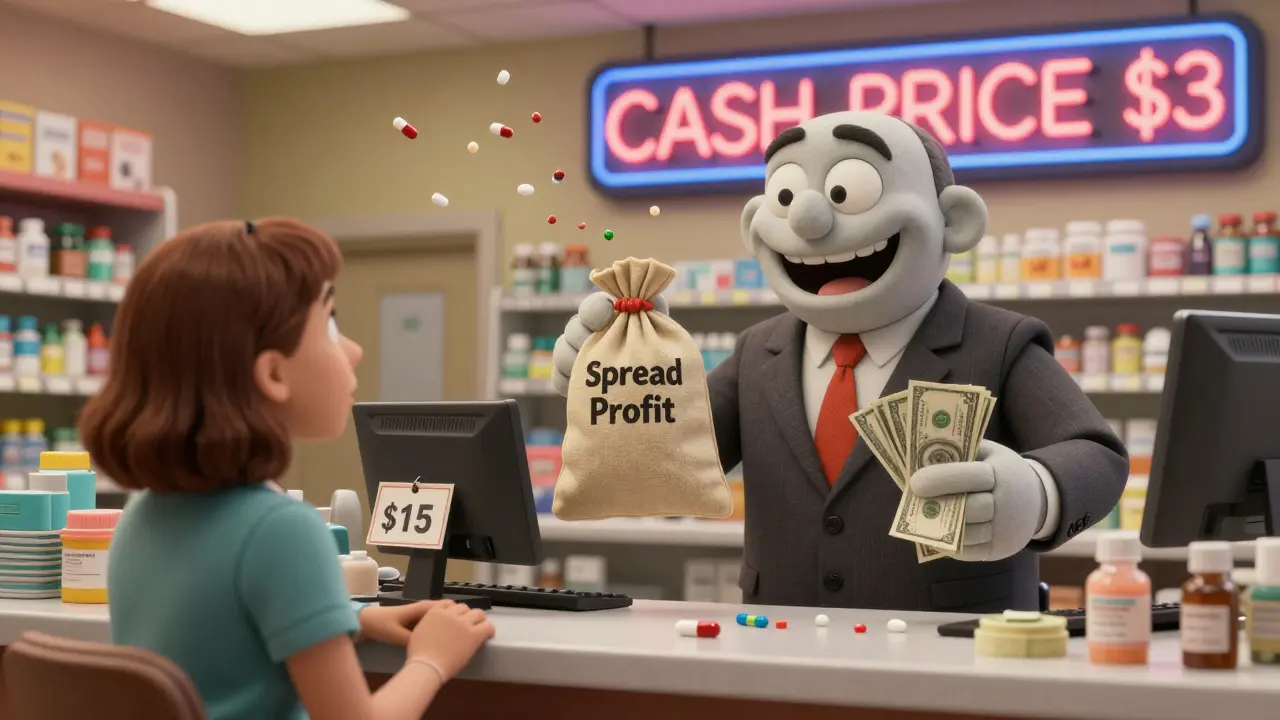
Here’s the catch: you don’t always see those savings at the pharmacy counter. That’s because of pharmacy benefit managers - or PBMs. These are middlemen between drug manufacturers, insurers, and pharmacies. They negotiate prices, manage formularies, and collect rebates. But they don’t always pass those savings along. One sneaky trick? Spread pricing. A PBM might tell your insurer they paid $10 for a generic pill, but they actually paid $2. They keep the $8 difference as profit. Then, your copay is still $10 - even though the drug cost $2. You’re paying more than the drug is worth. Another issue? Copay clawbacks. If your copay is $15, but the cash price is $10, some insurers will make you pay the full $15 anyway. The pharmacy can’t tell you the cash price is lower - until 2018, when a federal law banned "gag clauses." Even now, many pharmacists still don’t volunteer that info. A 2022 USC Schaeffer Center study found that in nearly 30% of cases, the cash price was cheaper than the insurance copay. But most people never know because no one told them.
Why Some Generics Are Still Expensive
Not all generics are created equal. If only one or two companies make a drug, prices stay high. That’s because there’s no real competition. The FDA calls these "thinly competitive markets." Take apixaban (Eliquis). When the patent expired, only three companies rushed to make generics. Prices dropped - but not enough. One patient paid $120 for a 30-day supply. When a fourth maker entered six months later, the price dropped to $35. That’s the power of competition. But if that fourth maker had left the market because profits were too low? The price would’ve jumped back up. This is why shortages happen. When prices fall too low, manufacturers stop making the drug. They can’t cover costs. In 2024, 30% of generic shortages occurred in markets with four or more competitors - exactly where you’d expect the biggest savings. The math doesn’t add up for them. So they quit.Who Controls the Market?
It’s not a free-for-all. Five companies - Teva, Viatris, Sandoz, Amneal, and Aurobindo - control over 60% of the U.S. generic drug market. That’s not competition. That’s an oligopoly. And when only a few players dominate, they can quietly coordinate prices, delay entry, or exit markets to create artificial scarcity. Harvard professor Louis Kaplow pointed out in 2023 that this level of consolidation undermines the whole idea of a price war. If you have five companies, and they all decide not to undercut each other? Prices stay high. No one wins. The FDA has tried to fix this. Since 2021, they’ve fast-tracked approvals for generics in markets with few competitors. In 2023 alone, they approved 1,010 new generics - up from 748 the year before. That’s a good sign. But it’s not enough.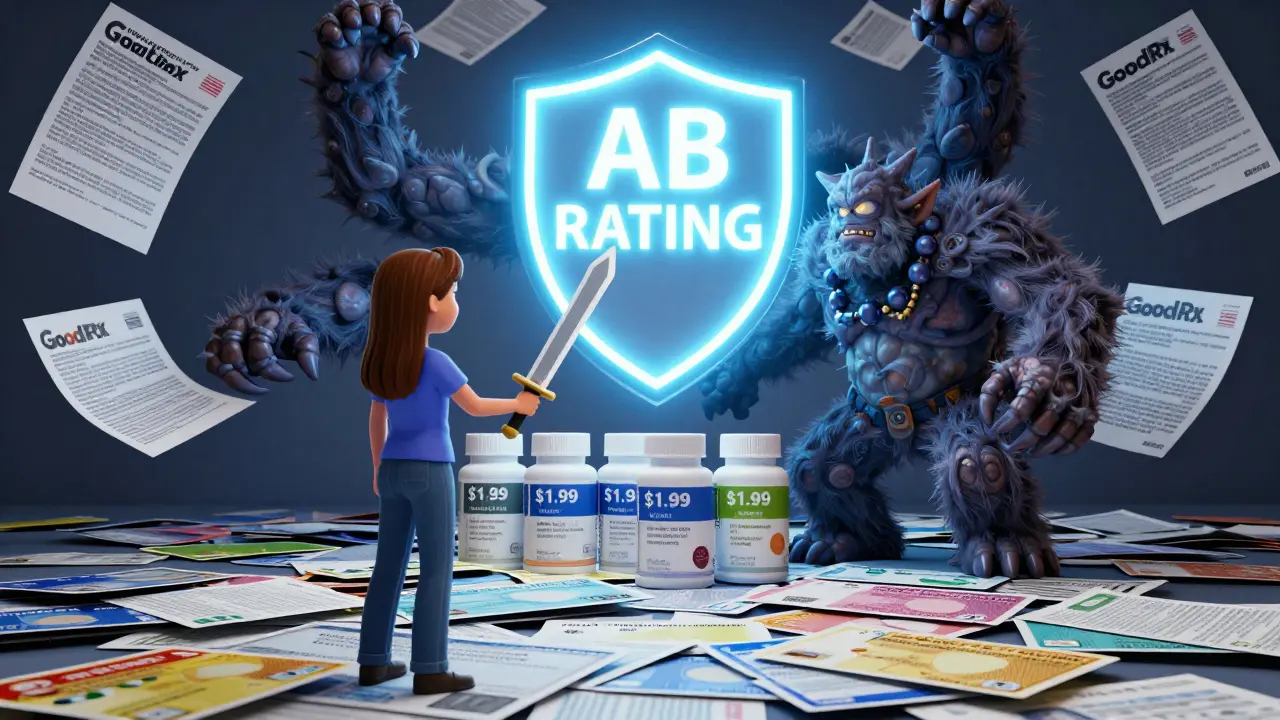
How to Get the Real Savings
You can’t fix the system. But you can beat it. Here’s how:- Always ask for the cash price. Even if you have insurance. In 28% of cases, the cash price is lower than your copay. It’s not a myth - it’s common.
- Use GoodRx or SingleCare. These apps show you prices at nearby pharmacies. For the same generic, prices can vary by 300%. A pill that costs $15 at CVS might be $3 at Walgreens.
- Check for therapeutic equivalence. Look for the "AB" rating on the label. It means the generic is bioequivalent to the brand. No need to pay more.
- Switch to Walmart, Costco, or Amazon Pharmacy. These chains have $4 generic programs for dozens of common medications. No insurance needed. No tricks.
- Focus on chronic meds. Small savings on blood pressure, cholesterol, or diabetes drugs add up fast. $5/month saved = $60/year. Do that for five drugs? That’s $300 in your pocket.
The Bigger Picture
The U.S. spends $71 billion a year on generic drugs. That’s 90% of all prescriptions - but only 23% of total drug spending. That’s because generics work. They’re safe, effective, and cheap - when competition is real. But the system is rigged. PBMs profit from opacity. Manufacturers flee when prices drop too low. And patients? They’re left guessing. The good news? Change is coming. The 2023 Pharmacy Benefit Manager Transparency Act aims to ban spread pricing. The Inflation Reduction Act lets Medicare negotiate prices. The FTC is pushing for full disclosure of rebates. These aren’t just policy tweaks. They’re attempts to finally let the price war reach the patient. For now, the best weapon you have is information. Don’t assume your copay is the lowest price. Don’t trust that your insurer got you the best deal. Ask. Compare. Switch. Your wallet will thank you.Why are some generic drugs still expensive?
Generic drugs stay expensive when there’s little competition - usually because only one or two manufacturers make them. Without rivals to undercut prices, there’s no pressure to lower costs. The FDA tracks these "thinly competitive markets" and fast-tracks approvals to fix them, but it takes time. Some drugs also face shortages because manufacturers quit when prices fall too low to be profitable.
Can I save money by paying cash instead of using insurance?
Yes, often. Pharmacy benefit managers (PBMs) sometimes set your copay higher than the actual cost of the drug. They keep the difference as profit. In nearly one-third of cases, the cash price is cheaper than your insurance copay. Always ask your pharmacist for the cash price before you pay.
What’s the difference between a generic and a brand-name drug?
Generics have the same active ingredient, dosage, strength, and effect as the brand-name drug. The only differences are in inactive ingredients (like fillers or dyes) and packaging. The FDA requires generics to be bioequivalent - meaning they work the same way in your body. The "AB" rating on the label confirms this.
Why do prices for the same generic drug vary so much between pharmacies?
Because pharmacies negotiate different prices with PBMs, and PBMs don’t always pass savings along. Some pharmacies use loss leaders - selling a few generics at cost to draw customers. Others mark up prices because they know patients won’t shop around. Apps like GoodRx show you price differences of over 300% for the same drug at nearby stores.
Are generic drugs safe?
Yes. The FDA requires generic manufacturers to meet the same quality, safety, and effectiveness standards as brand-name companies. They’re held to identical manufacturing rules. In fact, many brand-name companies make their own generics after the patent expires. There’s no difference in how they’re made.
What’s the best way to find the lowest price for a generic drug?
Use a price-comparison tool like GoodRx or SingleCare. Enter your drug name and zip code - it’ll show you prices at nearby pharmacies. Then call ahead to confirm. For chronic medications, switch to Walmart, Costco, or Amazon Pharmacy - they often offer $4 to $10 monthly prices for common generics, with no insurance needed.

Milad Jawabra
March 6, 2026 AT 00:16Deborah Dennis
March 6, 2026 AT 08:14Shivam Pawa
March 7, 2026 AT 09:33Diane Croft
March 8, 2026 AT 17:35Ethan Zeeb
March 10, 2026 AT 04:50Mariah Carle
March 11, 2026 AT 02:40Megan Nayak
March 12, 2026 AT 10:04Tildi Fletes
March 13, 2026 AT 02:36Siri Elena
March 14, 2026 AT 18:25RacRac Rachel
March 16, 2026 AT 03:50Jane Ryan Ryder
March 17, 2026 AT 04:33Callum Duffy
March 17, 2026 AT 18:34Chris Beckman
March 18, 2026 AT 05:58Levi Viloria
March 18, 2026 AT 06:18Zacharia Reda
March 18, 2026 AT 07:36Milad Jawabra
March 19, 2026 AT 18:36RacRac Rachel
March 20, 2026 AT 22:17Ethan Zeeb
March 20, 2026 AT 23:44Tildi Fletes
March 22, 2026 AT 23:23Zacharia Reda
March 24, 2026 AT 14:36