 Mar, 1 2026
When you walk into a pharmacy to pick up your prescription, the first thing you’re usually asked is: "Do you have insurance?" But what if your insurance doesn’t cover your drug, or the copay is higher than paying cash? That’s where services like GoodRx come in - and they’re changing how millions of Americans pay for medications.
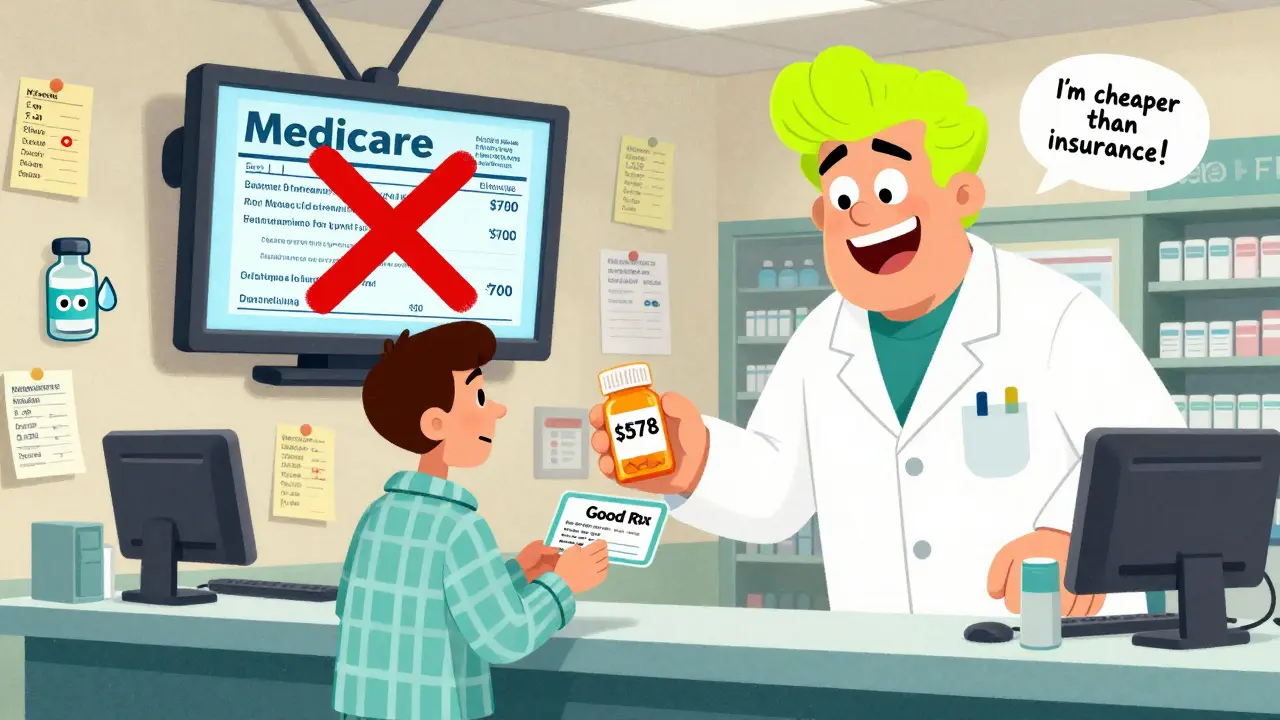
GoodRx isn’t insurance. It doesn’t require monthly premiums, deductibles, or enrollment. Instead, it’s a free tool that shows you the lowest cash price for your drug at nearby pharmacies. In many cases, especially for brand-name drugs or medications not on your insurance’s formulary, the GoodRx price is cheaper than your insurance copay. For example, a 30-day supply of Jardiance (empagliflozin) costs $700 under Medicare Part D but only $578 with a GoodRx coupon - a $122 saving. That’s not a fluke. According to GoodRx’s own 2022 data, users save an average of $71.75 per prescription.
How GoodRx Works (Without Insurance)
GoodRx doesn’t negotiate prices itself. It taps into existing deals between Pharmacy Benefit Managers (PBMs) like Express Scripts and pharmacies. These PBMs have contracts with drug manufacturers and pharmacies that give them bulk discounts. GoodRx accesses those same discounted rates and passes them along to you as a coupon. You don’t need to be insured to use it. All you do is search for your drug on the GoodRx app or website, pick the pharmacy with the lowest price, and show the digital or printed coupon at checkout.
It works for over 6,000 medications, and 70,000+ U.S. pharmacies accept it - including CVS, Walgreens, and Walmart. The app updates prices hourly, so you’re seeing real-time data. In 2023, GoodRx processed over 300 million transactions. That’s not small-scale. It’s a major player in how people pay for prescriptions.
GoodRx vs. Insurance: When the Coupon Beats Your Copay
Many people assume insurance always saves money. It doesn’t. Especially if you haven’t met your deductible, or if your drug is on a high-tier formulary. For example:
- A person on Medicare Part D paying $337 for a Humalog insulin vial might pay only $98 with GoodRx.
- Someone with a high-deductible plan paying $250 for Ozempic (semaglutide) could pay $140 with GoodRx - a $110 difference.
- For compounded medications (not covered by most insurance), GoodRx saves an average of $287 per prescription.
NCPA’s 2023 survey found that 34% of insured patients saved more using GoodRx than their insurance copay - especially for non-preferred brand drugs. If you’re paying full price before your deductible is met, or if your plan has a narrow formulary, GoodRx can be your best option.
What About GoodRx Gold?
GoodRx isn’t just one service. It has a paid tier: GoodRx Gold. For $9.99/month (or $19.99/month for a family), you get deeper discounts - up to 90% off - and free home delivery on 38,000+ pharmacies. It’s especially useful for chronic conditions. For instance, users report paying $1,200/month for Jardiance with GoodRx Gold versus $900 with Medicare Part D in the coverage gap. But here’s the catch: even Gold doesn’t beat Medicare Part D in every case. For specialty drugs with manufacturer coupons, you might still be better off using your insurance.
GoodRx Gold also adds telehealth visits at $19 each. If you need a quick refill or a new prescription, this can cut down on doctor visits. But it’s not for everyone. If you only need one or two prescriptions a month, the free version is usually enough.
Other Services: SingleCare, RxSaver, and Amazon Pharmacy
GoodRx isn’t alone. SingleCare and RxSaver offer similar coupon services. But they’re not the same.
| Service | Pharmacy Coverage | Price Updates | Extra Features | Monthly Cost |
|---|---|---|---|---|
| GoodRx | 70,000+ pharmacies | Hourly | Free + Gold subscription | Free or $9.99+/mo |
| SingleCare | 60,000+ pharmacies | Daily | Telehealth, pet meds | Free or $10/mo |
| RxSaver | 45,000+ pharmacies | Daily | Price alerts | Free |
| Amazon Pharmacy | 30,000+ pharmacies | Real-time | Prime membership discount | Free with Prime |
SingleCare is good if you need telehealth or pet meds. RxSaver is simple and ad-free. Amazon Pharmacy is cheaper for Prime members - especially on generics - but has far fewer participating pharmacies. GoodRx still leads in coverage breadth, real-time pricing, and user volume.
Where GoodRx Falls Short
It’s not magic. There are serious limits:
- Not accepted everywhere. Only 65% of independent pharmacies accept GoodRx. Some chains like Rite Aid have policies against third-party coupons.
- Can’t use with Medicare/Medicaid. Federal law prohibits combining GoodRx with government insurance. If you accidentally present both, you could trigger a fraud investigation - 18% of such cases led to coverage termination.
- No help with deductibles. Unlike manufacturer coupons, GoodRx savings don’t count toward your deductible. That means you might pay less now but still owe more later.
- Controlled substances don’t qualify. Adderall, oxycodone, and other DEA-regulated drugs can’t be discounted through GoodRx.
- Price changes fast. A coupon that worked yesterday might not work today. Always check at checkout.
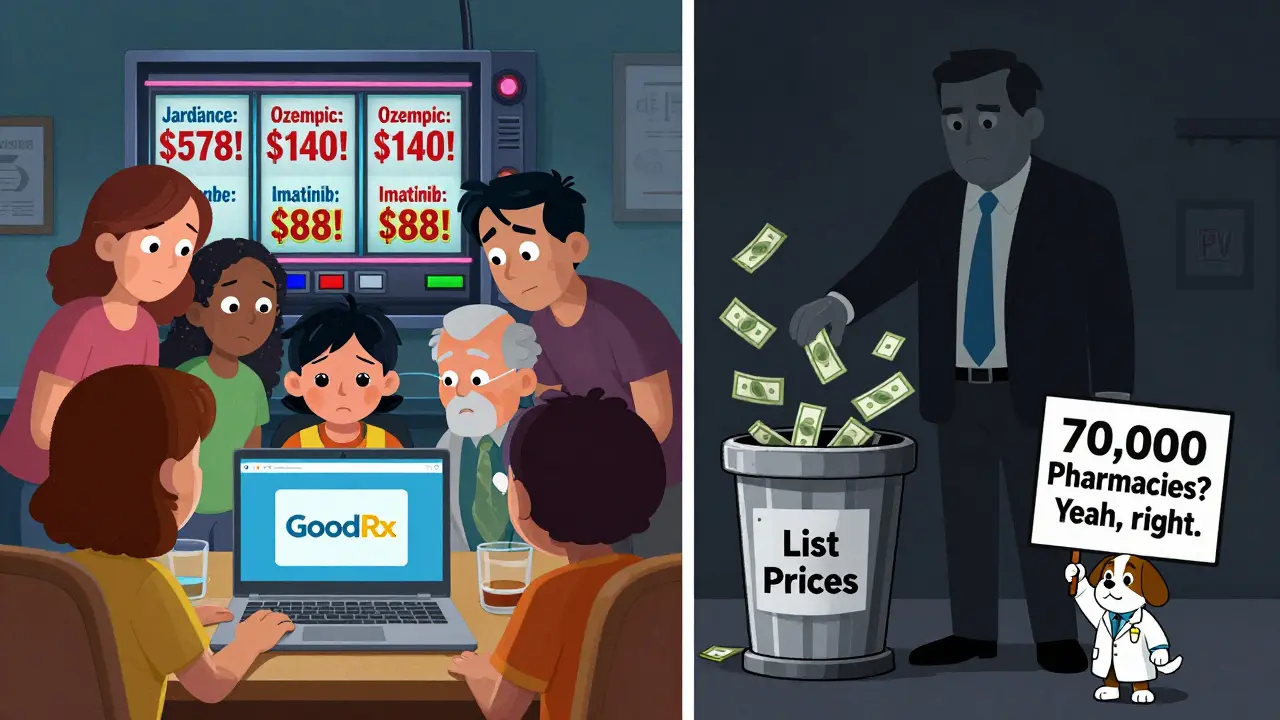
Dr. Aaron Kesselheim from Harvard warns that services like GoodRx may be inflating list prices. PBMs adjust rebates because they know consumers are using coupons. So while you save today, the system might be pushing prices up tomorrow.
How to Use GoodRx the Right Way
If you’re considering using GoodRx instead of insurance, here’s how to do it right:
- Compare first. Always check your insurance copay on your EOB (Explanation of Benefits) or call your insurer. Then check GoodRx. Use the app - it’s faster than calling.
- Ask for the cash price. At the pharmacy, say: "Can I see the cash price? I have a coupon." Don’t mention insurance unless they ask.
- Verify the pharmacy. Not all locations accept GoodRx. Use the app to find the nearest one that does.
- Don’t mix with Medicare. If you’re on Medicare, never hand over both your card and a GoodRx coupon. Use one or the other.
- Use it for non-formulary drugs. If your insurance doesn’t cover it, GoodRx is your best shot.
Pharmacists at NCPA say 92% of them recommend patients ask for a cash price comparison - even if they have insurance. It’s not risky. It’s smart.
Real User Stories
Reddit’s r/GoodRx has over 127,000 members sharing experiences. One user, u/PharmTech2020, saved $412 on Ozempic - their insurance copay was $935. Another, u/InsuredButBroke, was denied a $150 discount at Rite Aid because the pharmacy didn’t accept third-party coupons.
On Trustpilot, 78% of positive reviews mention Ozempic or Wegovy savings. But 32% of negative reviews say pharmacy staff didn’t know how to process the coupon. That’s why it’s worth printing the coupon or having the barcode ready on your phone.
The Bigger Picture
GoodRx exists because the U.S. drug pricing system is broken. Insurance formularies change every year. Deductibles keep rising. And list prices - the ones pharmacies use as a baseline - are often absurdly high. A 400mg bottle of imatinib (a cancer drug) can cost $7,666 at retail but only $88.74 with GoodRx. That’s not a discount - that’s a rescue.
But there’s tension. PBMs are starting to reduce discounts because GoodRx is using too many of them. Express Scripts cut discounts on over 200 drugs in early 2024. If this continues, GoodRx’s savings could shrink.
Meanwhile, the government is watching. CMS has warned that using coupons with Medicare can violate anti-fraud rules. But 12 states now require pharmacies to tell customers about discount programs. That’s a sign this isn’t going away.
Final Advice
Don’t assume insurance is always better. Don’t assume cash is always cheaper. Always compare. Use the GoodRx app before you pay. Keep a screenshot of your insurance copay. If the cash price is lower - even by $20 - use it. It’s legal. It’s safe. And for millions of Americans, it’s the only way to afford their meds.
GoodRx won’t fix the system. But right now, it’s one of the few tools that actually helps people get the drugs they need without going broke.
Can I use GoodRx with Medicare?
No, you cannot use GoodRx with Medicare or Medicaid. Federal law prohibits combining third-party coupons with government insurance. If you present both your Medicare card and a GoodRx coupon, the pharmacy may reject the coupon, or worse, your coverage could be flagged for potential fraud. If you’re on Medicare, compare your Part D copay with the GoodRx price - then choose one or the other, never both.
Is GoodRx cheaper than insurance?
Sometimes yes, sometimes no. If you haven’t met your deductible, or if your drug isn’t on your plan’s formulary, GoodRx is often cheaper. For example, users on high-deductible plans save $100-$400 per prescription on brand-name drugs like Ozempic. But if your insurance has a low copay for that drug, or you’re in the Medicare coverage gap with manufacturer coupons, insurance may win. Always compare both prices before paying.
Does GoodRx work at all pharmacies?
No. About 65% of independent pharmacies don’t accept GoodRx. Major chains like CVS, Walgreens, and Walmart do, but smaller or rural pharmacies often don’t. Always check the GoodRx app before heading out - it shows which locations accept your coupon. Some pharmacies require you to show the digital coupon on your phone; others only accept printed versions.
What’s the difference between GoodRx and GoodRx Gold?
GoodRx is free and gives you access to discounted cash prices at pharmacies. GoodRx Gold is a $9.99/month subscription that offers deeper discounts - up to 90% off - and includes free home delivery on 38,000+ pharmacies. It also adds telehealth visits at $19 each. If you take multiple medications, Gold can save you more. But for occasional use, the free version is usually enough.
Why can’t I use GoodRx for controlled substances like Adderall?
Controlled substances - like Adderall, oxycodone, or Xanax - are regulated by the DEA. Federal law prohibits pharmacies from offering discounts on these drugs through third-party coupons like GoodRx. The goal is to prevent misuse and diversion. You’ll have to pay the pharmacy’s regular cash price or use insurance if available.

marjorie arsenault
March 2, 2026 AT 01:15Just wanted to say thank you for this breakdown. I’ve been using GoodRx for my mom’s diabetes meds and it’s cut her costs in half. She’s on Medicare and we had no idea cash prices could be lower. This made me feel less alone in figuring it out.
Deborah Dennis
March 3, 2026 AT 02:25Ugh. Another one of these ‘GoodRx is magic’ posts. No-it’s not. It’s a band-aid on a hemorrhage. The system is broken. You’re just gaming a rigged game. And don’t get me started on how PBMs are jacking up list prices because they know you’ll use this. You’re not saving money-you’re enabling the exploit.
Shivam Pawa
March 4, 2026 AT 04:26From India, I’ve seen how absurd drug pricing is. Here, generics are cheap but branded meds are unaffordable. GoodRx model is fascinating-free access, real-time pricing. Not sure if it works outside US but the concept? Brilliant. PBMs are the real villains. They’re middlemen who don’t add value, just extract it.
Diane Croft
March 4, 2026 AT 04:55Always compare. Always. I’ve saved over $300 this year just by checking GoodRx before swiping my card. Even with insurance. It’s not complicated. Just open the app. It takes 30 seconds. Do it.
tatiana verdesoto
March 5, 2026 AT 14:51I used to think insurance was always better until I tried GoodRx for my husband’s antidepressant. The copay was $280. GoodRx was $47. I cried in the pharmacy aisle. This isn’t just about money-it’s about dignity. You shouldn’t have to choose between meds and groceries.
RacRac Rachel
March 7, 2026 AT 03:11GoodRx Gold is a game-changer if you’re on multiple meds. I pay $19.99/month and save over $800 on my prescriptions. Worth every penny. Also-have you tried the telehealth? $19 for a refill consult? Yes please. 🙌
Jane Ryan Ryder
March 8, 2026 AT 03:22Oh great another rich person telling poor people to use coupons instead of fixing healthcare. Real solution? Single-payer. Not your coupon app. You’re not a hero. You’re a workaround. And you’re helping them keep prices high. Congrats.
Callum Duffy
March 9, 2026 AT 23:11While I appreciate the utility of such services, I remain concerned about the structural implications. The normalization of third-party discounting may inadvertently disincentivize systemic reform. One must question whether such tools, however beneficial in the short term, serve as a distraction from the necessity of legislative intervention.
Chris Beckman
March 10, 2026 AT 04:43wait so goodrx works with medicare? i thought you couldnt do that? i used it last month and they took it and then charged me like 500? what the heck. my pharmacist said it was fine but now i think i got scammed? someone help
Levi Viloria
March 11, 2026 AT 08:16I’ve lived in four countries and the U.S. drug pricing system is the most chaotic I’ve ever seen. GoodRx isn’t the solution-it’s the symptom. But until we fix the root, it’s the only tool that keeps people alive. I’m grateful for it. I just wish we didn’t need it.
Dean Jones
March 11, 2026 AT 12:01Let’s not romanticize this. GoodRx is a symptom of a broken system, not a fix. The reason it works is because pharmaceutical companies set insane list prices knowing that PBMs will negotiate rebates, and then those rebates are hidden from consumers. GoodRx just exposes the gap between the list price and the net price-but that gap exists because the system is designed to confuse. You think you’re saving money? You’re just being funneled into a pricing scheme that makes the industry richer. And yes, PBMs are adjusting discounts because they’re being overused. That’s not a bug-it’s a feature. The whole thing is a house of cards built on opaque contracts and regulatory loopholes. And now we’re all just trying to survive inside it.
Gretchen Rivas
March 12, 2026 AT 17:51Always check the cash price. Even if you have insurance. Pharmacists are trained to help you save. Ask. Don’t assume. I’ve saved hundreds this way. It’s not magic. It’s just knowing how to ask.