 Mar, 18 2026
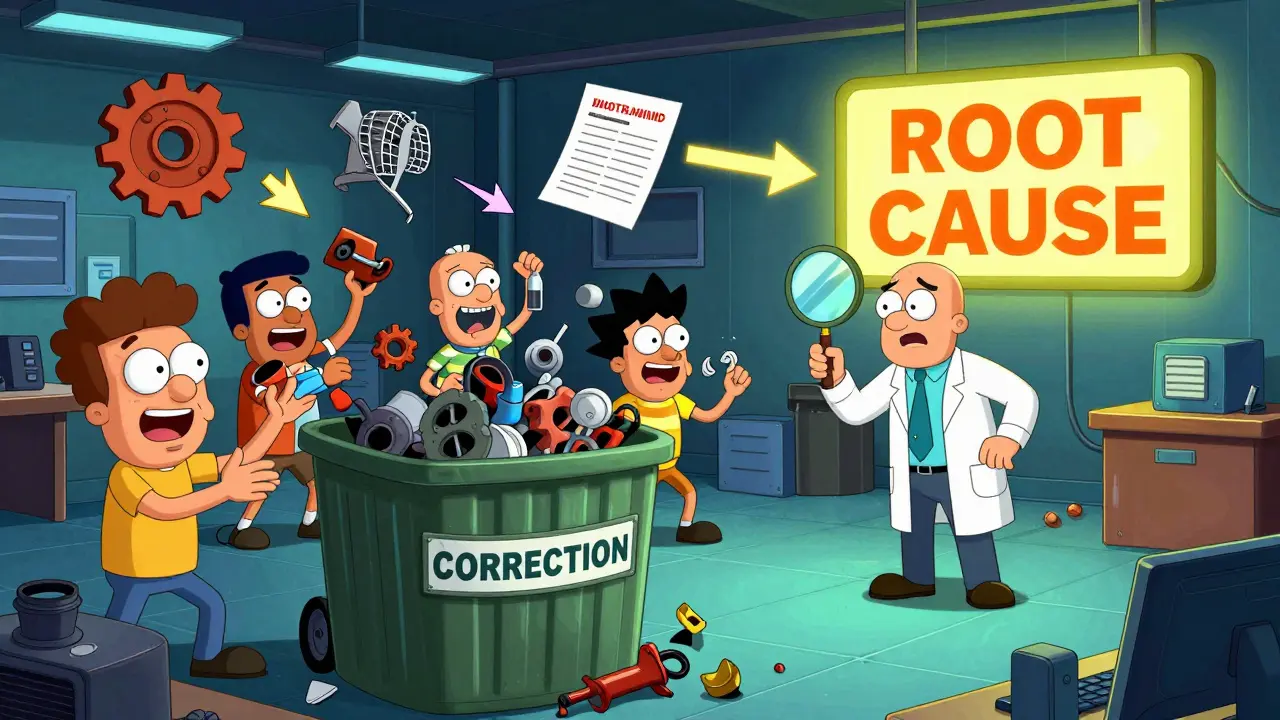
When a manufacturing line starts producing defective parts, it’s not enough to just toss out the bad ones. That’s a correction - a quick patch. But if you don’t figure out why the defect happened in the first place, it will keep coming back. That’s where corrective actions come in. They’re not about fixing the symptom. They’re about killing the cause.
Manufacturers don’t guess. They follow a clear, documented process called CAPA - Corrective and Preventive Action. It’s not optional in industries like medical devices, pharmaceuticals, or aerospace. Regulatory bodies like the FDA and ISO demand it. And companies that do it right see real results: 37% less downtime, 28% higher customer satisfaction, and 19% lower costs from wasted materials and rework.
What’s the difference between correction, corrective action, and preventive action?
People mix these up all the time. And that’s why so many quality problems keep happening.
- Correction is a quick fix. Stop the line. Adjust the machine. Throw out the bad batch. Done. It’s reactive and temporary.
- Corrective action digs deeper. Why did the machine go out of tolerance? Was it a worn part? A training gap? A flawed procedure? This is where you find the root cause and change the system so it doesn’t happen again.
- Preventive action is proactive. You see a pattern - maybe a similar defect popped up in another line last month. You act before it becomes a full-blown problem. No defect yet? Good. But you’re still fixing the risk.
Here’s the hard truth: 68% of quality failures happen because someone treated a corrective action like a correction. They fixed the part, not the process. And when regulators audit, they look for evidence that you changed the system - not just cleaned up the mess.
The six steps of a real corrective action
A good CAPA doesn’t rely on luck. It follows a strict workflow. Here’s what it looks like in practice:
- Identify the problem - It starts with data. A customer complaint. A rejected batch. A sensor alert. Quality teams track every deviation, no matter how small. In one automotive plant, they noticed a 0.3% increase in misaligned bolts. That sounds tiny - until you realize they make 500,000 units a month.
- Evaluate and categorize - Not all problems are equal. Is this a safety risk? A regulatory violation? A nuisance defect? Medical device makers use risk scoring. A defect that could harm a patient? That’s a critical deviation. It triggers a full CAPA. A scratch on a non-critical surface? Maybe just a correction.
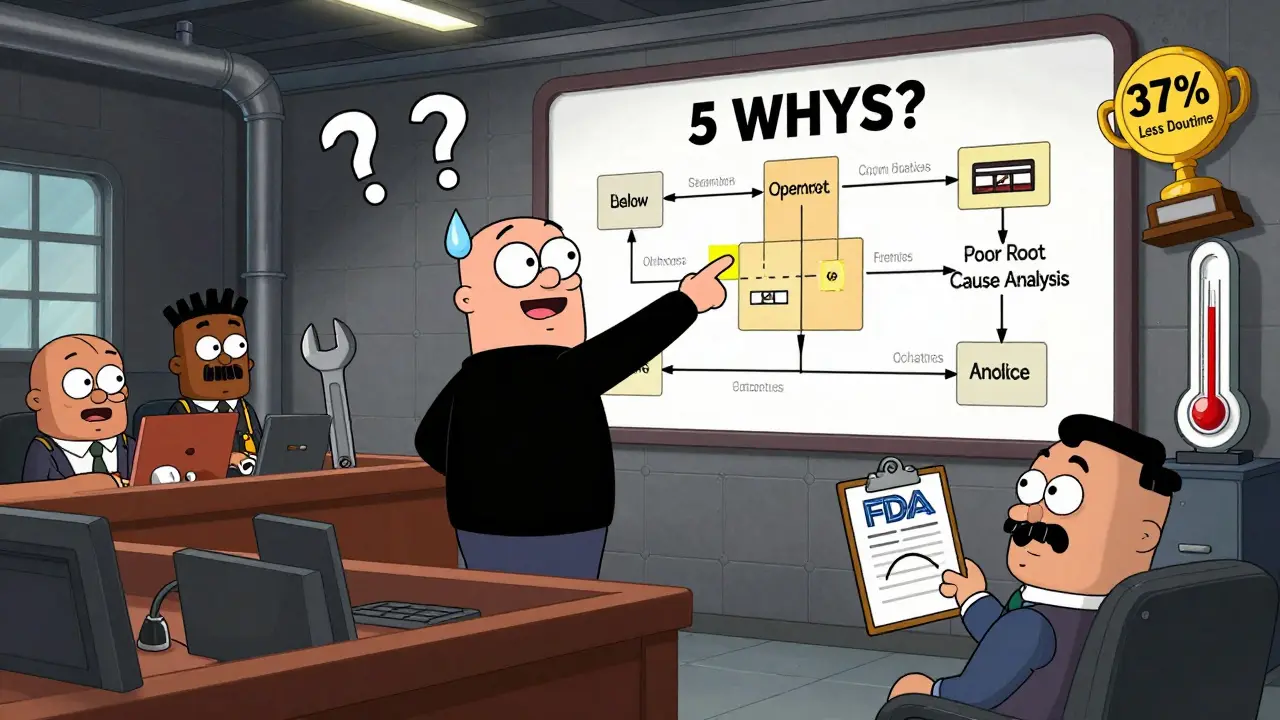
- Find the root cause - This is where most CAPAs fail. Too many teams stop at “operator error.” But why did the operator make that mistake? Was the training outdated? Was the tool hard to use? Tools like the 5 Whys and Fishbone diagrams force deeper thinking. One pharmaceutical company kept seeing contamination in vials. After five whys, they found it wasn’t the technician - it was the air filter in the cleanroom that hadn’t been changed in 18 months, not the required 12.
- Plan the fix - A good plan has four things: specific action (replace filter), deadline (by next shift), owner (maintenance lead), and how we’ll know it worked (test 30 vials after change). Vague plans like “improve training” fail. Specific ones like “update training module by March 25 and retest 15 operators” work.
- Implement the fix - Change the procedure. Train the team. Replace the part. Update the work instruction. Document every step. If you don’t document it, regulators assume it didn’t happen.
- Verify effectiveness - This is the make-or-break step. Did the fix actually work? You can’t just hope. You need data. Test 30+ units. Run the process for at least three full production cycles. Track defect rates. If the rate doesn’t drop by at least 50%, you haven’t solved it. One factory reduced defects from 2.8% to 0.4% - but only after running 11,000 units post-fix to prove the change stuck.
Why most corrective actions fail
It’s not because people are lazy. It’s because the system is broken.
The biggest problem? Root cause analysis gets rushed. FDA data shows 57% of failed CAPAs had shallow investigations. Teams stop at the first obvious answer. “The machine broke.” So they replaced it. But the real cause? A power surge from an overloaded circuit no one checked.
Another issue? No clear verification. 38% of CAPAs don’t prove the fix worked. They just say “we fixed it.” But how do you know? Did you test? Did you measure? Did you watch for 30 days?
And then there’s paperwork. Oh, the paperwork. One quality manager on Reddit said their CAPA for a single defect generated 47 pages of documents. That’s not control - that’s paralysis. Teams avoid reporting problems because they know the paperwork nightmare that follows.
The solution? Digital tools. Manufacturers using integrated CAPA software cut documentation time by 41%. Instead of printing, signing, and scanning, they click. A sensor triggers an alert. A form auto-populates. An engineer assigns the task. The system tracks who did what, when, and the results. It’s faster. It’s auditable. And it’s what the FDA is pushing toward with their Digital Health Innovation Plan.
What industries demand the strictest corrective actions?
Not all manufacturing is the same. The stakes vary.
- Medical devices - 82% of companies have formal CAPA systems. Why? ISO 13485 requires it. If a pacemaker fails, someone dies. The FDA issued 28% of its 2022 warning letters over poor CAPA. That’s the #2 citation behind document control.
- Pharmaceuticals - cGMP rules force CAPA for any deviation that could affect patient safety. Even a tiny change in mixing time needs documentation. 76% of firms use full CAPA systems.
- Aerospace - One cracked turbine blade can crash a plane. IATF 16949 and AS9100 standards demand rigorous CAPA. 68% of firms here have mature systems.
- General manufacturing - Only 49% use formal CAPA. Many still rely on corrections. But those who switched saw 19% lower costs and fewer customer returns.
Here’s the trend: the more regulated the industry, the more structured the CAPA. But even in low-regulation spaces, smart manufacturers are adopting CAPA because it just makes business sense.
The future of corrective actions
AI is changing everything. Instead of waiting for a defect to happen, smart systems now predict it.
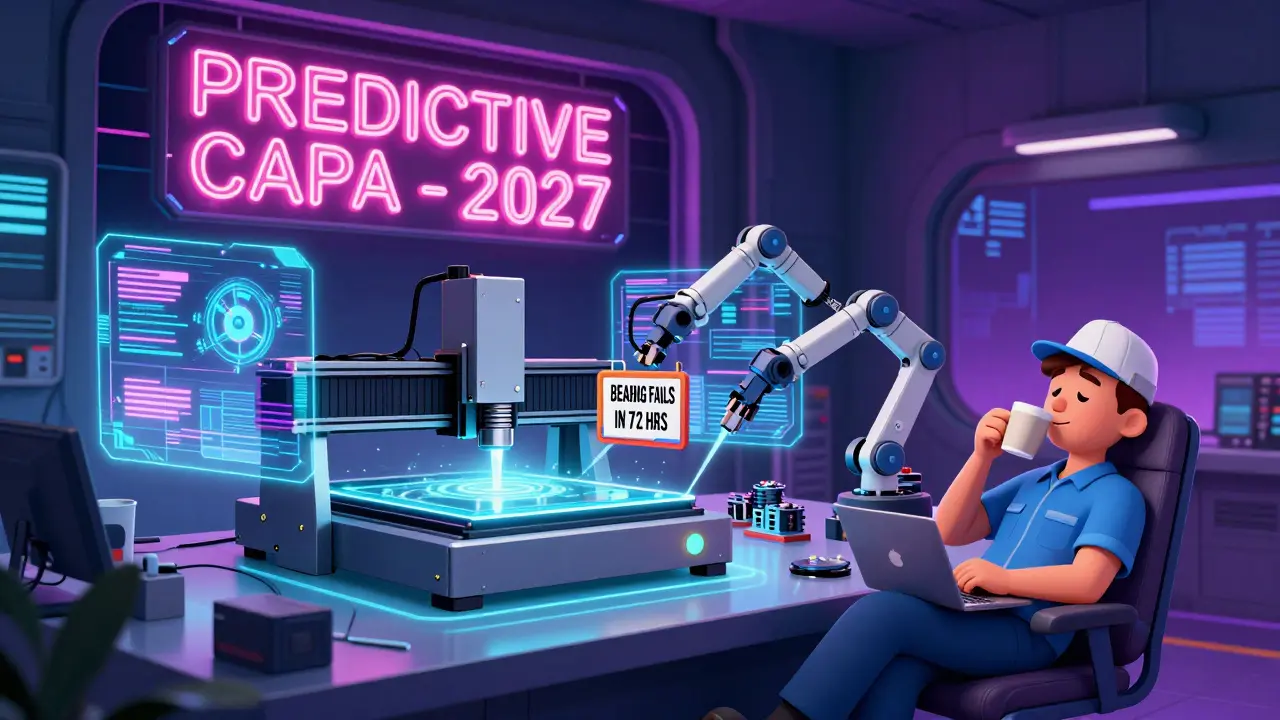
One manufacturer in Brisbane (yes, right here) started using AI to monitor vibration patterns on their CNC machines. The system flagged a subtle change in torque - three days before a bearing failed. It triggered a preventive action: replace the bearing and adjust the lubrication schedule. No downtime. No scrap. No CAPA needed.
That’s the next level: predictive CAPA. Gartner predicts 65% of manufacturers will use systems that auto-trigger corrective actions based on real-time data by 2027. These systems don’t just react. They anticipate. They learn. They improve.
And regulators are catching up. The FDA’s new QMSR (Quality Management System Regulation) and ISO 13485:2016 Amendment 1 (effective March 2024) now require manufacturers to trend defects - not just fix them. If the same type of error shows up three times in a month, even if each one was minor, you’re required to launch a CAPA. It’s no longer about single events. It’s about patterns.
Corrective actions aren’t about compliance. They’re about building trust. Customers don’t care about your ISO certificates. They care that your product works. Every time you fix a problem at the root - not just the surface - you prove you’re not just making things. You’re making them right.
What’s the difference between a correction and a corrective action?
A correction is a quick fix - like stopping the line and throwing out bad parts. It doesn’t prevent the problem from happening again. A corrective action finds the root cause - like a faulty sensor, bad training, or a worn tool - and changes the system so the error can’t recur. Corrections fix the product. Corrective actions fix the process.
Why is root cause analysis so important in corrective actions?
If you don’t find the root cause, the problem will come back. The FDA found that 61% of firms fail CAPA inspections because they only fix symptoms. For example, if a part cracks, replacing the mold isn’t enough. Maybe the cooling time is wrong. Or the material batch is inconsistent. Root cause analysis digs past the obvious to find the real trigger - and that’s what stops the problem for good.
How do you prove a corrective action worked?
You don’t guess. You measure. After implementing a fix, you run at least three full production cycles and test a statistically significant sample - usually 30 or more units. You compare defect rates before and after. If the defect rate drops by more than 50% and stays low, you’ve validated the fix. If it doesn’t, you haven’t solved it yet.
Do small manufacturers need full CAPA systems?
If you’re in a regulated industry - medical devices, pharma, aerospace - yes, even small shops need CAPA. It’s the law. But if you’re in general manufacturing with low risk, you can start simpler. Use a lightweight version: document the problem, find the cause, fix it, and record the result. The goal isn’t paperwork. It’s preventing recurrence. Start small, but don’t skip the logic.
Can software help with corrective actions?
Absolutely. Digital CAPA systems cut documentation time by 41% and reduce errors. They auto-track who did what, when, and the results. They link defects to production data. Some even use AI to spot patterns before they become problems. Manufacturers using these tools report fewer audit findings and faster resolution times. For small teams, cloud-based tools are affordable and easy to start with.

Manish Singh
March 18, 2026 AT 19:31Been in manufacturing for 18 years, mostly in India. What this post misses is how culture affects CAPA. In many plants here, people fear admitting mistakes because of blame culture. You fix the machine, sure, but if the operator thinks they’ll get yelled at or fired, they’ll hide the defect. The real root cause isn’t the tool-it’s the fear. We need psychological safety before we can fix processes. No amount of software fixes that.
Nilesh Khedekar
March 19, 2026 AT 23:34lol so the fda is now telling us how to run our factories? next theyll be telling us how to breathe. they dont even know what a bearing is. i bet they got a 300 page manual on how to change a lightbulb. and ai? yeah right. my cousin works at a plant and they use excel sheets and duct tape. 41% less paperwork? more like 41% less common sense. this whole thing is a scam to sell software.
Robin Hall
March 20, 2026 AT 09:46While the article presents a technically sound framework, it fundamentally underestimates systemic institutional inertia. Regulatory compliance is not a technical problem-it is a sociopolitical one. The FDA’s increased emphasis on trend analysis and predictive CAPA is not an innovation-it is a reaction to decades of documented failures in post-market surveillance. The true root cause of CAPA failure lies not in tools or training, but in the structural disincentives for transparency within corporate hierarchies. Until accountability is decoupled from punitive outcomes, all software and AI will remain superficial bandages on a hemorrhaging system.
jared baker
March 22, 2026 AT 08:38Simple truth: if you don’t measure after you fix something, you didn’t fix it. I’ve seen too many teams say ‘we fixed it’ and then the same problem comes back in two weeks. You gotta test. You gotta count. You gotta watch. No magic. Just math. 30 units. Three cycles. If the defect is still there, go back to step three. No excuses.
Michelle Jackson
March 23, 2026 AT 03:21So let me get this straight. You’re telling me that in 2024, we’re still using 5 Whys like it’s 1998? And AI is just ‘trending’ defects now? Wow. That’s revolutionary. Meanwhile, in the real world, people are getting fired for missing a single non-critical scratch because someone in compliance got nervous. This whole system is designed to protect managers from accountability, not to make better products. The paperwork isn’t the problem-it’s the culture that demands it.
Suchi G.
March 24, 2026 AT 21:15I’ve been in this field for over two decades, and I’ve seen the same cycle repeat itself over and over. The moment you introduce a formal CAPA process, the bureaucracy begins to grow like mold on damp bread. What started as a simple checklist becomes a 17-page form with 12 signatures. Then comes the audit, then the training, then the software subscription, then the consultant. And somewhere in the middle of all this, the person who actually makes the product-the one who knows the machine better than anyone-gets silenced because they ‘didn’t follow procedure.’ We’ve turned problem-solving into a performance art. The goal isn’t to fix the process. The goal is to prove you fixed the process. And that’s why nothing ever really changes.
becca roberts
March 25, 2026 AT 15:40Wow. So we’ve officially turned ‘fixing a machine’ into a TED Talk. First, we identify the problem. Then we categorize it. Then we diagram it. Then we document it. Then we verify it. Then we celebrate it. And all this… just to stop a bolt from being misaligned? I get it. You’re trying to look professional. But here’s the irony: the companies that actually fix things fast? They don’t have CAPA manuals. They have one guy who knows the machine, a wrench, and the guts to say ‘this ain’t right.’
Andrew Muchmore
March 25, 2026 AT 22:33Root cause analysis is not a checklist. It’s a mindset. If you’re asking ‘who messed up’ instead of ‘what broke,’ you’re already wrong. I’ve worked in aerospace. You don’t fix a cracked turbine blade by blaming the tech. You fix it by asking why the inspection didn’t catch the micro-crack six months ago. That’s the real work. And nobody wants to do it. Because it’s uncomfortable. And that’s why we keep having the same failures.
Paul Ratliff
March 27, 2026 AT 07:44ai is gonna do this for us soon. sensors will spot the problem before it happens. no forms. no meetings. just fix it. the old way is dead. the kids with tablets are winning.
SNEHA GUPTA
March 27, 2026 AT 21:30There’s a deeper question here that no one dares to ask: Are we fixing the process… or are we fixing our fear of failure? Every CAPA form, every root cause diagram, every audit trail-it’s all a ritual to soothe anxiety. We don’t believe in systems. We believe in control. And control is an illusion. The machine doesn’t care about your procedure. The defect doesn’t care about your ISO certification. What matters is whether the person who built it felt safe enough to speak up. That’s the only corrective action that ever truly lasts.