 Aug, 5 2026
Medication Metallic Taste Assessment Tool
Select the category of medication you are currently taking that might be causing a metallic taste in your mouth.
Analysis & Recommendations
Personalized Coping Strategies:
When to see a doctor:
Have you ever taken a bite of your favorite meal only to be hit with the distinct, unpleasant flavor of chewing on a penny? If this happens regularly and you haven't started eating coins, you might be experiencing dysgeusia, medically known as an altered sense of taste. Specifically, a persistent metallic taste is one of the most common and frustrating forms of this condition. For many people, this isn't just a minor annoyance; it can ruin meals, lead to weight loss, and even cause them to skip necessary prescriptions.
You are not alone in this struggle. Research indicates that anywhere from 38% to 84% of patients undergoing chemotherapy report altered taste perception. Even outside of cancer treatment, approximately 11% of elderly patients taking multiple medications experience significant taste problems. This phenomenon, often called "medication mouth" or simply a metallic taste, occurs when drugs interfere with how your tongue perceives flavor. Understanding why this happens and how to manage it can make a huge difference in your daily quality of life.
Why Do Medications Cause a Metallic Taste?
To fix the problem, we first need to understand the mechanism. Your taste buds don't just sit there waiting for food; they rely on a complex chemical environment. Medications can disrupt this balance in several ways. According to research published in PubMed Central (2018), some drugs enter your bloodstream and are then secreted directly into your saliva. Once in your mouth, these chemicals interact with your taste receptors, sending false signals to your brain that interpret as metal.
Other medications affect the body's mineral levels. For instance, certain antibiotics like amoxicillin and metronidazole can lower zinc absorption. Zinc is essential for maintaining healthy taste buds. Without enough of it, your ability to taste accurately diminishes, often resulting in a metallic aftertaste. Additionally, drugs that cause dry mouth-such as selective serotonin reuptake inhibitors (SSRIs) like fluoxetine or sertraline-reduce saliva production. Saliva is crucial because it helps dissolve food particles so your taste buds can detect them. Less saliva means distorted flavors.
| Medication Class | Examples | Mechanism of Action |
|---|---|---|
| Antibiotics | Amoxicillin, Metronidazole, Clarithromycin | Reduces zinc absorption; alters saliva composition |
| Psychiatric Drugs | Lithium, Fluoxetine, Sertraline | Direct interaction with taste receptors; causes dry mouth |
| Cardiovascular Agents | ACE Inhibitors, Nifedipine | Secretion into saliva; interferes with ion channels |
| Antiretrovirals | Efavirenz, Ritonavir (Paxlovid) | Strong bitter/metallic profile due to molecular structure |
| Chemotherapy Agents | Cisplatin, Carboplatin | Damages taste bud cells; alters salivary proteins |
Identifying the Culprit: Is It Your Meds or Something Else?
Before you start changing your diet or buying supplements, it’s important to confirm that your medication is indeed the cause. Drug-induced dysgeusia has a specific signature: it usually starts shortly after beginning a new prescription or increasing a dose. Dr. Jeannette Y. Wick, a pharmacy expert, notes that if the taste issue appears within 24 to 72 hours of starting a new drug, suspect the medication.
However, other conditions can mimic this symptom. Oral health issues like gingivitis or periodontitis often present with bleeding gums and bad breath alongside taste changes. Upper respiratory infections can also distort taste, but these typically resolve within 7 to 14 days as the infection clears. If your metallic taste persists long after a cold is gone, or if it aligns perfectly with your pill schedule, your medications are likely the primary driver.

Practical Coping Strategies That Actually Work
If stopping the medication isn't an option-and for chronic conditions, it rarely is-you need effective coping strategies. The goal is to minimize the intensity of the metallic sensation and protect your nutritional intake.
Optimize Your Oral Hygiene
Your mouth is the frontline defense against bad tastes. Brushing twice a day is standard, but for metallic taste, consider using a toothpaste containing baking soda. Baking soda helps neutralize acids in the mouth that can exacerbate metallic perceptions. Flossing daily is equally important to remove plaque, which can harbor bacteria that worsen taste distortion. Some patients find relief by rinsing with a mild saltwater solution before meals to cleanse the palate.
Dietary Adjustments and Utensil Swaps
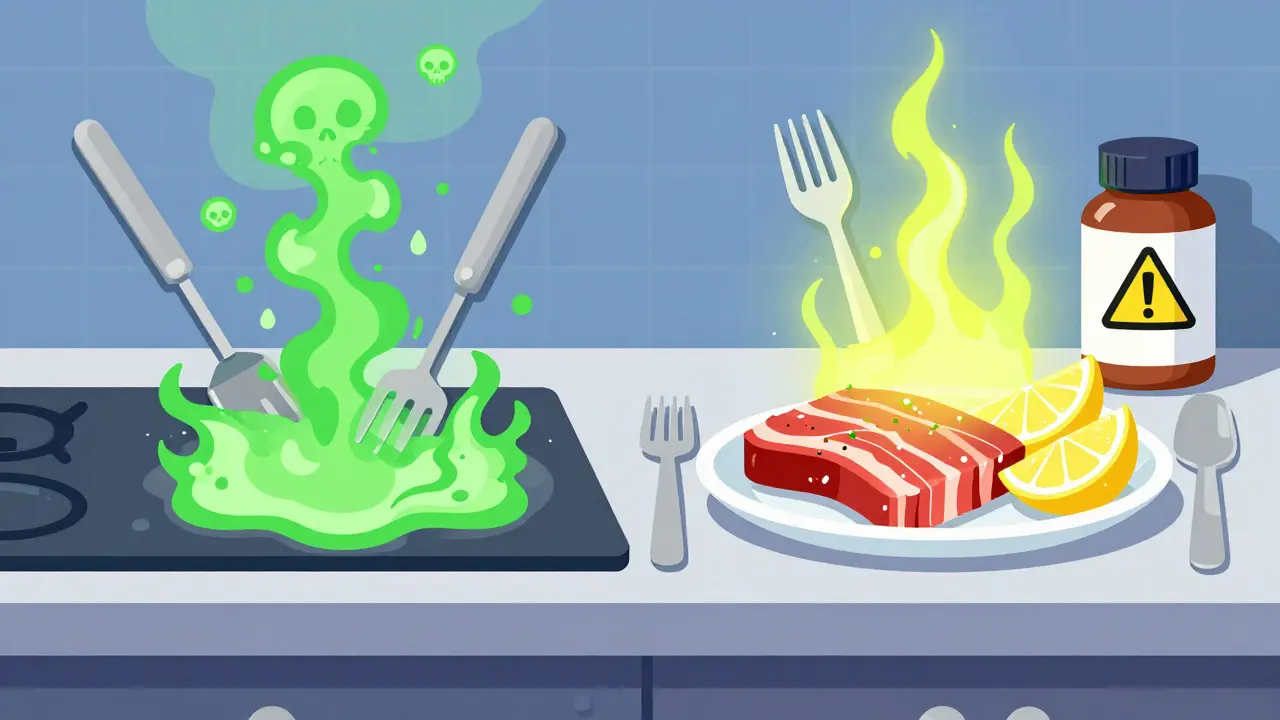
Believe it or not, what you eat with matters as much as what you eat. Metal utensils can react with acidic foods, releasing tiny ions that intensify the metallic taste. Switch to plastic, glass, or ceramic plates and utensils. You might be surprised by how much difference this simple change makes.
Flavor layering is another powerful technique. Since your taste buds are confused, use strong, bold flavors to override the metallic background. Marinate meats in teriyaki, barbecue sauce, or citrus-based marinades. Tart foods like lemon wedges or pickles can stimulate saliva production, which helps wash away the metallic residue. For Paxlovid users, the FDA recommends taking the medication with food, specifically a high-fat meal, which has been shown to reduce metallic taste complaints by 27% compared to taking it on an empty stomach.
Zinc Supplementation: A Double-Edged Sword
Zinc plays a critical role in taste perception. For patients with zinc deficiency-related dysgeusia, supplementation can be highly effective. The American Dental Association suggests a trial of 25-50 mg of zinc gluconate daily for 2-4 weeks. However, caution is needed. Prolonged high-dose zinc use can lead to copper deficiency, which causes its own set of health problems. Always consult your doctor before starting zinc, especially if you are on long-term medication regimens. For chemotherapy patients, protocols at centers like MD Anderson recommend 50 mg daily starting 24 hours before treatment and continuing for 14 days after, showing significant improvement in 65% of patients in controlled trials.
When to Seek Professional Help
Sometimes, home remedies aren't enough. If the metallic taste is causing you to lose weight, avoid entire food groups, or feel depressed about eating, it’s time to talk to your healthcare provider. Don’t suffer in silence. Many patients report feeling dismissed by providers who view taste changes as "not serious." But as the Dysgeusia Research Foundation highlights, 78% of affected patients report a significant impact on their dietary choices and quality of life.
Your doctor might consider adjusting your dosage, switching to an alternative medication without taste-related side effects, or prescribing a specialized rinse. In cases of severe dry mouth, artificial saliva products or prescription medications like pilocarpine might help restore the moisture needed for normal taste function.
The Future of Taste Management
Good news is on the horizon. The pharmaceutical industry is increasingly recognizing taste disorders as a major barrier to medication adherence. A 2022 IQVIA analysis found that taste-related side effects contribute to 17% of premature discontinuations for chronic meds in older adults. In response, companies are developing advanced taste-masking technologies. For example, Johnson & Johnson recently approved a new lithium formulation with a polymer coating that reduced metallic taste complaints from 68% to 23% in clinical trials. Similarly, Aptar Pharma’s Geomelt® technology has shown an 89% reduction in metallic taste for iron supplements.
Research is also moving toward personalized medicine. Scientists are identifying genetic variants, such as TAS2R38 polymorphisms, that predict susceptibility to medication-induced metallic taste. In the future, clinicians may be able to select alternative medications for at-risk patients before symptoms even develop, sparing you the hassle of coping strategies altogether.
How long does metallic taste from medication last?
For most medications, the metallic taste persists as long as you take the drug. However, for some people, the body adapts over time, and the sensation may lessen after a few weeks. For short-course medications like antibiotics or Paxlovid, the taste usually resolves within a few days after finishing the course. If it continues for more than two weeks after stopping the medication, consult your doctor to rule out other causes like zinc deficiency or dental issues.
Can zinc supplements cure medication-induced metallic taste?
Zinc supplements can help if the metallic taste is caused by zinc deficiency, which some antibiotics and other drugs can induce. Studies show that 25-50 mg of zinc gluconate daily may improve taste perception for many patients. However, it is not a universal cure for all drug-induced dysgeusia. Long-term high-dose zinc use can lead to copper deficiency, so it should only be used under medical supervision.
What foods should I avoid if I have a metallic taste?
Avoid red meat, which often tastes particularly metallic during dysgeusia. Acidic foods like citrus fruits or tomatoes can sometimes irritate the mouth further if you have dry mouth, though they can also help stimulate saliva. Strongly flavored or marinated foods are generally better tolerated. Try to stay hydrated and avoid very hot or very cold foods if they trigger discomfort.
Does Paxlovid cause a metallic taste?
Yes, "Paxlovid mouth" is a well-documented side effect, affecting up to 58% of users. It typically presents as a strong metallic or bitter taste. Taking the medication with a high-fat meal can significantly reduce the severity of this symptom. The taste usually resolves within a few days after completing the 5-day course.
Should I stop taking my medication if it causes a metallic taste?
Never stop taking prescribed medication without consulting your doctor. Abruptly stopping psychiatric, cardiovascular, or other chronic medications can be dangerous. Instead, discuss the side effect with your healthcare provider. They may adjust the dosage, switch to an alternative drug, or suggest supportive treatments like zinc supplementation or oral rinses to manage the symptom.
