 Jul, 4 2026
Imagine picking up a prescription for a life-saving medication, only to find out later that it contains nothing but chalk and starch. This isn't a scene from a thriller; it is the terrifying reality of counterfeit drugs, which are illegitimate medications that mimic genuine products but lack active ingredients or contain harmful substances. Every year, millions of patients worldwide fall victim to this silent crisis. But how do we ensure that the pill in your hand is safe? The answer lies in a complex, high-tech web known as supply chain security, specifically within the pharmaceutical industry, where regulatory frameworks and digital tracking systems protect legitimate drugs from manufacturing to patient administration.
In the United States, the backbone of this protection is the Drug Supply Chain Security Act (DSCSA), a federal law enacted in 2013 that mandates electronic traceability and verification of prescription drugs throughout the supply chain. Signed into law on November 27, 2013, the DSCSA has evolved from a draft concept into a rigorous operational standard. By 2027, every single prescription drug package moving through the U.S. system must be digitally traceable. This means that if a suspect product appears, authorities can pinpoint its origin, track its journey, and remove it before it harms anyone.
The Digital ID: Serialization and Unique Product Identifiers
At the heart of modern drug security is a technology you likely see but rarely notice: the barcode. However, these aren't your average supermarket barcodes. Under the DSCSA, every prescription drug package must carry a Unique Product Identifier (UPI), which is a distinct code embedded in a 2D Data Matrix barcode containing the National Drug Code, serial number, lot number, and expiration date.
Think of the UPI as a digital passport for your medication. It includes four critical pieces of data:
- National Drug Code (NDC): Identifies the specific drug product.
- Serial Number: A unique alphanumeric string (up to 20 characters) that distinguishes each individual package.
- Lot Number: Groups packages manufactured at the same time.
- Expiration Date: Ensures the drug is still viable.
This level of granularity is massive. Across the U.S. supply chain, approximately 1.2 million unique identifiers are generated daily. When a wholesaler receives a shipment, they scan these codes. If a scanner picks up a duplicate serial number or one that doesn't match the manufacturer's database, the system flags it immediately. This process prevents about 12,000 suspect product incidents annually from ever reaching pharmacy shelves.
Connecting the Dots: Electronic Data Exchange
Having a unique ID is useless if no one can read it or share the information. This is where Electronic Product Code Information Services (EPCIS), a GS1-standardized system for sharing supply chain event data electronically between trading partners, comes into play. EPCIS acts as the universal language of the pharmaceutical supply chain.
Previously, companies used different formats-some XML, some proprietary databases-making interoperability a nightmare. Now, the FDA mandates that all trading partners exchange transaction information using EPCIS standards. As of 2023, the system processes over 15 million daily transactions with 99.95% accuracy. By November 2027, full electronic interoperability will be mandatory, eliminating paper-based transactions that currently account for 14% of documentation.
Why does this matter to you? Because speed saves lives. During the 2022 infant formula crisis, this digital infrastructure allowed implicated batches to be traced and removed from shelves within 72 hours. In the past, such recalls took an average of 14 days. That difference in time is the gap between a manageable situation and a public health emergency.
Verifying Trust: Authorized Trading Partners
Even with perfect tracking, human error or malicious intent can introduce fake drugs into the mix. To combat this, the DSCSA requires strict verification of who is selling the drugs. This is handled through Authorized Trading Partner (ATP) protocols, which require pharmaceutical companies to verify the identity and authorization status of any entity they buy from or sell to.
Before a wholesaler buys from a distributor, they must check that the distributor is authorized by the FDA. The FDA’s DSCSA ATP Verification Router Service processes over 50,000 daily verification requests with a 99.8% success rate. This creates a closed loop of trust. If a company is not on the approved list, the transaction is blocked.
However, the system isn't flawless. Dr. Amir Attaran of the University of Ottawa noted in a 2023 Health Affairs article that enforcement gaps exist, with only 47% of wholesale distributors conducting required ATP verifications according to 2022 audit data. This highlights a ongoing challenge: regulation sets the rules, but consistent adherence across thousands of small businesses remains difficult.
Global Differences: US vs. EU Approaches
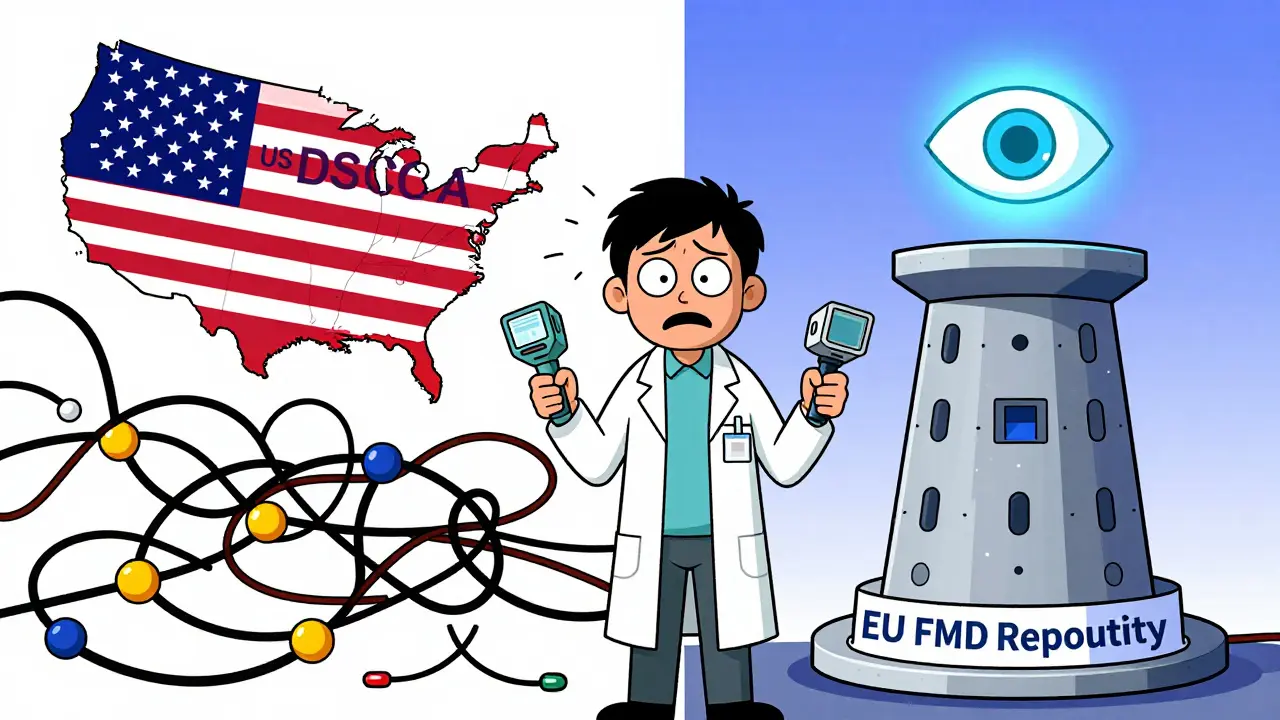
If you travel abroad, you might wonder if the same protections apply. They do, but the methods differ significantly. While the U.S. relies on the decentralized DSCSA model, the European Union uses the Falsified Medicines Directive (FMD), which implements a centralized repository model through the European Medicines Verification System (EMVS) for tracking medicines across 32 countries.
| Feature | US (DSCSA) | EU (FMD) |
|---|---|---|
| Data Model | Decentralized (Company-to-Company) | Centralized (National Repositories) |
| Verification Point | Throughout Supply Chain | Mandatory at Pharmacy Dispensing |
| Serial Number Format | 20-character Alphanumeric | 20-digit Numeric |
| Primary Goal | Traceability & Interoperability | Anti-Tampering & Patient Safety |
The EU approach requires pharmacists to scan and "decommission" the code at the point of sale, ensuring the drug hasn't been scanned before. The U.S. approach focuses more on the movement of goods between entities. For multinational companies, this duality is costly. PwC reported in 2022 that global firms face 22% higher compliance costs because they must adhere to both DSCSA and FMD simultaneously, along with other regional rules like Brazil’s RDC 351/2020.
The Human Cost and Implementation Challenges
While the technology sounds impressive, implementing it is expensive and complex. For large manufacturers, the cost is manageable. Merck’s Director of Global Serialization, Sarah Johnson, reported in May 2023 that their EPCIS implementation reduced verification response time from 15 minutes to 47 seconds. However, for smaller players, the burden is heavy.
Independent pharmacy owner David Chen documented in August 2023 that DSCSA compliance costs his business $18,500 annually in software and hardware, representing 3.2% of his net profit. The Healthcare Distribution Alliance found that 89% of distributors consider compliance "operationally manageable but financially burdensome." With average implementation costs hitting $4.7 million per mid-sized company, many small pharmacies struggle to keep up. In fact, 63% of independent pharmacies with fewer than 10 employees reported difficulties meeting the 2023 electronic data exchange requirements.
Cybersecurity also poses a significant risk. The 2023 Change Healthcare cyberattack disrupted DSCSA verification for 72 hours, affecting 35% of U.S. pharmacies. When the digital ledger goes down, the physical supply chain grinds to a halt. This vulnerability underscores that while we have solved the problem of counterfeit tracking, we have introduced new dependencies on digital infrastructure that must be fiercely protected.
What Comes Next?
The future of drug security looks increasingly automated and intelligent. We are seeing a shift toward predictive analytics. McKinsey projects that by 2030, the pharmaceutical supply chain security infrastructure will evolve into a platform that reduces counterfeit incidents by 95% while generating billions in efficiency savings. Emerging trends include blockchain integration trials by 34% of major pharma companies and AI-driven anomaly detection used by 27% of wholesalers.
For now, the system works. FDA Commissioner Robert Califf stated in September 2023 that DSCSA requirements have reduced counterfeit drug incidents by 63% since 2015. Seizures dropped from 1,103 in 2014 to 412 in 2022. The path forward involves closing the remaining interoperability gaps and supporting small businesses so they don't become weak links in the chain. Your safety depends on every link holding strong.
How can I tell if my prescription drug is counterfeit?
You cannot reliably detect counterfeit drugs by sight alone. Modern counterfeits look identical to genuine products. The best protection is purchasing medication only from licensed pharmacies and authorized online retailers. If a price seems too good to be true, it likely is. Additionally, check for tamper-evident seals on packaging and report any suspicious discrepancies to the FDA MedWatch program.
When will full DSCSA compliance be mandatory?
Full interoperability under the DSCSA is mandated by November 27, 2027. By this date, all trading partners must exchange product tracing information electronically in a secure, interoperable format. Paper-based transactions will no longer be acceptable for prescription drugs.
What is the role of the 2D Data Matrix barcode?
The 2D Data Matrix barcode stores the Unique Product Identifier (UPI), which includes the NDC, serial number, lot number, and expiration date. High-speed scanners read this code at every transfer of ownership, allowing the system to verify authenticity and trace the product's history instantly.
How does the US system differ from the European system?
The US DSCSA uses a decentralized model where companies share data directly with each other via EPCIS. The EU FMD uses a centralized model where all data flows through national repositories, and verification is mandatory at the point of dispensing to the patient. The EU also requires anti-tampering devices on all packages.
Are there risks associated with digital supply chain security?
Yes, cybersecurity is a major concern. As seen in the 2023 Change Healthcare attack, disruptions to digital verification systems can halt drug distribution. Additionally, small pharmacies face high financial barriers to compliance, potentially creating gaps in the network if they cannot afford necessary technology upgrades.

Anna Bartle
July 6, 2026 AT 12:10Great breakdown of the DSCSA! It is fascinating how serialization works. The 2027 deadline is approaching fast. Many small pharmacies are struggling with compliance costs. We need more support for independent businesses.
Mohit Patil
July 7, 2026 AT 15:30they say its to stop fakes but really its just big pharma wanting total control over your health data. every scan is a surveillance point. dont trust the barcode it tracks you not the drug. wake up sheeple
Chandan Sharma
July 7, 2026 AT 16:11The article presents a rather pedestrian overview of pharmaceutical logistics. One might argue that the distinction between decentralized and centralized models is trivial when considering the overarching inefficiency of modern bureaucracy. The EU model, while ostensibly superior in patient-facing verification, suffers from its own bureaucratic inertia. It is a nuanced topic often reduced to simplistic narratives by the layperson.
Katie Dixon
July 9, 2026 AT 00:11I love how we protect our supply chain so well here in America. Other countries can learn from us. But honestly, why do I need to know all this? Just take my meds and be happy. Privacy is important though. Don't let them track everything. Stay safe out there friends!
Chris Munton
July 10, 2026 AT 22:34It is morally reprehensible that we allow such high costs to burden small pharmacies while large corporations profit immensely from these compliance measures. The system is designed to fail the little guy. We must hold these entities accountable for their greed. The ethical implications are staggering and cannot be ignored by anyone with a conscience.
Amrithaa Thayaparan
July 11, 2026 AT 02:30u r all missing the point. the real issue is that the system is flawed from the start. only the elite understand how deep this goes. its not about safety its about power. stop being so naive and look at who benefits. the truth is hidden in plain sight but u refuse to see it because ur too busy trusting the narrative
Paul Diamond
July 12, 2026 AT 04:29One must consider the philosophical underpinnings of trust in digital systems. When we delegate verification to algorithms, we abdicate personal responsibility for our own well-being. Is this progress or merely a convenient illusion of security? The answer lies in the balance between technological reliance and human intuition.
Sydney Jarrett
July 13, 2026 AT 20:33You guys are completely missing the technical nuances here. The EPCIS standard is critical for interoperability. Without proper serialization and UPI integration, the entire supply chain collapses. It's not just about barcodes; it's about the underlying data architecture. If you don't understand GS1 standards, you're wasting everyone's time with these superficial comments.
Lorena Suarez
July 15, 2026 AT 00:01cool read. i guess its good to know they are trying. hope it works out for everyone. seems complicated tho
Isis Fleming
July 15, 2026 AT 18:06Thank you for sharing this informative piece. It is crucial that we remain vigilant about medication safety. The transition to full electronic traceability by 2027 will undoubtedly enhance patient protection. Please ensure you purchase medications only from authorized sources.
Ben Murphy
July 17, 2026 AT 12:10The moral decay of our healthcare system is evident in these compliance failures. Only 47% of distributors verify ATPs. This negligence is unacceptable. We need stricter enforcement and accountability. The current laissez-faire approach endangers lives and erodes public trust in our institutions.
Fred Stone
July 18, 2026 AT 21:48hey guys just wanted to say this is pretty interesting stuff. i work in logistics so i see some of this stuff. yeah the scanners are annoying but i guess it keeps things safe. hopefully the cost goes down soon cause its killing small biz owners
Brett Aungst
July 20, 2026 AT 00:54This is a solid explanation of how DSCSA works. The shift to electronic exchange is huge. I've seen firsthand how much faster recalls are now. The 72-hour turnaround during the formula crisis was impressive. Keep an eye on the cybersecurity risks though, that's the weak link right now.
Kimberly Simbulan
July 21, 2026 AT 05:39Oh wow, another day, another government mandate saving us from ourselves. Sure, Kim, because nothing says 'trust me' like a barcode that tracks your every move. But hey, at least we're all feeling cozy and secure knowing Big Pharma has our back. Thanks for the laugh, seriously needed that today!
Anna Bartle
July 22, 2026 AT 18:25I appreciate your perspective! It is definitely a complex issue. While the tracking is extensive, the primary goal is safety. We should focus on supporting those implementing these changes. Let's keep the conversation constructive and helpful for everyone involved.